Think Before Win Loss Analysis: Stay Connected with Your Customers Before the Sales Event!

I’ve been talking about the sales intelligence practice of win loss analysis a lot lately. It’s the process of interviewing your customers to find out why you REALLY win or lose business, and is one of the best values for collecting market intelligence from your customers. You can get ideas for product development, competitive intelligence, changing account reps, realizing that customers don’t value what you thought they did…the list is as endless as your imagination if you stretch it.

However, many people just interview customers when they have lost business. Be practical: How long will it be before you can do business with them again, unless this loss just represents a portion of the business you do together?

Interview wins since they will give you ideas for product development, and they are interested in maintaining a relationship with you, especially if you can offer products that better meet their needs over time.

Especially in these tough economic times, take the time to develop even deeper relationships with your customers to boost retention rates. This is a key cooperative intelligence practice since your account reps or inside sales will be seen as leaders, connectors and communicators, while the competition won’t since they may be operating with a reduced sales headcount.

If you have the cashflow, don’t lay off your sales force or inside sales: keep them busy connecting with your customers. Here are some processes that you might include in their hardship job description in addition to their periodic account visits:

1. Interview customers one month or a reasonable interval after implementation of the product or service. Keep them happy and engaged, right from the beginning. Work with your marketing and product development people to include some open ended questions so they can vent and you learn what’s on their minds without the bias of closed ended questions.

2. A year after implementation, interview your customers again. They will have had a chance to use the product or service enough to have formed some strong opinions. Listen to their ideas, and let them know that you are considering or have made changes to your product or service based on their feedback. Include open ended questions about market trends, new technology and the competition so you don’t get blind sided.

3. Six months to a year before the contract expires, come back to the customer with another set of questions concerning the product/service, your customer service, you know the drill. Your goal is to influence them to stay with you, and they will be more tempted since you’ve been staying in touch with them…and this is not a last ditch effort just before the sale.

The point it: don’t wait for the sales event and then conduct win loss analysis interviews afterwards to find out what you’re doing right and wrong. Include this as part of the account planning and sales follow-up processes and watch your customer retention soar!

What have you included in your sales intelligence process to increase customer retention in these tough economic times?

Be notified when our book, Win/Loss Analysis: How to Clinch and Keep the Business You Want is published.

Capture Competitor & Market Intelligence through Elicitation: Webinar Follow-up

Last Wednesday, I gave a webinar to give product managers a tool to improve their relationship with Sales. Teach Sales elicitation skills: they don’t get it anywhere else and it will help them close more deals and collect information to help your company develop better products. Elicitation is conversational communication that compels people to voluntarily tell you things without you asking. However, it does involve planning to make it work, since most of us grow up asking people questions directly to extract information. You can download the slides from Slideshare, but as of April 31, 2014, Slideshare will discontinue slidecasts, so I am uncertain how to transfer this to another provider.

There were some questions that got me thinking more over the Easter/Passover weekend.

1. What is the personality type of the ideal person who conducts elicitation?

The person who asked the question assumed that this person would be outgoing and extroverted. Actually some of the best elicitors are more introverted since they are likely to be more thorough in their preparation for elicitation interviews. In addition, introverted people are often better listeners than extroverts, who like to hear themselves talk, not what elicitation is about. Its focus is getting the other guy to talk!

Here are some other desired skills for an elicitator: natural gift for making friends; establish rapport well; practical psychological insight; broad general knowledge; good memory; two level listener; non-threateningly curious; appreciates cultural/national differences; understands subtleties of personal relationships; and is intuitive, spontaneous, and discrete.

2. Ethical Considerations around Elicitation

This always comes up when talking about competitive intelligence, especially collection tools, where elicitation fits. There are two codes of ethics that I point to: SCIP’s code of ethics and AIIP’s code of ethics. My own ethics are the most important to me and they are situational. The other thing to consider is practicality and conversation flow. For example, some people want you to disclose who you are, your company name, where you’re based, who your client is, and why they want to know “x”. Try scripting all this “stuff” at the start of a conversation: it is not natural and it’s too long. It’s better to let the person you’re talking to, ask questions and gradually tell them this information as the conversation flows.

3. Resources I recommend

Confidential  by John Nolan and What Every BODY is Saying by Joe Navarro for supplementary reading on elicitation practices.  I have also written an article entitled “Enable Sales to Elicit Market Intelligence”  published in SCIP’s Competitive Intelligence Magazine.

How to Detect and Prevent Lying Behaviors

Do you ever get that feeling that someone is lying to you, but you’re not quite sure, and you don’t want to ask them since you want to keep the conversation flowing. Perhaps this is a friend who is telling a little white lie or perhaps it is a co-worker who is warming up to the boss.  We are surrounded by lies in our society, and it’s good to identify when you’re being lied to. One way is to ask a question that alludes to a person’s possible lying behavior since if you accuse the person outright, you will put him on the defensive.  Another way is to present a similar scenario and ask the person how they would correct it.  A third way is to start the sentence out with, “Isn’t it amazing” and allude to the behavior or lie in a general way.

Never Be Lied to Again by David Lieberman, is a good read and gives you a myriad of concrete examples to raise your awareness as to when someone is lying to you.  In my fields of competitive intelligence and sales intelligence, we are often asking questions to collect data, whether developing an opportunity analysis for new product or service, finding out when a competitor is introducing a new product, or determining why our customers really buy or don’t buy from us. It is imperative to be attuned as to whether the person you’re talking to is telling you the truth or not. Important decisions are being affected by the information and analysis we develop.

Here are a few tips David shares that I have noticed in my experience:

* Deceitful responses to your questions about beliefs and attitudes take longer to deliver.
* Beware of overreaction to your questions or statements.
* He depersonalizes his answer to your question by offering his belief about the subject instead of answering your question directly.
* He will use your words to make his point.
* Liars often slouch, and are unlikely to stand tall with their arms out or outstretched.
* A liar won’t face you if you’re accusing him, and may turn his head or shift his body away.
* The person makes little or no eye contact.
* There is little or no physical contact during his attempt to convince you.
* The guilty tells his story bit by bit until he gets a verbal communication to stop. He speaks to fill the gap left by silence.
* A liar willingly answers your questions, but asks none of his own.
* Might say, “To be perfectly honest” or “To tell the truth” at the start of the sentence unless they do this all the time.
* Beware of answers that are pat and seem too well rehearsed.
* Use stalling techniques like asking you to repeat the question or answering your question with a question.

I’ve just touched the tip of what David offers to help you spot and prevent deception.  Do you have any tips you would like to share?

Capture Precious Competitor & Market Intelligence through Elicitation: Webinar April 8, 2009

product-mgmt-view-blog-webinars1

Hello, I just got back from Texas and two weekends at my husband, Rodgers’ art shows in Houston. This is short notice, but tomorrow–April 8–the spotlight will be on me, well just a little. From Noon – 1:00 p.m. Eastern USA time, I’ll be giving a webinar and answering questions from my talk, “Capture Precious Competitor & Market Intelligence through Elicitation.”


What is elicitation? Simply put, it’s a conversational way to learn information from another person, and it can be used with anybody. The technique works across all cultures since it’s based on human nature. It is a valuable communication skill in comparison to interviewing, which relies on questions to get answers, which is more direct. When you interview people, they might wonder why you are asking certain questions, and over time they might even become a suspicious of your motives. Whereas a skilled elicitor will entice the other person to talk and share information almost without the other person realizing that they’re sharing.

One valuable way to use elicitation: learn about the competition, market trends or new technology from customers using sales people, customer service, installation or maintenance people as the conduit. It’s also a very useful skill when going to trade shows, and finding out all that juicy marketing and product development information from your competitors, industry experts and the like.

The key to successful elicitation, aside from practice, is to prepare how you would like the conversation to flow, to be ready for any detours that the customer may present, which will take you off course. Some detours render you even more information than you can imagine, so you need to think about these so you can be flexible. You also need to be prepared to answer questions the customer might ask you. That’s a faux pas of many people who start elicitation programs: they forget about cooperative intelligence.  People usually will share if you give. Know what it is “safe” to talk about with your customers before starting your elicitation program. Sales and other customer facing people are a natural at elicitation, although they often don’t think they are since elicitation is not part of sales training. It should be, since elicitation skills also help sales close more deals. Who is more spontaneous than Sales when things don’t quite go as planned?

The webinar is part of an ongoing series of talks that are sponsored by Ryma Technology Solutions and Ready Talk. These webinars are given most weeks on Wednesday at Noon Eastern USA time, and last for one hour. See you tomorrow if you have the time! This webinar will also be followed by Twitter under #pmv, so you can check out the Tweets. You can also check out this article, “Enable Sales to Elicit Market Intelligence: The Cooperative Angle.”

Persuading through Competitive Intelligence Tools: the Cooperative Angle

Using Tactical Competitive Intelligence for Decision-Making alluded to the chart below, minus the weighting scales of this Company Comparison analysis. Recall this analysis portrayed and compared the top 3 PBX manufacturers according to customers’ top reasons for buying PBX equipment. These comparisons addressed the strengths that our key dissenter claimed for ROLM, but also illustrated some of the weaknesses that he was not previously aware of. The analysis supported the key dissenter showing that customers were very impressed with ROLM’s technical features. But since ROLM’s architecture differed from the other systems on the market, our installation, maintenance, and repair crews would have to be specially trained to support it, at additional time and expense—news to our key dissenter.

customerweightfeatures

This chart weighted each reason for the customer’s buying criteria. 1 is the highest or most important reason for buying. Customers highly valued Northern Telecom’s (Nortel) reliability and good service, which were perceived as average for ROLM. Our dissenter changed his mind when shown that customers’ buying decisions were minimally swayed by technology but hugely influenced by service and reliability, Northern Telecom strengths, not ROLM’s. With this presentation, the dissenter realized that his reasons for acquiring ROLM were not accurate from a customer’s perspective.

The Cooperative Angle

Our analysis allowed our key dissenter to change his mind with dignity, and illustrates cooperative intelligence practices as follow:

Cooperative Leadership: We acknowledged the leadership of our key dissenter by finding out his reasons for preferring a ROLM acquisition. On the flip side, our leadership skills were valued by our management since they trusted us to conduct the acquisition analysis.

Cooperative Connection: We connected with the key dissenter and addressed each of his reasons point by point, showing respect and acknowledgement. We connected with the right people both within our company, Sales; and outside the company, a reputable consultant, to gather the right information to put together a persuasive analysis in “executive speak”.

Cooperative Communication: The presentation to our executives consisted of just 3 charts which told the story persuasively and understandably: The BCG Matrix Share, The Telco Company Analysis Chart and lastly the Customer Weighting Chart. We could tell a story with each chart which built upon the preceding chart. People like stories, and I notice stories make it easy to avoid ego conflicts. Using the customer’s decision-making criteria rather than our opinions, was a gentle, yet persuasive way to communicate our analysis.

Don’t be so persuasive that you forget about the dignity of the people you are addressing. Tell a good story that leads them to your conclusions, as though your audience had thought them up themselves. This works with everyone I have ever addressed regardless of profession or culture.

BCG Matrix Share: A Visual Strategic Competitive Intelligence Tool: Explanation & Case Study

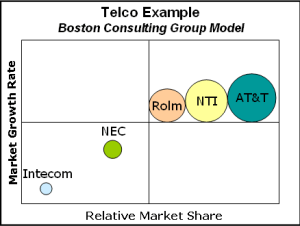
A strategic visual competitive intelligence tool I like is an adaptation from the Boston Consulting Group’s (BCG) Matrix Share model which depicts share momentum.  You can see at a glance with little explanation how to read this model.  The size of the bubble or circle represents the company’s share of market relative to the rest of the competitors illustrated.  Those companies which appear above the diagonal line are losing share and those below the diagonal line are gaining share.  (See below)

bcg-matrix-share2

In competitive intelligence terms, the BCG Matrix Share is a great primer to communicate a snapshot of competitor’s share of market.  Many years ago when I worked at Bell Atlantic (now part of Verizon), we used the BCG Matrix Share model to show our management the relative share of market of our key competitors relative to the systems we marketed.  This was the starting point for a discussion about acquiring the installed base of Northern Telecom, a key PBX (private branch exchange) telephone system manufacturer.

In the spirit of cooperative intelligence, we chose this model since we heard that our executive team was comfortable with it.  It was often used in merger and acquisition decision-making, and this was supporting an acquisition that we were recommending. When using any model, I think it’s important to consider how receptive your audience is to it culturally, and if it’s the right model to persuasively illustrate your analysis and recommendations.

bcg-telco-example

Before we could get to the specific reasons why we should acquire Northern Telecom’s installed base in our region, we needed to set the stage, and give our executives a clear picture of the competitive landscape.  We focused on 5 manufacturers so as not to confuse our executives.  The big 3 PBX manufacturers—AT&T (now Avaya), Rolm (now part of Siemens) and Northern Telecom—would have to be included in any discussion about telephone systems.  Intecom and NEC were the two PBX systems we were marketing at the time.  The BCG Matrix Share clearly portrayed their weak positions as compared to the big 3.

From here we could jump off and discuss the specific reasons why we should acquire Northern Telecom and not Rolm, for example.  Looking at this BCG Matrix Share analysis, Northern Telecom’s share of market is larger than Rolm’s, but this alone was not enough reason to acquire Northern Telecom’s installed base.  In my next blog, I’ll show the next competitive intelligence analytical tools we used to persuade our management that acquiring Northern Telecom’s installed base was the right move.

How have you used BCG model with your management?  What do you see as its strengths and weaknesses?

Win/Loss Analysis book gives you a process to learn why you’re losing business and how to keep more of it!

Receive our 6-page Win/Loss Cheat Sheets

Connect on LinkedIn  Connect on Twitter

Visualize Your Competitors on a Radar Screen Competitor Map, a Great Competitive Intelligence Tool

The Radar Screen competitor map is one of my favorite competitive intelligence tools.  It is totally visual, and fits on one page for easy digestion. It can be used both strategically and tactically, and is a rich communication tool. I first read about it in Adrian Slywotzky’s Value Migration: How to Think Several Moves Ahead of the Competition  in the 1990s.

It’s a great way to visualize how competitors are positioned relative to your company and each other. The Retail Radar Screen example below shows competitors relative to Macy’s, the large retail store which offers a broad spectrum of products including clothing, housewares, bed & bath, jewelry, shoes, cosmetics, fine china, handbags, and various accessories. It could be argued that Sears and JC Penney are Macy’s most direct competitors, as they offer a broad spectrum of similar products in their stores. Thus they are placed in the middle of the radar screen to show their relative position as a more direct competitor to Macy’s. Wal-mart and Target might fit in the next tier as they both sell clothing and housewares, but also sell food and sporting goods where they don’t compete. Outliers include Costco and Sam’s Club as they compete across some products such as clothing and housewares, but don’t offer the depth in either area, and sell food where Macy’s scarcely competes, and offer other products that Macy’s doesn’t such as computers and automotive.

radar-screen-retail

Ideally you would have a cross-functional team create a Radar Screen competitor snapshot. There is rich discussion about where and why competitors should be placed which is extremely valuable to capture.  Some companies use the Radar Screen as the home page for their company’s competitive intelligence Intranet. They will re-position the competitors based on the news, and visually depict changes with a different color, for example. If you would click on each competitor, there would be the relevant news and a competitor profile explaining its positioning.

Be creative: the uses for the Radar Screen competitor map are as rich as your imagination. The screen can be divided into 4 quadrants which might depict competitors by 4 separate business units, 4 different geographies, and on a tactical level 4 different reasons why customers buy.

I have used the Radar Screen with companies who claim they have 20 major competitors in one business unit. This exercise achieves more focus, and we will often narrow that list to 6 – 8 competitors after some rigorous discussion.

How do you use Radar Screen competitor maps?  I would love to hear from you.

Win/Loss Analysis book gives you a process to learn why you’re losing business and how to keep more of it!

Connect on LinkedIn  Connect on Twitter

Take a Cooperative Approach to Conflict Resolution

Many in my fields of competitive intelligence and research have lost their jobs in this tough economy.  While cooperative intelligence skills of leadership, connection and communication don’t guarantee job security, they will help you stand out since many people have lower emotional intelligence: that is they have weak people skills.

I like the cooperative approach shared in Hot Buttons to solve conflicts with colleagues as it’s objective, focuses on constructive communication, and not “who dunnit?:

How did our conflict start? What hot buttons were pressed? Yours? Mine?

Which of your needs are not being met? What are your goals?

What do I need?

What am I doing, saying or not saying that is preventing your goals>

What is the cost of not solving this problem? Specifically…

What are the benefits of resolving the problem? What can I do?

How can we start?

At the heart of any organization is the connection between manager and reporting employees.  To improve the relationship and demonstrate cooperative leadership and promote loyalty consider the following 4 attributes:

Trust – is a two-way street.  Managers and employees need to express confidence in each other.

Respect – recognize your employee’s competence. Show thanks and appreciation for your employee’s work, in a note, a conversation…

Inclusion – include employee’s opinions and welfare in decisions that affect him/her.

Fairness – give all an equal opportunity to be successful. Be even handed, impartial and objective.

Another pet peeve I have is that many managers don’t give good feedback to their employees during their quarterly or annual review process.  Lousy feedback, lack of feedback or the destructive delivery of feedback is a form of disrespect and maddens people.

I had a difficult employee who I had to provide feedback to outside of the annual review process.  She wasn’t pulling her weight, and was certain that her contribution–based on her straight A’s in a decent college–was excellent.  I was at my wit’s end to get her to produce.  How could I cool my heels and get through to this woman?  I started with her place of strength: I complimented her on her wonderful grades and high IQ which caused her to relax and smile.

Then I asked her for the date to get her to realize she was now out of school and while the grades got her this job, production would be the key to keeping it since her co-workers completed their projects in less time.  I also implored her sense of fairness since the other workers had to stay late to finish work that she wasn’t, and she knew she didn’t want that.

We turned it around since we started with her strong point and built on it, and I knew she had a strong sense of fairness towards her co-workers.  She started to produce great work once she had time to digest that I valued her intelligence, and wanted her to apply it at work.

What stories do you have where you turned around a difficult situation?

Conflict Resolution: Know Your Hot Buttons & Be Aware of Other’s!

I’m still visiting my folks in VA and my Dad is failing. As I ponder his life, I recall what a great attorney he was, and how he could chew right through conflict. Case in point: he started his legal career defending Japanese war criminals after WWII.

I had the good fortune to read Hot Buttons: How to Resolve Conflict and Cool Everyone Down by Sybil Evans and Sherry Suib Cohen.

The mind and the body are twins. Poet Algernon Swinburne

What happens in your mind and spirit gets to your stomach and your heart.

A Hot Button is an emotional trigger and when someone pushes one of your hot buttons, you know it since it make you a little crazy. Self awareness of what makes you crazy and an awareness of others’ hot buttons—is very useful in business. It is important to know your conflict style. Before you can diffuse your hot buttons you must be clear about what inflames them. This sounds a lot like emotional intelligence to me!

The book describes 5 conflict styles:

Avoider – Make “it go away” is the goal when conflict intrudes your life

Slash-and-Burn – Tough guy who is “in-your-face”

Peace at all Costs – Harmony is the goal here

Problem Solver – No problem is insurmountable if you work at it

Exploder – Into high drama, emotional and demonstrative

This bleeds right into cooperative intelligence’s leadership, connection and communication.

Leadership – Good leaders are self-aware and observant enough to notice what triggers other’s hot buttons.

Connection – This sensitivity helps develop trusting and lasting relationships.

Communication – Hot button awareness helps us be better observers, listeners and communicators.

So how do you resolve conflicts which stem from Hot Buttons? The book outlines 5 steps:

1. Watch the Play – as though you’re the audience, not a participant. “Watch & play” creates a mental attitude of detachment and objectivity.

2. Confirm – the validity of the other person’s anger. You let them know you’re ready to listen.

3. Get more Info – by asking open-ended Questions.

4. Assert your own interests and needs. Note: this is step 4 after you have calmed down and listened to the other guy’s point of view. Now he is likely to listen to you.

5. Find common ground – for a solution with a problem-solving approach.

There are several tippers from this book that I practice to avoid conflicts:

1. People’s beliefs are not always what you assume they are. When people make wrong assumptions, it can push hot buttons.

2. Empathy is a great hot button diffuser since it acknowledges the other person’s feelings, and takes your mind off your own feelings and allows you to creep into someone else’s. This is calming during a conflict.

3. Ask questions – Questions help you learn more information about the other guy’s feelings, and give you time to cool down, if you’re angry

4. Paraphrase – By restating I can make sure I heard exactly what my partner meant me to hear. Paraphrasing also lets the other guy know I am listening, a key ingredient to conflict resolution.

Here are two books I recommend which are in a similar vein:

Crucial Conversations by Kerry Patterson, Joseph Grenny, Ron McMillan, Al Switzler and Stephen R. Covey (my comments)

The Power of a Positive No: How to Say No and Still Get to Yes by Bill Ury

Read up on Social Networks: Integrating Competitive Intelligence into Marketing: Part 3

In 2 earlier posts I shared book lists we used to supplement our AMA (American Marketing Association) workshop on Integrating Competitive Intelligence into Marketing. In the cooperative spirit, today’s post provides books and blogs to help you spruce up your social networking skills, the key on-line communication and connection media.  A targeted social networking strategy is a strong and essential ingredient to any research project!

One of the classics on social networks is Virtual Handshake by social networking gurus David Teten and Scott Allen. This book is somewhat dated, but I like how it gets you thinking about developing a strategy around social networking and rolling out your program.  It’s pre-Twitter, so if you’re looking to learn more about Twitter consider Twitter Power: How to Dominate Your Market One Tweet at a Time by Joel Comm, and Twitter Revolution: How Social Media and Mobile Marketing is Changing the Way We Do Business & Market Online by Warren Whitlock and Deborah Micek.

My favorite book on LinkedIn is: I’m on LinkedIn–Now What??? (Second Edition): A Guide to Getting the Most Out of LinkedIn by Jason Alba. I read the first edition in 2007, and the second edition was just released in Jan. 2009.

Another golden oldie is Naked Conversations: How Blogs are Changing the Way Businesses Talk with Customers by Robert Scoble and Shel Israel.

The following are top selling books on social networking published in 2008 or 2009:

Groundswell: Winning in a World Transformed by Social Technologies by Charlene Li and Josh Bernoff

The New Rules of Marketing and PR: How to Use News Releases, Blogs, Podcasting, Viral Marketing and Online Media to Reach Buyers Directly by David Meerman Scott. Just yesterday his new book World Wide Rave: Creating Triggers that Get Millions of People to Spread Your Ideas and Share Your Stories was released.

Social Media Marketing: An Hour a Day by Dave Evans

I would be remiss if I didn’t recommend a book on YouTube:

YouTube for Business: Online Video Marketing for Any Business
by Michael Miller

Social networks are changing so rapidly so I suggest you follow blogs to stay up on the latest.  All these authors have blogs.  In addition I recommend Chris Brogan’s, Hubspot and Duct Tape Marketing.

You have one last chance to attend this AMA workshop in Chicago on March 12.

Happy Reading!