Let’s Hear it for Librarians in Competitive Intelligence!

Our CI Ning brings out so much discussion in competitive intelligence.  Here is one point I shared recently and it bears repeating: I would like to support the role of librarians in the CI field. Often in competitive intelligence there is so much confusion about what we do, that we ram our way into places where we don’t belong somewhat in desperation.

We can learn from librarians about good service, which is a lot what I believe is behind the practice of cooperative intelligence, which promotes a spirit of giving by integrating the practices of leadership, connection and communication.  Many of us in CI are very good at digging up good insightful data and providing relevant analysis.  We’re not so good at the human issues of connection and communication, which is where librarians run circles around many of us.  They learn about this in librarian school both as undergrads and in master’s programs.

Many librarians don’t have extensive analytical skills, while some do.  I have been disturbed over the years by how some in our field seem to put down the library science field, when it’s the first step in most CI projects, and the librarian can be one of the major sources of fuel to feed the CI process so we can spend more time connecting with primary sources and doing the analysis and communication to help our companies be more competitive.

I learned to value librarians back in 1985 when I started our CI function at Bell Atlantic, now part of Verizon. Our corporate librarian was an important part of my CI team, and she threw more good stuff my way…yes, this was before the Internet, email and voice mail…now librarians can do so much more, and watch a librarian connect on social networks. This is just an extension of what they already have been doing for years.

I think these are some of the reasons that SLA’s CI division is so successful.  Librarians get where their role is in the company, that it’s evolving and provide it with a spirit of service and giving. They also know what they don’t know and learn about it: that’s where CI fits in and why SLA’s CI certificate program has been so successful. Another reason is it was developed and executed by a seasoned CI professional, Cynthia Cheng Correia who understands librarian’s needs since she also has her MLS.

Competitive Intelligence Starts with Your Company

I was recently invited to help a customer improve their competitive intelligence process.  I traveled to their headquarters and was given a grand tour of their plant operations and new R&D facility.

The HQ is a lovely building, not too fancy yet decorated with fine art and photography from the owner’s collection and world travels. The management team was warm and positive even in these tough economic times. Their cafeteria served fresh food, and is near the workers, who mostly work on the first floor where the plant is located.

The plant was tidy, and the VP who showed me around was proud of his workers and their operation. The plant had deployed lean manufacturing and most of the employees were cross-trained so they could do “the assembly of the moment” with some exceptions for specialized work. The Just in Time inventory implementation had greatly reduced the company’s need for storage, so much so that there were empty areas at their plant which one year ago had been bursting at the seams.

The owner of the company really cares about his employees, and practices cooperative intelligence, even though he doesn’t call it that. Here’s an example: they’re headquartered in a small town, not that close to a major city. He built a medical clinic for his employees so they would have better medical care since they could walk to it from work. His staff figured out how many hours the clinic should be open for optimal use. Next to the clinic, he put in a gym since the doctor and nurse practitioner recommend exercise programs for employees as preventative maintenance. The workout machinery can be programmed to track an employee’s exercise program. Healthy employees are happier and more productive.

What I really admire about this owner is his combination of caring about the employees while watching the bottom line. Previously, employees would go without care for longer than they should since medical care was too far from the office. Now they routinely visit the doctor when they are ill, and also for maintenance. Medical expenses for the company have decreased in the year since he opened the clinic. It’s also professional in appearance just like you would expect at a regular doctor’s office.

You can just imagine how good morale is working at this company, where its leadership is supportive of employees, has a “can do” approach, and promotes open communication throughout the organization.

Often in competitive intelligence we’re so busy looking externally at the competition and market conditions that we forget to consider how we can improve our own operation by investigating ourselves. Before I look at a company’s competitors, I always like to take a long look at the company which hired me. Their operation, including their management’s behavior and motivation, becomes my yardstick to consider as I learn about the competition.

Are We in a Rut in Competitive Intelligence Innovation? #SCIP09 Post-conference

scip-09-chicagoKen Sawka of Outward Insights led this dialog for our friend, Bill Fiora at #SCIP09’s annual conference in Chicago last week.  Bill had a bike accident which kept him home in Boston. The dialog was a follow-up discussion from Bill’s post on our Competitive Intelligence Ning.

We listed many of the common competitive intelligence tools and techniques such as Porters 5 Forces, 4 Corners, War Games, Scenario Planning, SWOTs and competitor profiles.  There hasn’t been much innovation among competitive intelligence tools and techniques that anyone was willing to share.

The innovation that people shared was around process which involved social networks and more sophisticated monitoring and analysis tools. The cost of information acquisition is really inexpensive today even compared to 10 years ago, so companies can afford to text mine and use tools that provide visualization at a reasonable cost.

Another discussion was around trust: management listens to individuals they trust to get strategic intelligence, such as McKinsey.  This is the kind of relationship we in competitive intelligence need to develop with our management through dialog where we become valued. We need to deliver high quality products that address business needs. Ken told a story about a consultant who listened and advised one of the company’s executives on the Friday before the executive held his Monday monthly briefing. He didn’t charge for this time, but he did gain the executive’s trust. This relationship building supports the practice of cooperative intelligence which integrates leadership, connection and communication.

Ken shared another story where a Best Buy manager openly shared that each of its 983 stores used Web 2.0 technology such as a wiki to share day to day store operations, mystery shopping observations, sales results, and all kinds of good scoop, and how this became part of the company’s DNA. I wasn’t surprised since this is how the retail industry works: it’s more of an open book since you can freely walk into your competitor’s store and buy products and assess their service. Another attendee suggested that Best Buy might have implemented more advanced Web 2.0 processes since sharing their story. A participant in the pharmaceuticals was reluctant to share his company’s Web 2.0 practices since this industry is more secretive due to long lead times to get products approved by the FDA and out to the market place.

We concluded that industry norms can be a deterrent to sharing innovation.  However, as we build our human networks and develop trust, we often share our innovation with others, either one on one or among a smaller group. The Council on Competitive Analysis and Liam Fahey’s Knowledge Leadership Forum were sited as two examples of groups with trusting relationships where innovative competitive intelligence practices are shared.

One fear that some expressed is that we could be replaced by artificial intelligence as described in Jeff Hawkins and Sandra Blakeslee’s  book On Intelligence.

We concluded with a couple of questions:

1. How do we more effectively improve our value?
2. How do we quantify and communicate the benefits of competitive intelligence?

What do you think?  I’ll be blogging about #SCIP09 sessions this week.  Speaking of innovation, look for a summary of Competitive Intelligence Foundation’s book on Competitive Technical Intelligence (CTI) just released at SCIP 09.

Think Before Win Loss Analysis: Stay Connected with Your Customers Before the Sales Event!

I’ve been talking about the sales intelligence practice of win loss analysis a lot lately. It’s the process of interviewing your customers to find out why you REALLY win or lose business, and is one of the best values for collecting market intelligence from your customers. You can get ideas for product development, competitive intelligence, changing account reps, realizing that customers don’t value what you thought they did…the list is as endless as your imagination if you stretch it.

However, many people just interview customers when they have lost business. Be practical: How long will it be before you can do business with them again, unless this loss just represents a portion of the business you do together?

Interview wins since they will give you ideas for product development, and they are interested in maintaining a relationship with you, especially if you can offer products that better meet their needs over time.

Especially in these tough economic times, take the time to develop even deeper relationships with your customers to boost retention rates. This is a key cooperative intelligence practice since your account reps or inside sales will be seen as leaders, connectors and communicators, while the competition won’t since they may be operating with a reduced sales headcount.

If you have the cashflow, don’t lay off your sales force or inside sales: keep them busy connecting with your customers. Here are some processes that you might include in their hardship job description in addition to their periodic account visits:

1. Interview customers one month or a reasonable interval after implementation of the product or service. Keep them happy and engaged, right from the beginning. Work with your marketing and product development people to include some open ended questions so they can vent and you learn what’s on their minds without the bias of closed ended questions.

2. A year after implementation, interview your customers again. They will have had a chance to use the product or service enough to have formed some strong opinions. Listen to their ideas, and let them know that you are considering or have made changes to your product or service based on their feedback. Include open ended questions about market trends, new technology and the competition so you don’t get blind sided.

3. Six months to a year before the contract expires, come back to the customer with another set of questions concerning the product/service, your customer service, you know the drill. Your goal is to influence them to stay with you, and they will be more tempted since you’ve been staying in touch with them…and this is not a last ditch effort just before the sale.

The point it: don’t wait for the sales event and then conduct win loss analysis interviews afterwards to find out what you’re doing right and wrong. Include this as part of the account planning and sales follow-up processes and watch your customer retention soar!

What have you included in your sales intelligence process to increase customer retention in these tough economic times?

Be notified when our book, Win/Loss Analysis: How to Clinch and Keep the Business You Want is published.

Capture Precious Competitor & Market Intelligence through Elicitation: Webinar April 8, 2009

product-mgmt-view-blog-webinars1

Hello, I just got back from Texas and two weekends at my husband, Rodgers’ art shows in Houston. This is short notice, but tomorrow–April 8–the spotlight will be on me, well just a little. From Noon – 1:00 p.m. Eastern USA time, I’ll be giving a webinar and answering questions from my talk, “Capture Precious Competitor & Market Intelligence through Elicitation.”


What is elicitation? Simply put, it’s a conversational way to learn information from another person, and it can be used with anybody. The technique works across all cultures since it’s based on human nature. It is a valuable communication skill in comparison to interviewing, which relies on questions to get answers, which is more direct. When you interview people, they might wonder why you are asking certain questions, and over time they might even become a suspicious of your motives. Whereas a skilled elicitor will entice the other person to talk and share information almost without the other person realizing that they’re sharing.

One valuable way to use elicitation: learn about the competition, market trends or new technology from customers using sales people, customer service, installation or maintenance people as the conduit. It’s also a very useful skill when going to trade shows, and finding out all that juicy marketing and product development information from your competitors, industry experts and the like.

The key to successful elicitation, aside from practice, is to prepare how you would like the conversation to flow, to be ready for any detours that the customer may present, which will take you off course. Some detours render you even more information than you can imagine, so you need to think about these so you can be flexible. You also need to be prepared to answer questions the customer might ask you. That’s a faux pas of many people who start elicitation programs: they forget about cooperative intelligence.  People usually will share if you give. Know what it is “safe” to talk about with your customers before starting your elicitation program. Sales and other customer facing people are a natural at elicitation, although they often don’t think they are since elicitation is not part of sales training. It should be, since elicitation skills also help sales close more deals. Who is more spontaneous than Sales when things don’t quite go as planned?

The webinar is part of an ongoing series of talks that are sponsored by Ryma Technology Solutions and Ready Talk. These webinars are given most weeks on Wednesday at Noon Eastern USA time, and last for one hour. See you tomorrow if you have the time! This webinar will also be followed by Twitter under #pmv, so you can check out the Tweets. You can also check out this article, “Enable Sales to Elicit Market Intelligence: The Cooperative Angle.”

Persuading through Competitive Intelligence Tools: the Cooperative Angle

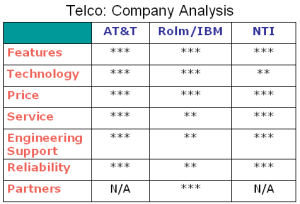
Using Tactical Competitive Intelligence for Decision-Making alluded to the chart below, minus the weighting scales of this Company Comparison analysis. Recall this analysis portrayed and compared the top 3 PBX manufacturers according to customers’ top reasons for buying PBX equipment. These comparisons addressed the strengths that our key dissenter claimed for ROLM, but also illustrated some of the weaknesses that he was not previously aware of. The analysis supported the key dissenter showing that customers were very impressed with ROLM’s technical features. But since ROLM’s architecture differed from the other systems on the market, our installation, maintenance, and repair crews would have to be specially trained to support it, at additional time and expense—news to our key dissenter.

customerweightfeatures

This chart weighted each reason for the customer’s buying criteria. 1 is the highest or most important reason for buying. Customers highly valued Northern Telecom’s (Nortel) reliability and good service, which were perceived as average for ROLM. Our dissenter changed his mind when shown that customers’ buying decisions were minimally swayed by technology but hugely influenced by service and reliability, Northern Telecom strengths, not ROLM’s. With this presentation, the dissenter realized that his reasons for acquiring ROLM were not accurate from a customer’s perspective.

The Cooperative Angle

Our analysis allowed our key dissenter to change his mind with dignity, and illustrates cooperative intelligence practices as follow:

Cooperative Leadership: We acknowledged the leadership of our key dissenter by finding out his reasons for preferring a ROLM acquisition. On the flip side, our leadership skills were valued by our management since they trusted us to conduct the acquisition analysis.

Cooperative Connection: We connected with the key dissenter and addressed each of his reasons point by point, showing respect and acknowledgement. We connected with the right people both within our company, Sales; and outside the company, a reputable consultant, to gather the right information to put together a persuasive analysis in “executive speak”.

Cooperative Communication: The presentation to our executives consisted of just 3 charts which told the story persuasively and understandably: The BCG Matrix Share, The Telco Company Analysis Chart and lastly the Customer Weighting Chart. We could tell a story with each chart which built upon the preceding chart. People like stories, and I notice stories make it easy to avoid ego conflicts. Using the customer’s decision-making criteria rather than our opinions, was a gentle, yet persuasive way to communicate our analysis.

Don’t be so persuasive that you forget about the dignity of the people you are addressing. Tell a good story that leads them to your conclusions, as though your audience had thought them up themselves. This works with everyone I have ever addressed regardless of profession or culture.

Using Tactical Competitive Intelligence to Make a Strategic Decision: A Case Study

This post continues my story from the BCG Matrix Share discussion where we set the stage for an acquisition with a share of market visual.  This was a great start since it put everyone in the same knowledge place.  However, share of market by itself was not compelling enough for management to make its decision about acquiring Northern Telecom’s (Nortelinstalled PBX base in Bell Atlantic’s (Verizonterritory.

Management needed some more proof.  One key executive was keen on acquiring ROLM since he thought they were more technically advanced than Northern Telecom, and that the government would favor this solution since they had many ROLM PBX systems installed.  The government is one of Verizon’s major customers since their territory includes the Washington, DC metro area. The market leader, AT&T (now Avayawas not for sale, but it was essential to include them as the yardstick for the “big 3” PBX manufacturers.

To improve our analysis, we used sales intelligence by consulting with our sales force and a consultant who specialized in PBX RFPs (request for proposals).  We decided to posture a company analysis comparison based on key customer buying criteria, and decided it would be more credible if we represented the comparisons from a customer’s point of view, casting aside our blind spots and biases.  It would also be more pallitable for the ROLM supporter if we presented from the customer’s point of view, not our own.

companyfeatureanalysis

We agreed on 7 key reasons why customers buy PBX systems: features, technology, price, service, engineering support, reliability, and partners.  All 3 manufacturers were at parity in price and features.  AT&T had the strongest ratings overall in all 7 areas.  ROLM rated higher than Northern Telecom in technology, which supported the key dissenter’s view.  Meanwhile, Northern’s service, engineering support and reliability were stronger than ROLM’s.

At that time IBM owned ROLM, which was perceived by our ROLM supporter as a key strength.  We acknowledged that in this company comparison in the word, Partner.  However, we acknowledged that were we to acquire ROLM, then IBM would be out of the picture in our territory, so this would not be the strong advantage he had envisioned.  Also PBX customers didn’t value the IBM name as their strong brand ID was more in computers and data communication.

We followed the practices of cooperative intelligence as we presented this company analysis taking into account the dignity of the dissenter as we confirmed his beliefs about ROLM.  We could start to observe his change of heart as we delivered this company analysis.

This is an example of how using tactical competitive intelligence swayed executives to make the right strategic decision.  We brought in the voice of the customer and the reasons why they buy, very simply, and it engaged our executives.

In our next post, I will show the modification to this feature analysis that further swayed the board to acquire Northern Telecom’s installed base of PBXs in our region.

How have you used tactical competitive intelligence to influence strategic decisions?

BCG Matrix Share: A Visual Strategic Competitive Intelligence Tool: Explanation & Case Study

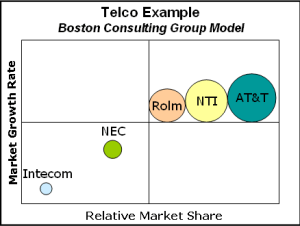
A strategic visual competitive intelligence tool I like is an adaptation from the Boston Consulting Group’s (BCG) Matrix Share model which depicts share momentum.  You can see at a glance with little explanation how to read this model.  The size of the bubble or circle represents the company’s share of market relative to the rest of the competitors illustrated.  Those companies which appear above the diagonal line are losing share and those below the diagonal line are gaining share.  (See below)

bcg-matrix-share2

In competitive intelligence terms, the BCG Matrix Share is a great primer to communicate a snapshot of competitor’s share of market.  Many years ago when I worked at Bell Atlantic (now part of Verizon), we used the BCG Matrix Share model to show our management the relative share of market of our key competitors relative to the systems we marketed.  This was the starting point for a discussion about acquiring the installed base of Northern Telecom, a key PBX (private branch exchange) telephone system manufacturer.

In the spirit of cooperative intelligence, we chose this model since we heard that our executive team was comfortable with it.  It was often used in merger and acquisition decision-making, and this was supporting an acquisition that we were recommending. When using any model, I think it’s important to consider how receptive your audience is to it culturally, and if it’s the right model to persuasively illustrate your analysis and recommendations.

bcg-telco-example

Before we could get to the specific reasons why we should acquire Northern Telecom’s installed base in our region, we needed to set the stage, and give our executives a clear picture of the competitive landscape.  We focused on 5 manufacturers so as not to confuse our executives.  The big 3 PBX manufacturers—AT&T (now Avaya), Rolm (now part of Siemens) and Northern Telecom—would have to be included in any discussion about telephone systems.  Intecom and NEC were the two PBX systems we were marketing at the time.  The BCG Matrix Share clearly portrayed their weak positions as compared to the big 3.

From here we could jump off and discuss the specific reasons why we should acquire Northern Telecom and not Rolm, for example.  Looking at this BCG Matrix Share analysis, Northern Telecom’s share of market is larger than Rolm’s, but this alone was not enough reason to acquire Northern Telecom’s installed base.  In my next blog, I’ll show the next competitive intelligence analytical tools we used to persuade our management that acquiring Northern Telecom’s installed base was the right move.

How have you used BCG model with your management?  What do you see as its strengths and weaknesses?

Win/Loss Analysis book gives you a process to learn why you’re losing business and how to keep more of it!

Receive our 6-page Win/Loss Cheat Sheets

Connect on LinkedIn  Connect on Twitter

2014 Update: Books on Analytic Tools for Competitive Intelligence

This is a 2014 update of new and updated books on competitive intelligence tools and techniques from a 2009 blog.

Business and Competitive Analysis: Effective Application of New and Classic Methods by Craig S. Fleisher and Babette E. Bensoussan, 2007.

Strategic and Competitive Analysis: Methods and Techniques for Analyzing Business Competition by Craig S. Fleisher and Babette Bensoussan, 2002.

These above two books have not been updated, and are classic reference material and describe competitive intelligence analytic tools in great detail. These are written for the academic market as well as competitive intelligence, marketing and strategy professionals. There is no repetition of tools between the two books with about 50 in total. The authors also provide their assessment of the strengths and weaknesses of each tool. I have a copy of each book, since I use analytic tools when they help me tell the story of my research, interviewing or win loss analysis findings.

There are three more books on analytic tools and techniques which are a shorter and simpler read.  Analysis Without Paralysis was updated in 2012 and The Analysts’s Cookbook, Volume 2 was published in 2011.

Analysis Without Paralysis: 12 Tools to Make Better Strategic Decisions by Babette E. Bensoussan and Craig S. Fleisher, Second Edition, 2012

The Analyst’s Cookbook by Kristan J. Wheaton, Emily E. Mosco and Diane E. Chido, 2006. (Mercyhurst University) (paperback only)

The Analyst’s Cookbook, Volume 2 edited by Nicole Pillar and Dominic Vallone, 2011. (Mercyhurst University) (Kindle only)

Analysis Without Paralysis is a great book to have your boss read or someone who would like a simpler explanation of competitive intelligence tools and techniques without as much depth as Babette and Craig’s previous two books. In addition to updating techniques, the second edition has included 2 more techniques than the original did in 2006.

The Analyst’s Cookbook is another favorite since it is easy to read and understand. Kris Wheaton, leading author, teaches competitive intelligence at one of America’s foremost competitive intelligence colleges, Mercyhurst. They breathe competitive intelligence for a living and it shows as they clearly describe 16 analytic tools in 164 pages. Mercyhurst students published a volume 2 to their Analyst’s Cookbook series in 2011, available only in Kindle format.

Connect on LinkedIn  Connect on Twitter

Capture Competitive Intelligence from Sales: Switching Cost Analysis

How do you extract precious competitor and customer tidbits from Sales? The first rule with Sales is “You must give what they need in order to get.” Giving is one of the key principles of cooperative intelligence. It’s also helpful if you put yourself in Sales’ shoes. I was lucky in that I sold for a few years before I started our competitive intelligence initiative at Bell Atlantic, now part of Verizon. Thus I had credibility since I knew the challenges that Sales faced first-hand.

However, you who have no sales experience, can gain insight by accompanying Sales on customer calls. Other ways to connect with Sales include listening in on their challenges through Sales conference calls, attending Sales rallies, and perhaps getting on the agenda to speak at such a rally. It’s great if you can connect with Sales just as they’re hired by conducting some competitive intelligence training as part of Sales orientation. That way you can meet Sales people who may have come from the competition.

You gain sales intelligence and learn why customers do or don’t buy through win loss analysis. However, even though you include Sales in win loss, they may feel threatened when someone else calls their customer, treading on their precious relationship.

switchingcostanalysis

One tool that been very popular with Sales forces over the years is “Switching Cost Analysis.” The goal is to help retain your customers! As a competitive intelligence professional, you can help Sales boost their creativity in using this tool.

Often the purchase price for your product is more expensive than the competitor’s. However, once you identify all the hidden costs, the cost for the customer to switch to the competitor’s product might be more expensive than if they stayed with your company’s solution.

When I sold telecommunications systems, for example, my competitors only included the cost of the phone equipment and conveniently left out all the network fees required to make their phone system work. I included that cost. They also downplayed the cost and time to train people how to use new technology, not just the user’s but also the customer’s installation and maintenance people. You can help your sales force be more creative about what costs your competitor may be omitting, and perhaps cast a shadow of a doubt about the competition. If they forget to include too many costs, the customer might wonder what else the competitor is not telling them!