Your Employees are Your Competitive Advantage, REALLY

How many companies say “Our Employees are Our Most Important Asset,” but their actions don’t match these hollow words?

This is not the case at Southwest Airlines, where employees are valued in all phases of their relationship with the company’s management from the hiring process; allowing them to do their job and to make decisions that don’t quite follow the “rules,” but are often the right decision for the circumstance; to letting an employee go—tough LUV—who isn’t a match for the company’s culture.

Colleen Barrett, Southwest Airlines President Emeritus, was our keynote speaker at ASP’s (Association of Strategic Planning) annual conference. Her recently published book, Lead with LUV, co-authored with Ken Blanchard details Southwest Airline’s formula for success.

One of my favorite quotes from the book epitomizes Southwest Airline’s history:

“Profit is the applause you get for creating a motivating environment for your people and taking care of your customers.”  The airline has been profitable since 1973 two years after it was formed. Hmmmm treating your Employees as Customers works!

Another favorite quote: “We’re in the Customer Service business—we just happen to provide airline transportation.”

Southwest Airline’s employees do their best to ensure that Customers have a safe, on-time flight, for a reasonable price, with as little stress as possible, in a caring environment with a little humor to boot. In these tough times, Southwest Airlines does not charge an extra fee for luggage, unlike all its competitors who do. A resulting customer benefit is that the planes are not crammed full of luggage which takes a long time to stuff into compartments. A resulting operational benefit is passengers get on and off the planes faster, so Southwest Airlines can turn them around faster than the competition.

Employees follow servant leadership practices where they serve first and lead second at every level of the company. This promotes the egalitarian attitude that prevails at Southwest Airlines and makes it such a desirable place to work! Servant leadership was inspired by Robert K Greenleaf: A Life of Servant Leadership by James Sipe and Don Frick . In addition to traditional approaches, such as sending out cards on employees’ birthdays or anniversary dates of hire, the company sends notes of sympathy and condolence to employees when their family members are sick or die. As in cooperative intelligence leadership, all levels of management pitch in to get the job done. When the plane lands, everyone rushes to clean it out, including the pilots, as one of Southwest Airline’s competitive advantages is the speed with which that aircraft is back into the air producing revenue.

Southwest Airlines has a painstaking hiring process, and they run a lean operation. While many candidates have simlar professional qualifications and experience, it’s the right attitude and behavior that differentiate those who are hired and who stay—which is most employees. What differentiates my experience with Southwest Airlines, is the fun that the employees share with us customers.

One of my favorite customer service stories Colleen shared was just after 9 11 when one of the pilots rented a bus to take his stranded, stressed out passengers to the movies. He didn’t have to ask management’s permission, and didn’t tell management what he had done. Management heard from delighted customers. Southwest Airlines has many, many delighted customers. It has grown to be one of the largest US carriers from its humble roots in 1971, where it had to fight hard against the major US airlines to even enter the business.

Southwest Airlines is true to its original goal to make air transportation affordable for most people. What’s interesting to me as a competitive intelligence professional is how Southwest Airlines has publicized its competitive advantages for years giving its competitors the opportunity to study, analyze and adapt them to their operation. The one thing that just doesn’t translate is the supportive, egalitarian and fun loving culture that Southwest Airlines has valued right from its inception.

I was one of the lucky ASP attendees to win a copy of Colleen’s book which she signed “with LUV”.

Win/Loss Analysis book gives you a process to learn why you’re losing business and how to keep more of it!

Connect on LinkedIn  Connect on Twitter

Improve Your Competitive Intelligence Skill: Move out of Your Comfort Zone

Yesterday I impatiently waited for the lady driving the car in front of me to turn left onto the Freeway. The coast was wide open. Her head just kept wagging from left to right for what seemed like an eternity. So I went around her onto the right hand lane to turn left. As I swung onto the Freeway, so did she. She was going straight across the Freeway to a restaurant. I never assumed that’s where she was headed, as I always turn left from that lane as does most of our neighborhood. Fortunately, I stopped in time and she got to her destination.

How often do we get stuck in patterns and either make mistakes or don’t see events coming?  In competitive intelligence, we look for what is missing or what looks odd or out of place since oddity often is a precursor to change. How many people predicted that the overturn of the Tunisian government would lead to the riots in Egypt and the resignation of 30 year dictator, Hosni Mubarak? And now the wave continues to grow in that part of the world as other country’s citizens express discontent with their government. It reminds me of the surprise the world felt when the Iron Curtain tumbled in 1989.

There is always surprise in life and business. How we prepare ourselves for surprise is what separates the excellent from the average. I find I react better to surprises if I move out of my comfort zone more often.

  • Don’t rely on RSS feeds too much! That’s too much the same old same old.
  • Be spontaneous and pick up magazines you don’t normally read.
  • Pursue Twitter links that are out of your mainstream.
  • Comment on blogs out of your mainstream.
  • Go to a trade show which is not relevant to what you do.

In cooperative intelligence, I follow the time tested “Make new friends, but keep the old. One is silver and the other’s gold.” Retain and cultivate your Gold relationships, but keep your connections fresh!

Don’t always rely on the same colleagues to support your research projects. Reach out to new people, and prevent yourself from being blindsided by industry changes, new competitors, innovative technology and regulatory change. Seek new sources of intelligence on the Internet and social networks, but don’t forget the reliable standbys. Did you know that Highbeam Research is coming out with a business research product that will compete with Hoovers? Connect with people on LinkedIn that you don’t know, who are not “relevant” to what you do. You won’t believe how many more people you can connect with for research projects when you have over 10,000 first connections rather than the 300 people you already know!

The explosive growth of e-publishing makes me squirm as a prospective book author. However, I am squirming less as I just attended a class on “how to” given through our Denver Author U by the good folks at Darkfire Productions! Darkfire Productions will format your book for e-publishing. I’m excited as a first time book writer, since I don’t have to wait 1 year to get my book published! I have only myself to blame for any delay in getting published.

10 Tips to Find Competitive Intelligence Online

Yesterday I listened to a most engaging and informative AIIP webinar presentation by Arthur Weiss of CEO of Aware. I have taken many of Arthur’s Internet tippers especially to beef up Google Chrome searching and connection to improve my specialty,  primary research, that is finding information by talking to people. In a spirit of cooperative intelligence, I share these tippers which will help you both locate better information and identify relevant people more expeditiously.

The 10 Tips

1. Know What You are Looking For. Switch your perspective and look at the target company as though you were them, their competitor or a customer.

2. Create a Collection Plan. Identify sources: Why will the information be available? Where will you find it? How can you find it ethically?

3. Use Advanced Search Techniques. Start with the search engines & take advantage of the innuendos of key word searching, advanced search techniques and language translation. I like Wonder Wheel which visually mindmaps your Google search, which I didn’t realize was so easy to enable through Google Chrome. Arthur also reminded us to search Amazon for sources and to take advantage of the Even More features of Google and Google Labs. One Google Chrome extension I like in particular, is the Augment Search feature, which allows you to add/change search engines to your search.

4. Search the Deep Web. Arthur shared numerous Deep Web sites. Some of my favorites are NorthernLight, Deep Dyve, Biznar, Highbeam Research and Silobreaker.

5. Don’t Ignore Competitor websites. Aside from reading them thoroughly, don’t forget Domain Tools and Open Site Explorer since sites linked to your target company can be very telling, and may also provide you people to talk to. Don’t forget to search cache memory for some history of the website over time on Archive.org.

6. investigate Social Media. Aside from Twitter, LinkedIn, Xing, Facebook and industry Nings, don’t forget Slideshare, YouTube and Glassdoor. One of my favorite takeaways was the Rockmelt browser, a one stop access to all your social networks! Talk about a time saver!

7. It’s the people that make the difference! In addition to the common social media connections, Arthur recommends Quora. Other people search tools include Jigsaw, Yasni, Wink, Spokeo. Arthur wasn’t as keen on Zoominfo, since they have converted to fee based mostly. Be aware that these sources all need to be cross-checked. Look at your own profile and note the errors.

8. Remember the Quality of Paid Databases. Many of us at AIIP take advantage of the discounted rates from these service providers such as Dialog, Factiva, Skyminder, Morningstar and Lexis Nexis to name a few.

9. Keep Up-to-Date! I particularly valued Arthur’s tipper to follow industry and competitive intelligence experts on Twitter. This is so easy and you can clump their Tweets so easily in a Tweet Deck column. I also like to stay current with CI Ning, SCIP, AIIP and IntelCollab.

10. Think Differently. Look for things that are odd or out of place. If something doesn’t look right, feel right, or sound right, find out why.  Be a critical thinker.

This is just a smattering of what Arthur shared! These webinars are one of the key benefits of AIIP membership. They are all taped so you can listen to them anytime, and AIIP members can download a copy of the slides as well.

Assess the Reliability of Your Research Network

No Matter what form of research you are doing, when you talk to people, you need to assess the reliability of their information or insight. I have a rule of thumb when locating the best people to talk to. How motivated are they to know the information I am seeking? Generally those who are the most motivated, are the most reliable sources if they will share with you, and if they speak the truth. Another good connection is the person who might know what you’re looking for, but not realize the value of the data so will readily share.

In America, many people try to be helpful when you call them. It’s our culture. However, in their desire to be helpful, people can unintentionally misinform you. If you have done your secondary research before making your calls, you’ll often have learned enough that you’ll have a sense when the information doesn’t sound quite right. That’s where you need to trust your intuition. This is the art and science of primary research collection.

When setting up a competitive intelligence process, you locate diverse and reliable sources both within your company and externally. These are people who you will connect with periodically, and in the spirit of cooperative intelligence, you share information and connections that they value. Since we all seem to do more in less time, it’s important to pinpoint the right people to connect with, to stay connected with, and realize when the connection is no longer working. In that vein I developed some questions to ask about people. Positive answers and strong responsiveness help me stay focused on those who will be most helpful.

  • How responsive is each person when you reach out in meetings, by phone or e-mail?
  • Does s/he always get back to you within a few hours, a couple of days, a week or are they unpredictable?
  • When s/he gets back to you, does s/he share useful information or knowledge?
  • What is the quality of this person’s knowledge sharing?  Is it commonly known news, less known news, and do they offer any insight?
  • Do you have a good enough working relationship with this person so as to know their biases?
  • Does this individual connect you with people who are valuable to you, or are their connections not so useful?
  • How often do you interact with this person?
  • Is this person highly regarded by another person you know?  Who and why?  If not, how did you get linked to this person?

I am writing this blog to help my SCIP friend, Paul Nimalan. He is looking for some ideas about how people assess the validity of human source contacts when they do CI for his thesis at the Institute for Intelligence Studies at Mercyhurst College. He posed this question on our CI Ning and Trip Krant shared some of his ideas from the military intelligence world.

Do you have any best practices to share? Paul was thinking about creating a evaluating grid like Dax Norman developed to assess the credibility of web sites.

Design Thinking for Strategic Competitive Advantage

Many strategic planning executives assume that their strong leadership will lead their company to grow and thrive. Some of us are more visionary and curious by nature. Others are more comfortable taking great ideas and immature products and improving them using their analytical, financial and marketing skills. The simple idea behind design thinking is that you need both traits in leadership: the exploratory innovative to produce great ideas, and the analytical that exploits the business, improves the offering, and develops the right processes to gain market share. In the spirit of cooperative intelligence here are some nuggets that Arik Johnson, Chairman of Aurora WDC recently shared with the Denver Association of Strategic Planning (ASP) chapter. Check out his presentation!

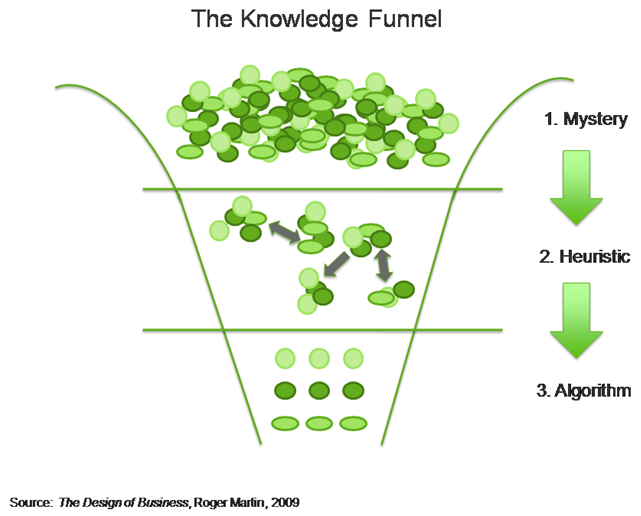
The ideas behind design thinking are well expressed in Roger Martin’s The Design of Business. Think of both the learning and the discovery process as moving through a knowledge funnel.  People need to apply analysis and creative thinking at different points within that funnel.

In Martin’s words, “This form of thinking is rooted in how knowledge advances from one stage to another-from mystery (something we can’t explain) to heuristic (a rule of thumb that guides us toward solution) to algorithm (a predictable formula for producing an answer).”

New firms emphasize exploration.  As they mature, they shift to exploiting known ideas, but if they stop at that point, other innovators will surpass them. Your organization must balance predictable or reliable production with validity, experimentation that leads to new ideas and commercial success. To protect a company, leaders must protect the exploration that leads to its validity. However, over time, organizations tend to emphasize reliability instead. We are too analytical which is good for refining current knowledge, but not great for innovating, the mystery stage. Sometimes we push product development too quickly once the product is in the marketplace, and customers aren’t ready to leap that far just yet. Or we make the product too feature rich and hard to use. This gives entrepreneurs a chance to enter the marketplace or competitors to gain share whose product is developed in balance with customers’ needs and acceptance.

Roger Martin gives examples of companies whose leadership supports design thinking. McDonald’s has perfected the hamburger business to be operationally efficient and serves the same hamburger product worldwide. The company creates new food products, and perfects production of products that the public supports.  For example, McDonald’s managers noticed customers were coming in with Starbuck’s coffee when buying their food at McDonald’s. So McDonald’s analyzed the market and developed an upgraded gourmet coffee to capture that business, which has been very successful.

Proctor & Gamble provides another example of applying successful design thinking.  P&G was losing market share across many of its numerous product lines. The company was investing considerable money into internal R&D and their products were losing market share due to lack of innovation. So they set up an external R&D lab (basically outsourcing their R&D), which has encouraged a higher level of innovation. As a result, their market share has climbed back up again.

A third example cited is Research in Motion (RIM) founded in 1984, but didn’t make it big until 1995. CEO Jim Balsillie was an intuitive thinker. Like many leaders with this tendency, he was distracted with new mysteries and got to the heuristic stage and then launched into the next project. It wasn’t until he hired co-CEO Mike Lazaridis to oversee sales and manufacturing (reliability) that the company took off. Now the company has the benefit of design thinking between the two CEOs.

Similarly Arik Johnson explained how he was influenced by design thinking when he promoted his brother Derek to CEO, due to his strong analytical and operational skills. Arik realized his visionary and exploratory skills were critical to create his business, but his brother’s skills would be more valuable in growing the existing business. Company founders are often entrepreneurial and visionary. Arik is now the company’s Chairman and has started an R&D lab, where he can focus on solving complex competitive intelligence problems and develop intellectual property around that line of business.

Morton suggests that to develop your design mind, broaden your “personal knowledge system.”  To start, be honest and identify the gap between what you think you know and what you actually know.  Living in the world of guessing is detrimental to business.  That’s why you need to understand both your known strengths and weaknesses as an individual and gain the knowledge you don’t yet have.

Design thinking and operating can give your company and you a competitive advantage since they provide a good balance between innovation and operational excellence. As a competitive intelligence professional I see another value to design thinking: it helps expose company and individual blind spots just as a course of doing business.  What a competitive advantage is that!

Denver Writing & Competitive Intelligence Event

When fellow Notre Dame alumni, Lynsey Strand asked me to speak about writing, I wondered how I could measure up since I haven’t written a book or published any of the music I have composed over the years. Then it dawned on me that I have published numerous articles for Competitive Intelligence Magazine among others. I also publish this cooperative intelligence blog and a newsletter, Naylor’s Mailer. Early this year I started a personal blog in honor of my dear Dad who died almost a year ago.

Like many things in life, my experience with publishing is part of my journey. In my case writing has been mostly in the field of competitive intelligence since that’s how I have made my living since 1985. Writing has helped me gain credibility in competitive intelligence and helps me develop as a person to dig deeper and be more expressive.

I think sharing my journey will help others feel encouraged about what they have done and where they are right now in their lives around publishing. I will also share where I am in the book publishing world which is where I am treading water. I will share some local Denver publishing venues like CIPA (Colorado Independent Publishers Association) and Author U. So in the spirit of cooperative intelligence I decided to say YES to this opportunity.

The evening will start with our featured author, Jenny Shank whose book The Ringer will be published early in March 2011. It sounds like a riveting story, and she will read some excerpts from it. Jenny is 20 years my junior and so accomplished. Unlike me, who has fallen into writing, Jenny is a trained and accomplished writer with an MFA in Creative Writing from the University of Colorado. I am looking forward to hearing her story and her words of wisdom.

BTW, our connection is our alma mater, the University of Notre Dame. In fact, it’s the women from the Denver Notre Dame Club who are sponsoring this event which takes place on November 5 at the Good Shepherd Catholic School Cafeteria at 620 Elizabeth St, Denver 80206 starting at 6 p.m. More details can be found at the Notre Dame club website. If this interests  you, I hope you will come!

Why Cooperative Intelligence? An Extreme Presentation

Recently, I wrote about the Extreme Presentation format for presenting material to smaller audiences. At the conclusion of that post, I gave an example of how Extreme Presentation looks. Several people have asked me to give another illustration with an example in competitive intelligence or research, since that’s usually what I write about.

Below is a one-page Extreme Presentation that I prepared for SCIP’s 2007 Annual Conference, just after attending Dr. Andrew Abela’s Extreme Presentation workshop. My objective was to define what cooperative intelligence is, how it works, and how you win by using it. You will notice that there are about 5 “charts” contained in this one page, and that it is not flashy.  You can also tell by looking at the page that I will be talking about a process.

I like this communication method for getting the conversation going in smaller meetings as it provides an outline of what I want to cover. As a presenter you really have to know your material since you don’t have a deck of PowerPoint slides to read from. As an attendee, you are more likely to process what’s being communicated and interact since you aren’t being flooded with one slide after the next which puts you into the passive roles observing and watching.

I had prepared a 25 page PowerPoint for this 1 hour talk, and provided this one-page Extreme Presentation as a handout. Attendees could download the deck later. I had about 100 attendees and noticed that very few people left the room even though my talk was the last one of the day.  Use your creativity with Extreme Presentation, and use it at office meetings instead of nothing or lengthy PowerPoints. You will be amazed at how you engage meeting attendees, and get something accomplished versus putting it off yet again!

Why & How Extreme Presentation Works

My friend, Professor Andrew Abela at Catholic University recently published The Presentation: A Story About Communicating Successfully With Very Few Slides,  which provides a case study example of executing the Extreme Presentation methods he details in his first book, Advanced Presentations Design: Creating Communication That Drives Action. His one-day workshop in 2006 was the best I’ve ever attended at a SCIP annual conference, so in the spirit of cooperative intelligence here are some highlights.

Have you ever heard anyone say, “That was a great presentation: could you have used more slides?” Of course not! Most people use slides to help themselves remember the material they are presenting, but they are not usually created to help you the audience understand the material or be convinced of what the presenter might be selling. This is a blind spot of many presenters and missed opportunity to sell an idea, close the sale or persuade someone or a group to take action! All these slides do is put most viewers into the passive viewing mode, which isn’t usually what you want!

The book focuses on Conference Room style presentation–that is the art of presenting persuasively to small groups. The objective of this venue is often to persuade a small group or a key individual to do or to agree to a specific thing.

To get started think, “What do you want your audience to do as a result of what you’ll be presenting to them?” Next: “Where is your audience right now?” So: “What evidence do you need to provide to your audience to get them to where you want them to be? This is the core of why Extreme Presentation works. You know at the outset where you want this presentation to end: what decision you want your audience to make. You present to your audience using persuasive, calculated steps to get to your endpoint.

Clearly identify what problem your audience has that your presentation will help solve. Research tells us that storytelling works since it’s causal information, not just mere facts, that makes your story more credible. Provide a compelling story about how this problem has been solved or can be solved. Find one or two stories to drive home your most important points.

Here is an example of how Extreme Presentation works with small audiences:

Situation: Most presentations don’t convince the audience and aren’t actionable

Complications: The presentation is agenda oriented, not objective oriented. There are too many slides which don’t encourage audience participation or engagement.

Resolution: 1 – 2 pages tell your story as a handout using your audience’s language + visual process “squint test”. Research shows that people need the right amount of detail and no distractions (no clip art) to promote the healthy discussion that is required to make decisions.

Example: This format encourages your audience to listen, absorb and engage, and leads them to make a decision, which is what you want! This method has been pilot tested extensively for at least 5 years by some big name companies such as ExxonMobil, Kimberly-Clark, Microsoft, eBay, Motorola, Xerox, WW Grainger and HJ Heinz to name a few!

The “squint test” initially confuses people, but it’s valuable for you to give the audience a shape which indicates the content of what you’ll cover such as a bar chart, process chart, organization chart, since you provide a handouts. Here are some templates to help you pass the squint test:

Extreme Presentation website www.ExtremePresentation.com/books/pres; SmartArt in PowerPoint and PowerFrameworks http://www.powerframeworks.com for thousands of templates.

I always like an example of what people are trying to communicate: below is the link to a 1 page handout which visually depicts what I just wrote about. I applaud Dr. Abela! The only thing I would have done differently is rename “extreme presentation”, “persuasive presentation,” since that’s really what it is: PERSUASIVE communication!

Persuasive Presentation Works

Be Competitive! 22 Tips to Kick Start Your Marketing

Yesterday I attended this most informative AIIP (Association of Independent Information Professionals) Webinar by Mary Ellen Bates, CEO of Bates Information. I have been in business for 17 years, but lack Mary Ellen’s business acumen and marketing focus. BTW these webinars are an additional benefit that AIIP did not offer when I first joined 5 years ago. How many associations offer more services for their members these days than they did previously? Since all webinars are recorded, AIIP members can listen to them anytime. Join AIIP here.

The tippers Mary Ellen shared are helpful for anyone who runs a business, not just information professionals, researchers or competitive intelligence managers. In the spirit of cooperative intelligence I will share a few of her best marketing practices.

Use the telephone and snail mail more, since email is an overused form of communication these days, and many emails are not opened. Even if you call a former customer and just get their voicemail, hearing your voice versus the digital word is a great reminder.

Review your client list annually and assess the quality of your clients. This process will help you plan for the upcoming year and figure out ways you can help clients improve their competitiveness. An informational interview is a great way to learn about a new industry to ultimately target. Ask good questions about how they make strategic decisions, and don’t promote yourself in these calls.

At the conclusion of a project that you know you delivered well, discretely ask for a referral. This is also a good time to ask for a LinkedIn recommendation in my opinion if your project deliverable was not top secret.

Connect with all your clients and prospects through social media: not just LinkedIn, but also Twitter, Facebook, industry Nings and blogs. Comment on blogs. Interaction is the key to develop social networks.

Identify client topics of interest and offer products accordingly. You might interview 5 people and write up a white paper that addresses a topic of interest or industry pain points.

A very practical tipper: give yourself one full day to update all your social network, blog, and other membership profiles. Do they jive and connect with each other?

Mary Ellen suggests many ways you can connect in writing whether digitally or in hardcopy: birthday cards, holiday cards, articles, blogs, Tweets, newsletters, thank you notes: be creative! If you use snail mail, it’s more likely to be opened than email.

Personally I like to create unique marketing to clients and prospects: I snail mail New Year’s cards designed by my husband, Rodgers Naylor with one of his original paintings on the front. Some people have kept our cards, and even framed them, over the years. These cards benefit both of our unrelated businesses!

To learn more, I recommend that you buy the recently published second edition of Mary Ellen’s book, Building and Running a Successful Research Business: A Guide for the Independent Information Professional.

Do You Question Your Assumptions?

How often do you read articles from the same sources and continue practices that you are comfortable with—without questioning your assumptions? I focus on research, competitive intelligence and cooperative intelligence and found “Think the Answer’s Clear: Look Again” a recent NY Times article a great example of questioning your assumptions.  Dr. Donald Redelmeier, a physician researcher published a study in 1997 in the New England Journal of Medicine which concluded that driving while talking on a cellphone was as dangerous as driving while intoxicated. While commonly believed today, this was news in 1997!

Dr. Redelmeier has conducted several studies around behaviors while driving since he believes “Life is a marathon, not a sprint,” and “A great deal of mischief occurs when people are in a rush.” One of my favorites is around the psychology of changing lanes in traffic. “You think more cars are passing you when you’re actually passing them just as quickly. Still, you make a lane change where the benefits are illusory and not real.” Meanwhile, changing lanes increases the likelihood of a collision about threefold!

Dr. Redelmeier says it so nicely, “Do not get trapped into prior thoughts. It’s perfectly OK to change your mind as you learn more.” He extends this belief not only across his research quests and findings, but also in his practice as a doctor. He is more likely to intercept diagnosis and treatment errors at an earlier stage since he is willing to change based on new information. I want to be treated by a doctor like Dr. Redelmeier.

Dr. Redelmeiers’ practices can be adopted by competitive intelligence and research professionals. He is a critical thinker who observes behaviors, questions them and conducts research which proves or disproves his beliefs. He has learned that so many accidents in life happen when people are in a hurry. This is true in competitive intelligence research as well as most business functions. We are in too much of a hurry to produce our work, and the quality suffers. We don’t learn from our mistakes since we’re too busy and onto the next project.

In “One Upping the Competition,” Ken Sawka suggests that companies also focus on post-strategy early warning. In simple terms, it’s recognizing the patterns of what a competitor might be planning based on their actions in real-time, and changing your strategy and tactics based on these observations. Does your company recognize the pattern changes of your competitors and your marketplace? Or are you too impatient and insular to do this? Once you recognize pattern changes, is your leadership nimble enough to change your behavior in time?

If you want to stay in business for the long haul, you need to be observant about your marketplace, question your assumptions, and be willing to make changes based on what you learn in time!