Using Tactical Competitive Intelligence to Make a Strategic Decision: A Case Study

This post continues my story from the BCG Matrix Share discussion where we set the stage for an acquisition with a share of market visual.  This was a great start since it put everyone in the same knowledge place.  However, share of market by itself was not compelling enough for management to make its decision about acquiring Northern Telecom’s (Nortelinstalled PBX base in Bell Atlantic’s (Verizonterritory.

Management needed some more proof.  One key executive was keen on acquiring ROLM since he thought they were more technically advanced than Northern Telecom, and that the government would favor this solution since they had many ROLM PBX systems installed.  The government is one of Verizon’s major customers since their territory includes the Washington, DC metro area. The market leader, AT&T (now Avayawas not for sale, but it was essential to include them as the yardstick for the “big 3” PBX manufacturers.

To improve our analysis, we used sales intelligence by consulting with our sales force and a consultant who specialized in PBX RFPs (request for proposals).  We decided to posture a company analysis comparison based on key customer buying criteria, and decided it would be more credible if we represented the comparisons from a customer’s point of view, casting aside our blind spots and biases.  It would also be more pallitable for the ROLM supporter if we presented from the customer’s point of view, not our own.
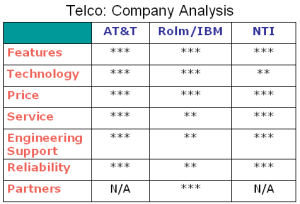
companyfeatureanalysis

We agreed on 7 key reasons why customers buy PBX systems: features, technology, price, service, engineering support, reliability, and partners.  All 3 manufacturers were at parity in price and features.  AT&T had the strongest ratings overall in all 7 areas.  ROLM rated higher than Northern Telecom in technology, which supported the key dissenter’s view.  Meanwhile, Northern’s service, engineering support and reliability were stronger than ROLM’s.

At that time IBM owned ROLM, which was perceived by our ROLM supporter as a key strength.  We acknowledged that in this company comparison in the word, Partner.  However, we acknowledged that were we to acquire ROLM, then IBM would be out of the picture in our territory, so this would not be the strong advantage he had envisioned.  Also PBX customers didn’t value the IBM name as their strong brand ID was more in computers and data communication.

We followed the practices of cooperative intelligence as we presented this company analysis taking into account the dignity of the dissenter as we confirmed his beliefs about ROLM.  We could start to observe his change of heart as we delivered this company analysis.

This is an example of how using tactical competitive intelligence swayed executives to make the right strategic decision.  We brought in the voice of the customer and the reasons why they buy, very simply, and it engaged our executives.

In our next post, I will show the modification to this feature analysis that further swayed the board to acquire Northern Telecom’s installed base of PBXs in our region.

How have you used tactical competitive intelligence to influence strategic decisions?

Capture Competitive Intelligence from Sales: Switching Cost Analysis

How do you extract precious competitor and customer tidbits from Sales? The first rule with Sales is “You must give what they need in order to get.” Giving is one of the key principles of cooperative intelligence. It’s also helpful if you put yourself in Sales’ shoes. I was lucky in that I sold for a few years before I started our competitive intelligence initiative at Bell Atlantic, now part of Verizon. Thus I had credibility since I knew the challenges that Sales faced first-hand.

However, you who have no sales experience, can gain insight by accompanying Sales on customer calls. Other ways to connect with Sales include listening in on their challenges through Sales conference calls, attending Sales rallies, and perhaps getting on the agenda to speak at such a rally. It’s great if you can connect with Sales just as they’re hired by conducting some competitive intelligence training as part of Sales orientation. That way you can meet Sales people who may have come from the competition.

You gain sales intelligence and learn why customers do or don’t buy through win loss analysis. However, even though you include Sales in win loss, they may feel threatened when someone else calls their customer, treading on their precious relationship.

switchingcostanalysis

One tool that been very popular with Sales forces over the years is “Switching Cost Analysis.” The goal is to help retain your customers! As a competitive intelligence professional, you can help Sales boost their creativity in using this tool.

Often the purchase price for your product is more expensive than the competitor’s. However, once you identify all the hidden costs, the cost for the customer to switch to the competitor’s product might be more expensive than if they stayed with your company’s solution.

When I sold telecommunications systems, for example, my competitors only included the cost of the phone equipment and conveniently left out all the network fees required to make their phone system work. I included that cost. They also downplayed the cost and time to train people how to use new technology, not just the user’s but also the customer’s installation and maintenance people. You can help your sales force be more creative about what costs your competitor may be omitting, and perhaps cast a shadow of a doubt about the competition. If they forget to include too many costs, the customer might wonder what else the competitor is not telling them!

Win Loss Analysis is more than Competitive Intelligence

Win loss analysis is my favorite tactical cooperative intelligence practice as it offers the best ROI of any sales intelligence tool. You gain intelligence by interviewing your customers shortly after the sales event to find out why they chose to do business with you or decided on a competitor. The data gathered combines knowledge from sales, customers, competitors, and your marketplace.

Consider these points to develop a cooperative B to B win loss process:

  • Clearly identify objectives for conducting win loss
  • Invest the time to develop the questions you want answered
  • Include Sales
  • Maintain professionalism throughout the process
  • Don’t just “survey” your customers
  • Don’t just interview losses; include wins
  • Communicate findings broadly within your company

I’ve conducted win/loss interviews and analysis for years, and enjoyed reading Ford Harding’s post, “Learning from Loss,” where he shared findings from Ken Sawka of Outward Insights about what can be obtained from conducting win loss interviews.

What I found most interesting was Ford’s experience in professional services firms where partners do the work and make or lose the sale so there isn’t a dedicated sales force.  Ford’s focus isn’t competitive intelligence so his perspective is valuable to those of us with our heads in the competitive intelligence sandbox.  He is the author of Rain Making: Attract New Clients No Matter What Your Field.  A rain maker is an employee who creates a significant amount of new business to a company. Rain Making uncovers how professional services are marketed successfully in terrific detail.  I decided to buy the book to gain the perspective of selling in professional services as I sold in the retail and telecommunications arenas. BTW Rain Making gets very good reviews on Amazon.

As a competitive intelligence professional, you will be more successful in capturing competitive data from sales if you build your emotional intelligence by gaining an understanding and empathy for the challenges and joys of their job. You will most certainly acquire this from Rain Making.  You might even give your company’s sales and PR folks some tippers from this book.

For more reading on win loss analysis consider this article, “Increasing Sales through Win Loss Analysis.”

Do you conduct win loss interviews at your company?  If so, how have you used the findings to improve your business?

Be notified when our book, Win/Loss Analysis: How to Clinch and Keep the Business You Want is published.