AttaainCI wins AIIP’s 10th Annual Technology Award

This time last week I was at Internet Librarian in Monterey, California. AttaainCI earned AIIP’s technology award. Founder and President, Daryl Scott was present to receive the award from AIIP’s President, Marcy Phelps. Every year, the AIIP Technology Award is presented to a company whose product, in the panel’s opinion, best assists independent information professionals in locating, analyzing, organizing and delivering information.AttaainCI software, was launched in early 2008, and provides real-time intelligence gathering, analysis, sharing and reporting alerts. One of my favorite uses is company tracking: your company, one you want to acquire or a competitor, for example. Track what’s being said about your company’s products or your key customers. It is reasonably priced at $149 per month for the first user and $69 for the second user for unlimited usage on a month-to-month basis. Discounted annual plans are negotiable with Attaain. Watch 10 instructional videos and learn in detail how AttaainCI will work for you.

AttaainCI continuously monitors, filters and integrates intelligence from a wide range of sources.
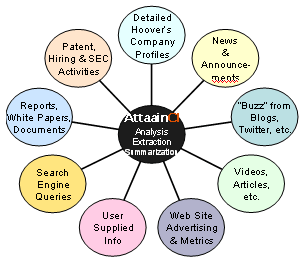
AttaainCI

The software had its start mostly tracking social networks such as Facebook, Twitter, LinkedIn among others.  Recently AttaainCI included Hoovers as a resource for information, greatly boosting its one-stop shopping appeal for research. You can use it both for a one-time research project, for example a company or person; and you can receive email alerts delivered to your mailbox according to a personalized schedule. It is cooperative in that you can share results with co-workers and view results more visually.

The typical output for a one-time company research query might be 3 or 4 pages of data that is easy to scroll through, as the abstracts appear neatly in 4 columns: Search Results, News & Announcement, Blog Mentions and Additional Intelligence. You can quickly connect to the best articles or reports to get up to speed on the topic you’re researching. You can also find out who is talking about that topic through your social networks. I find it is useful since I have a huge LinkedIn network, so I always find relevant people to follow-up with. Similarly I often can connect to good people on Twitter, who lead me to others once I determine the # for the topic in question, like #eldercare.  If you need more information than what is on those several pages, AttaainCI provides links to even more data right off the initial report.

AttaainCI is a good software package to get up to speed on just about any topic, and it’s great to use at the outset of a project whether it’s competitive intelligence or general research for sales, marketing, product management or strategic planning. AttaainCI is an effective tool for daily monitoring on topics to get the latest and greatest while you’re working on a project, which goes on for two weeks to a month, for example. Find out what people are saying about you, key executives, your products, and your company through AttaainCI.  AttaainCI will greatly reduce your communication time for intelligence deliverables.

Are Associations Going the Way of Print Media?: Part II

Association chapters, the grass roots of associations, are often the step-children in the association world since they don’t produce revenue, and many don’t even break even. I think that is particularly true using the traditional model, especially if the association centrally controls chapters versus letting them run themselves.

In today’s world the high cost of in-person chapter meetings has resulted in much lower attendance. Chapter leadership often runs in-person meetings using the same format in the same location year after year. We are certainly guilty of that in our Denver SCIP (Society of Competitive Intelligence Professionals) chapter, which I really hadn’t thought about until I did the research to analyze the location of our members. About half of us work in Boulder and the Northern Denver suburbs, so are not keen on trekking into Denver where we hold our meetings. We have never hosted a Boulder meeting, and then again none of our Boulder members has volunteered to host. They probably didn’t realize that half of us are there!

Recently a few of us put our heads together to start adapting our chapter meeting venue to the reality of today’s dispersed and busy workforce. We are co-hosting a meeting with the Denver APMP (Association of Proposal Management Professionals) chapter on Sept. 25 at 3 p.m. where people will have 3 choices for connection:

1. In person business meeting: 3:00 – 4:30 pm
Ballard Spahr, LLP
1225 17th Street, Suite 2300 Denver, CO  80202
Directions:  http://maps.google.com/maps?hl=en&tab=wl
Cost:  $10 (pay on-site or register through SCIP)

2. Webinar Business Meeting: 3:00 – 4:30 p.m.
Dimdim Webinar: RSVP apmp.colorado@gmail.com, and include name, SCIP/APMP member or guest and David Shipley will email you instructions from Dimdim.
Cost: None

3. Social Meeting: 4:40 p.m. – 6:00 p.m. (or later…)
Location: Prime Bar
1515 Arapahoe Street Denver, CO  80202
(One block away from Ballard Spahr) RSVP: renaylor at wispertel.net
Cost: You pay for your drinks & snacks

The presentation “From CI to the Opportunity: Practical Steps to Winning!”
addresses the competitive intelligence (CI) process and how to use CI to get to the “First Place”—that is winning more business!

Folks are invited to attend any of these venues. If you don’t have time for the meeting, you can meet us at Prime Bar. We are hoping to engage our members by giving them more choices for connection, and the additional cross-pollination between SCIP and APMP members. Just in case you’re interested, here is the detail for things like registration, speakers, etc.

So what are you doing to engage participation and cooperation among your membership at the local association level? We’re considering a LinkedIn Group, a Ning group, or starting a Denver chapter within the already existing CI Ning group. We will Tweet on Twitter about our local meetings under #denverci. Our virtual space will provide 24/7 communication and we will help our members find work through job postings there too.

In the spirit of cooperative intelligence, I am forming a Denver group around intelligence collaboration to include people who are not full-time CI practitioners. For example your job might be in product management, sales, marketing, forecasting, strategic planning or mining information, but intelligence collection and analysis is part of your job. If you’re interested, please contact me at renaylor at wispertel.net and I’ll include you in our future events.

BTW, this is similar to the intelligence collaboration instigated by futurist Eric Garland  on our CI Ning which I invite you to join.

Key Insights to Be a Better Leader in Today’s World

leadershippanelists2009DenIn the spirit of cooperative intelligence I am sharing my takeaways from this workshop on leadership sponsored by Denver-based Sustainable Business Group, a leadership and management consulting firm led by Herb Rubenstein.

Wayne Nelson, Chief Strategist at Anderson Professional Systems Group kicked off the meeting with a discussion about emotional intelligence, telling us the 5 components of emotional intelligence: self awareness, self-regulation, motivation, empathy and social skill from Daniel Goleman’s book, Emotional Intelligence.

What I found even more interesting was his discussion about 6 leadership styles:

Coercive – Tight control over things. “Do what I tell you.”
Authoritative – Build the vision. “Get people to follow where you need to go.”
Affiliative – Promote harmony, cooperation. “Puts people first, tasks second.”
Democratic – Builds on group consensus. “So what do you think?”
Pacesetting – Intent on setting high performance standards. “Do as I do it.”
Coaching – Develop the team or individual for the future. “Try this: How can I support you?”

We all have a tendency towards a particular leadership style.  A good manager is flexible and uses the right style to be effective at the appropriate time. It’s also good to employ people whose styles you lack to keep balance in the workplace.

Jennifer Churchill of Opus Leadership Group focused on talent retention.

She suggests 3 key areas to promote talent retention:
1. Senior Management must be involved (acquisition/retention of top talent)
2. Conduct a gap analysis of your company’s talent to find what’s missing
3. Strong leaders attract and retain strong talent (management by example)
So know yourself and the kind of leader you are.

Kevin Asbjörnson, Founder and Principal Performing Artist of Inspire! Imagine! Innovate!  brought a global aspect to leadership. Music is a global language and inspires whole person leadership by getting us to use the right side of our brain and connect both sides of the brain to bring leadership balance and passion. One take-away for me was that Empathy is the foundation of emotional intelligence regardless of your culture. I had thought it was Self-Awareness. As a behind the scenes primary researcher I am an ‘off the chart’ empath, and don’t think of myself as a leader. I look forward to hearing and experiencing Kevin’s piano performance around leadership. Somehow we didn’t have room for a Yamaha at our session!

Inevitably, the topic of social networks came up in the context of emotional intelligence as people reach out for connection in cyberspace. I have the idea that social networks have taken off since the workplace has become lonely. Gone are the days when a product team meets in the company cafeteria. We work remotely from each other all too often with a lack of leadership and weak connection. We have this human need to connect and cooperate and help each other out. This is increasingly achieved through connections made via social networks!

I liked the saying that Herb shared with us, “Nobody cares what you know until they know you care.” That’s good to keep in mind when you’re connecting, whether through the old fashioned ways of in-person meetings, telephone and email; or the various forms of social networks such as LinkedIn, Twitter and Facebook. Keep that communication two-way and listen!

Will Associations Go the Way of Print Media?

SCIP just announced that its formal merger was consummated with Frost & Sullivan’s Institute. This merger is a sign of the times: it’s hard for associations to survive in this tough economic climate. But I think it’s more than that: the association model is changing not just due to competition from other associations, but for people’s time and easy access to connections formerly made through associations via social media.

Historically associations mailed trade journals and relevant news to the membership; and conducted in-person events such as conferences, educational programs and city chapter meetings. Member volunteer time was crucial to keeping costs down and content up, and still is. The association staff needed to be sensitive to the association’s industry, but association management was the key skill required.

Today the transaction cost of in-person meetings has escalated as people are stretched to do more with less, and can’t get away from work as easily. They can also find relevant information and connections especially through social networks liked LinkedIn, Twitter and industry formed Nings. These changes are sorely felt by associations in reduced attendance at annual conferences and chapter meetings. Annual conference revenues are the bread and butter of most associations. Like other associations, most SCIP chapters record poor attendance. The more progressive include complementary associations such as Robert Bugai, SCIP’s NJ Chapter Chair who hosts semi-annual networking meetings with 10 other organizations. The Denver chapter of the Association of Corporate Growth attracts strong attendance. It has local association support, an excellent PR machine and strong word of mouth fuelling intense interest. It is known to offer some of the best networking connections in the Denver metro.

SCIP has responded by offering fee-based Webinars and an on-line news bulletin, which contains a “New & Notable” section by Bonnie Hohhof, worth the price of membership for those who take the time to read it!  However, all major educational programs are in-person.

I belong to AIIP (Association of Independent Information Professionals) which hosts a listserv (AIIP-L Discussion List), alone worth the price of membership. Individual members ask questions of each other, share information and words of encouragement—an excellent, ongoing form of connection. AIIP’s member directory is public and searchable. The publicity is fuelled by strong word of mouth and through such journals as FUMSI, a portion of which is edited by Marcy Phelps, current President of AIIP. AIIP actively exhibits at complementary association’s conferences such as SLA and SCIP. The booth is staffed by volunteers and paid for through reciprocal exhibition at AIIP’s annual conference. Webinars, free to members, are given by members. AIIP volunteers often ask other members how the association can serve them better. I predict this model will survive these tough times since it is evolving according to the needs of its members through good two-way communication.

Associations need to adapt their model to their membership in these changing times since the old value proposition won’t work. Here are a few ideas to consider:

1. Multiple, affordable means to connect members electronically
2. Free services that are interactive, like Webinars
3. Continuous PR blasts about the profession’s benefits to both users and providers of that association’s constituency
4. Strong industry knowledge by association staff (like Bonnie Hohhof at SCIP)
5. Steady corporate and service provider sponsorship (financial and time)
6. Cooperative affiliation with complementary associations or industry associations which value your association’s skill

As a long-time SCIP member, I hope that the Frost & Sullivan Institute’s marketing machine and reach extends SCIP and the competitive intelligence discipline to be more recognized and valued by those who use competitive intelligence in its many forms.

Looking at Security Issues in Social Media: What Doors Are You Leaving Open? (Webinar)

In the spirit of cooperative intelligence, here is a free webinar that takes place tomorrow night, Aug. 25 on Second Life. While social networks can be a great way to gain competitive intelligence, your company is increasingly vulnerable to losing information through social networks that you would rather keep in-house.  This session is a lot like counterintelligence in competitive intelligence terms, which forces people to have those difficult discussions about what information must be kept secret and how to accomplish this!

If you’re not into Second Life, you’ll need to join the community.

What Doors Did You Leave Open? A look at security issues in social media

Speaker: Marcia (Marcy) Rodney, Ball Aerospace & Technologies Corp.
When: August 25, 2009 – 6 pm US Pacific Time/Second Life Time
Where: Info Island Auditorium, register at: Second Life URL Cost: Free

Social networking tools like Twitter, Facebook, and LinkedIn are fabulous! However, be aware of what additional information may be leaking out about your organization through these same social networks! In this session, you’ll see real examples. Marcia will lead discussion on issues and best practices around security and privacy as well as how to find information when using these social network tools.

MarcyRodneyStraightHairAug09Marcia Rodney has been with Ball Aerospace & Technologies for more than six years, initially as senior analyst in library services reporting to strategic intelligence, and also supporting the scientific and engineering staff. She now works as an operations analyst, reporting to the Albuquerque office of Ball’s Systems Engineering Solutions business unit. Marcia both tracks and teaches social networking for her team. Prior to her work with Ball, Marcia worked in competitive intelligence at Qwest; supported technical research at Maxtor (now Seagate); worked at the Earth Sciences and Maps Libraries at CU-Boulder; and was a librarian for Communication Arts and a researcher at CBS News. As principal analyst for her own firm, RSL Research Group, she works on survey design and analysis, primarily in the library field, as well as supporting small business clients. Marcia is looking forward to more time on her bike and a different kind of searching.

Marcia Rodney is a long time friend whose is extremely knowledgeable and thorough. She absorbs information like a sponge, so I look forward to her wisdom as well as interacting in the Second Life virtual space!

Collective Intelligence: Approaches to Find Stolen Art, “Urban Sunset”

My husband, Rodgers is an oil painter of urban landscapes, countryside landscapesFrench countryside, and coastal water scenes. He makes his living totally by selling original art work that he creates—no prints.

Over the last couple of weekends, we were in Chicago selling his artwork at outdoor art shows. The first show was a great success in downtown Chicago pretty close to the tall buildings. It took place in a city neighborhood where there are a good number of homeless people, and many people begging for money in these hard times.

Last weekend, we were at an outdoor art show in a prosperous Chicago suburb. It was beastly hot, and the crowds were thin and did not engage with my husband’s art. The show took place in a nice outdoor shopping mall. The art booths were set up in two long rows on either side of the road where cars would normally be parked for shoppers.  Customers could enter the booths either from the shop side or the road which separated the two rows of artist tents.

UrbanSunsetRodgyOn Saturday night we enjoyed a nice dinner with friends. The next morning, we noticed that our tent flap was open. It was a sick feeling and my husband’s painting, Urban Landscape, had been stolen. We were flabbergasted since this was a safe, upscale neighborhood, and the show promoter had hired security to patrol the show. How could such a large painting, 24” by 30” plus the frame be stolen and not detected! This painting does not roll up: it’s on a canvas!

So we learned that “safe” suburbs aren’t. It was ironic that we had no theft experience in the tougher Chicago city neighborhood, where there are people who have nothing, so might steal in desperation.

AIIP logoSo in a cooperative mode, I will share some of the sources that my AIIP family has provided. If you’re an information professional running your own business, this is a group you want to join. I immediately posted this theft on our group listserv, and the advice has flooded in. One member, an ex-police officer warned us that the local police might not be so responsive as this is a small crime compared to what officers deal with, so set the stage…as we still haven’t heard back from the police and need a case number to really pursue our case. However, we can check out Craig’s list and e-bay in case this piece is being sold. We can also post on social networks such as Facebook, Twitter and LinkedIn…and find groups within who are art related.

People asked lots of good questions like: were other people’s art work stolen? Does the mall have security cameras? Has your husband posted this theft on his website? Did the art promoter or you have theft insurance?

Here are 3 good sources for finding lost art:

Art loss registry, Tineye a reverse image search engine, FBI’s National Stolen Art File

Mary Collette Wallace shared a post on “Who’s Copying Your Online Images” which was insightful.

Other sources are more city specific and include connecting with art dealers, pawn shops, art auction houses, art coops, and thinking about who would be likely to lay their hands on stolen art, even inadvertently.

We would love to recover this painting, but it’s probably not that likely, so I thought I would share this story with you to remind you to be careful, and to share some sources of intelligence for finding stolen art!

How a Good Relationship between Marketing & R&D Improves Product Development

When Marketing and R&D are truly focused on understanding and acting on customer needs, it makes both of their jobs easier and their results more productive! This is a powerful competitive weapon since this is not the case at many companies.

R&D employees complain that Marketers provide weak data, that they’re most useful in developing launch plans rather than in developing new products. Meanwhile Marketing employees perceive that R&D doesn’t involve marketing early enough in the product development process. R&D will take credit for successful products while blaming marketing when a product doesn’t sell.  Does this sound familiar?

But the point is that neither function will reach its full potential without the cooperation of the other! So here are some tippers to encourage cooperative behavior:

R&D and Marketing need to work together.  Perhaps R&D can be masters of the art of Possibility while Marketing can master the art of the Possible–that is what customers need and are willing to pay for.  It helps to boost awareness of each other’s functions and their value within the company.  Another idea is to get R&D to quantify the value of their work by how it will help the customer. Encourage Marketing to be more technically aware so as to appreciate R&D’s value to the company.

When Marketing has too much power, it stifles the creativity of engineers, so product advances may only be incremental  On the other hand when R&D has too much clout, Marketing is only called in at the end of the product development process, when it’s time to develop a launch plan.  Products might get developed that the customer will never buy!

Other ways to get Marketing and R&D to cooperate is to create cross-functional teams to discover unmet customer needs.  This forces people to experience each others’ contributions and to forge connections and communication.

A major oil company forces R&D to prepare its reports for Marketing and Sales based on how the new technologies will help customers.  Thus R&D has to explain all the critical benefits in layman’s terms.

Focus on the customer. Get both sides to ask good questions to customers. Observe and engage with customers to generate reliable, robust marketing insight. Let engineers spend time with current and potential customers.

Companies that bring R&D and Marketing together around what really matters to their customers will build a strong competitive company!

Check out an earlier blog on how teaching Sales elicitation skills–that is knowledge acquisition through conversation, rather than direct questions–will improve a company’s competitive intelligence, product development, and customer intelligence. This is also a good way to get Marketing, Sales, Product Developers and R&D to connect. They have to so that Sales knows and understands the key questions they need to get answered by their customers.

What behaviors have helped your company get marketing, R&D and product developers to communicate constructively?

This blog contains excerpts from “Playing Well with Others,” a Wall Street Journal article by Phil KotlerRobert C.Wolcott and Suj Chandrasekhar.

Win/Loss Analysis book gives you a process to learn why you’re losing business and how to keep more of it!

Receive our 6-page Win/Loss Cheat Sheets

Connect on LinkedIn  Connect on Twitter

Who Says Librarians Can’t be Analytic Competitive Intelligence Professionals?

I taught a couple of courses about analytical tools and techniques to librarians as part of SLA’s (Special Library’s Association) competitive intelligence certificate program.  I was amazed at how quickly these librarians built off their information expertise and applied it to analytics.  Here’s an example of how they dove into win loss analysis, my favorite sales intelligence tool. We used the scenario that they sold for Dialog and were losing cases to Lexis-Nexis.

Approach
First we would identify all the products that both vendors sell by geography and their perceived value proposition to our customers. We would divide sales according to our market segments to learn which segments are growing and shrinking. We would also consider our product bundling, and would ask Sales about this. We also would look to Sales and Customer Service for their perception of client’s needs versus wants and our competitor. We would tap into our Customer Service people to learn what problems they deal with and how they resolve them. We would incorporate strategic changes to our product line and how projected new releases would affect our position in the marketplace.

This information would help us develop a profile of our product and positioning versus the competition and identify the important issues so we ask the right questions in win loss interviews.

Start-up Issues
How often do we conduct win/loss interviews? We should conduct these interviews within 3 months of the sales event so people remember. Do we involve Sales in the process or do we conduct these calls anonymously without Sales’ knowledge? The argument for anonymity is that you will get less biased answers with neutrality.  However, you might get less deep answers since the customer isn’t sure where this information is going, even though you promise confidentiality. In all cases, we must stress the confidentiality of customer’s answers.

Is Sales already doing some form of win loss analysis or did they do it previously and discontinue it “for some reason”? If you involve Sales, they have great insight as to what questions we to ask since they know their customer’s decision-making criteria.  They also can help us target the right person at each account who has the most knowledge. Overall we thought it would be better to have sales involved in helping us develop questions, to tell us who to call and some facts about their dealings with this customer, their customer’s personality, motivation and communication style. Sales can also tell us why they think they won or lost a sale. Sales might not be as strong in developing questions around product development.

We needed to have the support of senior management all the way down to Sales if we include Sales in this process. We also need to be sensitive to Sales’ relationships with their customers. Perhaps win loss analysis was conducted before and it was not a positive experience for sales, so we need to find out why and overcome those objections and make it cooperative, a win:win for all, which if done correctly, win loss analysis is!

Questions for Win Interviews
Why did they select us? Was there a particular deal swinger?
How close a call was our “win”? Was this new business or a larger contract or was it harder to win than before? Was there some hesitation to continue business with us or to maintain the same level of business?
Did they consider competitors? Who?
What do we do well that we better continue to do if we want to keep their business? What does the competition do well that we could adopt or build on?
What improvements can we make in how we conduct business?
Are there specific wants or needs that we’re not addressing?

Questions for Loss Interviews
Why did we lose? (not in those words)
Who did we lose to?
Were there also other competitors & if so, how did we rate? Why?
Terms: price and contract duration
What was the customer’s budget for this service?
What improvements can we make in how we conduct business?
Are there specific wants or needs that we’re not addressing? Is there anything we could have done which would have caused us to win the business?

I particularly liked this question for both win and loss interviews: What do we offer, which is included in our cost, which is superfluous to our customers—that is they don’t need it?

Obviously we would reword our questions and perhaps incorporate some elicitation skills to be more conversational, but I was impressed that these librarians were so insightful!

Here is an article to supplement your knowledge in win loss analysis.

How Executives Find & Value Information

A recent Forbes survey of 354 executives at large US companies indicates that competitor analysis is the most critical area for research. This bodes well for competitive intelligence, but somehow my phone isn’t ringing off the hook.

The Internet is valued more than any other information source, including internal, external and personal contacts as well as newspapers, magazines, TV, radio, conferences and trade shows.

ForbesValueofInfoSources

Rob Shaddock , Senior VP and CTO of Tyco Electronics  explains his preference for digital information, “Newspapers and print are static. Often an article leaves you with just so many additional questions…on line, it’s so easy to find additional information.”

This is SCARY: info gained through the Internet is valued over experts! Furthermore, the c-suite first turns to mainstream search engines such as Google, Yahoo or Live Search. Yikes! They’re informative, but my, they’re shallow and, sometimes inaccurate and usually not that timely—the essential ingredients behind competitive intelligence—timely and accurate!

However, on the positive side, I like it that the c-suite does their own searching. Previously I think they relied too much on information from others and could more easily be blindsided by filtered information from managers who wanted to push their agendas. Now the c-suite is more armed to ask provocative questions based on their own research. However, their blinders might be swinging to an over-reliance on Google and the like!

Executives will dig through multiple links to find the information they seek and I can understand why they “Google” since search engines are “free” and easily accessed. However, to make good decisions, we need a balance of sources and I hate to think that the Internet wins over human intelligence—where you can engage in a dialog, not just more searching and multiple links!

I wonder how much time our leadership wastes looking for data, which could be found so much faster through the various paid sources such as Dialog, Dow Jones, Thomson reports or the invisible web. I’m also concerned that the c-suite might be further distancing itself from people—who have expertise from years of industry experience—in favor of Internet searching. The answers and analysis that are required to make good decisions do not reside on the Internet!

The digital age has forever changed the c-suite. Younger executives make extensive use of social networks such as Twitter, LinkedIn and Facebook—which allow them to engage with a far broader group of people than they would meet otherwise—another great resource to prevent from being blindsided. President Obama epitomizes today’s c-suite executive as the first president to use email, social networks and a Blackberry.

Thankfully personal and professional contacts still trump virtual networks. Sophie Zurquiyah, Chief Technology Officer at Schlumberger says, “I get the most valuable insight from my interactions with people.” She mixes the views “of vendors, colleagues, internal managers, workers…” While technologies such as email or Web video certainly enable such interaction, “you can never lose sight of the personal aspects—relationships with people are your most valuable information resources. You cannot discount personal interaction.”

You can read this set of articles in the July Forbes magazine. It goes into much more depth, and doesn’t include my editorial comments! I hope you’re having a great summer—those of you in the Northern hemisphere. It’s heavenly here in Conifer, Colorado!

Yesterday I sent this out as a newsletter…it evoked so many comments that I thought I better share this with you too, so you can share your thoughts and experiences dealing with executives.  If you want to subscribe to my newsletter fill in the blanks here. I send one out about every 6 weeks, so won’t crowd your mailbox too much!

Another source for comments and provocative discussion is our CI Ning where August Jackson created a forum around this bulletin. Connecting with the executive suite has always been a challenge for competitive intelligence professionals, but now that they can access information so readily, it’s even worse since it can give one a false sense of power! Today more than ever, we need to help our executives realize the value of accurate, insightful intelligence–which is NOT posted on the Internet!

How Corporate Recruiting Adds to a Competitive Intelligence Effort

Please welcome this article by Dorothy Beach, MBA CIR PHR. We are colleagues through our interest in competitive intelligence. We met at a Dallas/Ft. Worth SCIP Chapter meeting, and I really value her insight into the recruiting world!

DorothyBeachCompetitive intelligence (CI) is the process of gathering valuable information about your firm’s direct and indirect competitors including strategies, plans, practices or people. Companies value CI and its opposite, counterintelligence or protection of assets, in varying degrees. Those that value CI and counterintelligence are more cooperative about its collection and protection across all functions of the company.

As a new R&D employee in the Healthcare Division at Procter & Gamble I realized that counterintelligence was essential but when I transferred to product development in the Food & Beverage Division, everyone was responsible for gathering CI, especially when we conducted consumer research in the field. Marketing-based companies are especially sensitive to competitive forces and highly value both CI and counterintelligence.

As a Recruiting Researcher and Sourcer, I observed there were usually more formal processes around counterintelligence than CI. Examples of HR counterintelligence are protecting the Applicant Tracking System (ATS) from hacks, using stringent password protection and masking Social Security numbers. CI rarely was an organized effort either before or after a new employee was hired. While exchanging information with recruiters when sourcing candidates for them, I realized that we gathered a lot of CI while speaking to prospective candidates that was not well captured or shared. Much of what we heard was recorded in Excel spreadsheets or in notes of an ATS or not at all. It is no wonder that CI was not appreciated enough to develop a formal CI process and reward system for its information.

Once there is a high level management buy-in to develop a CI gathering process, start with a roadmap to include:

1.) Objectives or goals

2.) A scan of existing and needed resources

3.) An estimated budget for resources and training

4.) A way to record and communicate findings with a risk assessment

5.) Analytics to track progress

6.) A timeline for the roadmap which reassesses its effectiveness

Ideally this recruiting initiative should work cooperatively with the competitive intelligence employees in an information exchange. The process should be open to its evolution in the first launch and have a point of responsibility given to at least two people: a Recruiting Manager and their direct report. Some aspects of each step in the roadmap:

Step 1: A new program might need objectives or goals with some constraints. You can gather “real time” information across all company sources or just focus on the company’s closest competitors. The latter focus works if your company recruits heavily from competitors so there is representation of new hires from all functions

Sample objectives include answers to:

What influences the candidate choice of employer in this industry?

When we are turned down, where do the candidates go?

What recruiters at the competitor companies are stealing our talent?

What is the competition’s biggest impact on successful recruitment? Examples: website, field work, recruiting process, social media channels, job boards or other?

Is our salary and benefit package help or hinder recruitment?

Is the brand perception locally different from what is perceived elsewhere?

Step 2: Resource identification includes the development of formal new employee interviewing questions and additional informal candidate interviewing questions, resources to validate what is said such as financial databases, analyst reports (Gartner, IDC, Forrester) and social media monitoring and a process to acquire and record third party recruiter intelligence gathering.

Step 3: Calculate the budget to cover the expenses of an employee(s) covering this role and identify its responsibilities. Expenses can take the form of added recruiter bonuses for the intelligence that has impact, resources to validate findings, costs for communication platforms and training costs to launch the initiative to a team. Soft costs are the hours dedicated to implementing, executing and evaluating this job.

Step 4: Communication can be a platform such as a wiki for “real time” feeds or an eRoom for posts. More recent tools like Yammer.com, a Twitter-like blog communication internal to the company, can alert a researcher to validate a piece of intelligence and reissue to the staffing organization. Determinations of how long this information should be kept, where and in what form is part of assessing risk. Share it in a way that it cannot be changed (pdf) or downloaded (no PC peripheral policy) and share it broadly and as close to “real time” as possible. Access to this CI information between recruiting and competitive intelligence employees in other parts of the company would be ideal.

Step 5: Determine the analytics you need to track how the intelligence is used and what influence it has on decision-making. Examples of analytics are success in further recruitment, timing from first engagement of the candidate to their hire date, information that can or cannot be validated, and determination of what recruiting channels are most used. If intelligence can be validated it becomes more useful in strategic planning.

Step 6: Each quarter or half year, review what objectives were accomplished and broadly share. Make suggestions for improvement of CI and counterintelligence with an outcome of go/ no-go decision of resources for the initiative’s continuation and evolution.

Agencies using this roadmap can add value to their services to corporate clients with the added benefit of an arm’s length in its information gathering.

Dorothy Beach has been in research for her entire career, possesses an MBA in Marketing and is also certified in both Internet Recruiting (CIR) and Human Resources (PHR). Her blog, FrontEndRecruiting was created to showcase the latest trends, tools and techniques used by recruiters for the research phase of the recruiting cycle. More recently Dorothy has become a social media strategist for the Texas Recruiters Network. She can be found on LinkedIn and accepts all invitations to her extensive network using beach2000@gmail.com.