Beating Down our Deepest Fears

I have been reading Seth Godin’s blogs with more interest lately as he talks about our resistance to change and fear of success which he refers to as the lizard brain. While many of us are programmed at a young age to strive to be successful in our lives, we have problems with the little steps getting there, like prioritizing what we should be doing to progress, versus what we almost aimlessly “do” to get through our day, such as emails, Tweets, LinkedIn, Facebook, etc. While these daily actions help us create our brand ID and make new connections, and stay in touch with colleagues and friends, we need to have the confidence to move forward with why we’re here and how we’re going to leave our mark to humankind.

I have three practices to share with you in the spirit of cooperative intelligence which help me keep balance in my life. I can get even more sidetracked since I am intellectually curious, which enables me to be a great researcher, but also makes me predisposed towards irrelevant pursuits.

1. Create a list of what you want to do each day, each week, each month and each year and review them periodically. It’s interesting how things that were so important last week aren’t anymore. This helps me keep perspective and my sanity.

2. Take your emotional temperature several times a day. Your attitude drives you, but often it’s hidden away since you aren’t paying attention as you’re blindly doing. This also helps me stay focused on the bigger picture of life since I strive to bring gratefulness and optimism to the forefront.

3. Keep words and/or pictures close at hand, which help draw you to where you know you need to be. Examples for me are the Prayer of St. Francis and the Mother Teresa’s Do It Anyway prayer.

Seth’s blog about the lizard brain resonated with me, as I often resist doing what I need to be doing to move ahead by sharing my ideas about cooperative intelligence in a bigger way than just blogging. I am now driven to “Our Deepest Fear”  by Marianne Williamson, which explains a lot about how the lizard brain can hold us back, but also how to get past that resistance and move forward by realizing that there is so much more to life than just your drive, and as you let your passion and love shine through, you are gifting others who feel this and bring it into their lives.

Our Deepest Fear
Our deepest fear is not that we are inadequate.
Our deepest fear is that we are powerful beyond measure.

It is our light, not our darkness, that most frightens us.
We ask ourselves, Who am I to be brilliant,
gorgeous, handsome, talented and fabulous?

Actually, who are you not to be?
You are a child of God.

Your playing small does not serve the world.
There is nothing enlightened about shrinking
so that other people won’t feel insecure around you.
We are all meant to shine, as children do.

We were born to make manifest the glory of God within us.
It is not just in some; it is in everyone.

And, as we let our own light shine, we consciously give
other people permission to do the same.
As we are liberated from our fear,
our presence automatically liberates others.

A Return to Love: Reflections on the Principles of “A Course in Miracles”, Harper Collins, 1992. Fr Chap. 7, Section 3, Author: Marianne Williamson

Happy Valentine’s Day!!

Improve Your Cold Calling

I was writing an article for FUMSI and editor Marcy Phelps suggested that I add a list of ways to be better at cold calling. It was a challenge since most of my experience with cold calling is following my intuition. However, in the spirit of cooperative intelligence I will share some of the practices that I have developed over the years as a researcher. Like anything else, practice makes you a lot better. I am always thinking about ways to empathize and be more sensitive to the other person. I am most effective when I focus on the person I am speaking with, think emotional intelligence, and forget about myself. I also strive to keep an eye on the clock to respect their time.

Think and Do
How do you think they’re motivated?
Why would they want to talk with you?
Can you guess what they’re like based on their occupation?
Read up on their profession if you don’t know it.
Prepare a good intro about yourself: short and crisp.
Be ready for their questions about you. Decide what you won’t share.
Prepare the list of questions you need to have answered.
Why would they want to answer these questions?
Which questions might be easier for them to answer?
Make sure you have some open ended questions to start.
Do you want to mix your interview tactics with questions and elicitation? (that is getting a conversational interview rather than questions and answers)
Can you learn about them on LinkedIn, Zoom Info, Jigsaw or other social media?
Warm up the call up with this information: do you have something in common?
Or is it easier just to call the person without taking the time to research who they are?

How to Be
Psych yourself up: envision and expect them to share with you.
Be interesting on your end, even if you’re horrified!
Smile as you talk: your optimism travels through your tone of voice.
Think confidence: this comes through the phone line too.
Psych yourself up: what’s the worst thing that will happen? (They’ll hang up or ask you too many questions & you’ll hang up.)
Prepare yourself for the call to go differently than you had planned so you’re not taken by surprise. Some of my best intelligence collection comes from being open when the call takes a unexpected twist!
Learn what works with every phone call & tweak your approach accordingly.
If you listen closely to their tone, their words, their silence and confidence, you’ll be amazed at your creativity to probe in different ways.
Leave them feeling good about themselves: it’s always a good practice. Making them feel good also leaves the door open for future communication!

What are you doing to improve your cold calling?

How well do you Emotionally Connect?

I enjoyed Seth Godin’s blog a week ago on “too much data leads to not enough belief.” His bottom line is, “relying too much on proof distracts you from the real mission – which is emotional connection.”

I have noticed in my fields of research and competitive intelligence that we have this tendency to drown our customers with data, and while they might be impressed that we dug up all this information, they usually don’t want the details. We also talk the language of competitive analysis, which most people don’t resonate with, and there is no emotional connection—since competitive intelligence is not the issue. Solving a business problem or uncovering and entering new markets or product development are the issues.

Companies pay competitive intelligence professionals to provide them with what’s relevant and to weed out all the excess, which is most of the information that’s out there. Most of the time your customers will connect if you put together a crisp set of information and persuasively articulate your findings, and include some analysis, if it adds clarity and persuasiveness to your recommendations.

But whoa, remember everyone that you’re addressing has a different communication style, and it’s really all about them and not about you. This is a guiding principal of cooperative communication a key element of cooperative intelligence. Some people do want the details, and not just access to them “later”. You better present them and be ready to be grilled since they will have questions! Companies need these type of people to bring balance to decision-making and to avoid being blindsided. Not everyone can or should be a visionary!

Cooperative communicators know that they’re talking for their audience not TO their audience. Their attitude and practice is to listen to their audience, and to query ahead of time about how to connect with the key issues and concerns of their audience (or clients), and in a way that will stick with them.

There is another problem with all that data: it’s historic. The reams of research are helpful however, if you’re trying to put together some scenarios, since you need to be pretty thorough in developing scenarios to include all the factors that might change the scenario, to observe the patterns in the marketplace, including the competition and to conclude with a scenario that you believe is the most likely.

You ultimately want to get out your crystal ball and forecast where the market is heading, right? And better yet, be visionary and LEAD the market!

Back to Mr. Godin: emotional connection is what happens when you engage people. That doesn’t happen with some myriad of facts and figures. It happens because they believe. How do you communicate to make them believe?

Integrate Emotional Intelligence & Selling into Competitive Intelligence

Colleen Stanley

Last week I attended a webinar to improve my selling skills led by Colleen Stanley, Founder and Chief Sales Officer of SalesLeadership, Inc. Effective selling will help competitive intelligence professionals, product management and researchers gain respect, cooperation and appreciation from internal peers. Since many of us have no reporting employees, selling yourself is even more important in this “new economy”.

People obtain more knowledge than ever through the Internet, so they may feel like they don’t need you to provide them competitive intelligence. Due to the recession more people want to see a visible ROI for your solution. This isn’t always possible in competitive intelligence, but be creative and you can develop an ROI solution often enough. People are more skeptical due to the scandals which triggered this recession so really don’t like to be pushed into decision-making–not that they ever did.

Find the pain points and match your communication style to the decision-makers and key influencers in the buying process. This works for every business function I can think of!

People who are optimistic outsell those who aren’t by 33%. When bad things happen they realize that this is just temporary and their self-talk reflects this as they expect positive outcomes since they’re happy. They often find humor when others would be dragged down by unfortunate circumstances or stress. They live with an attitude of gratitude. Optimism must be real: people will see right through you if it’s feigned.

To really be successful in selling, your prospect needs to admit that they have a problem, and identify what it is costing them. This outlook works very well in competitive intelligence. I often ask what it will cost if we do nothing. Sometimes there is a very low cost to do nothing, so it’s not important enough to fix compared to bigger problems where we can more readily measure the impact of success or failure.

I loved Colleen’s Principles of Expectation:
1. Can the Sales person pass the pop quiz test? Make sure all parties in the meeting clearly understand the objective of the meeting.
2. Is there a Mutual Fit? Is the solution we’re discussing mutually good for all parties?
3. Examine your Intention. Are you there to Impress or to Influence? Influencers are intent on understanding customer’s issues; impressing is just selling.

Sales people with high emotional intelligence outsell those with low EI. I think high EI benefits anyone.

Here are some tippers to improve your EI:
Improve your Self-Awareness. Most people don’t take enough downtime to be reflective and introspective to learn why they react a certain way to situations. Solitude triggers the right brain where creativity often kicks in.
Be Assertive: Express your feelings and ask questions without being aggressive or abusive. You have the right to ask for what you need to know to do your job whether sales, marketing, research or competitive intelligence.
Delayed Gratification is usually worth it: Look beyond the immediate. Adopt a long term outlook when selling as relationships are always in development. Be a planner and work on time management towards connection and building these relationships.

Combine these emotional intelligence practices and selling with the collection skill of elicitation and cooperative intelligence, and watch your effectiveness as a competitive intelligence professional soar!

Purposeful Cooperative Leadership in Competitive Intelligence

I was led to the Purposeful Leaderships’ blog, “Leading from the Heart” by Janna Rust earlier this week. Leading from the heart is a trait of cooperative intelligence, namely cooperative leadership as it rings of caring and authenticity.  Janna also discusses taking care of your reporting people by being there for them and listening. Another great point is to “be protective” of your reporting people and let them know you’re all on the same team.

So many things I read about leadership focus on “managing up”, that is impress your bosses. This often comes at the expense of managing your subordinates, who are doing the work! Yet it’s a delicate balance since your boss decides on your pay raise, can open a lot of doors, and often controls or influences budget moneys allocated to your projects. Whether with bosses, peers or subordinates, cooperative leadership is more about “them” and less about me.

In competitive intelligence and research, many of us don’t have any reporting people and report into another functional area of the company such as Sales, Marketing, Strategic Planning, Product Development or Research & Development. Often enough, they aren’t quite sure what to do with us.

Cooperative and purposeful leadership skills are all the more essential when you rely on other people to give you great information or intelligence who don’t report to you, and your boss perhaps views you as an outlier since competitive intelligence doesn’t quite fit into anyone’s area.

I spent a lot of time meeting with people and listening to their business problems as a competitive intelligence manager. I was really attuned to emotional intelligence as I dealt with my network of contacts and internal company customers and was sensitive to how they were motivated. I would attempt to match my communication style with theirs, including my body language. This was how I behaved whether dealing with peers, subordinates, my internal clients, my sources or my superiors.

I was protective of my sources, especially Sales. Everyone in marketing wanted Sales’ input into their projects. Over time I became the “unofficial” marketing liaison person to Sales. This almost eliminated the number of requests that went to Sales for quick turnaround corporate projects. I made it my business to have more interaction with Sales, and to let them know I reduced their work load, and appreciated that their time should be spent selling. This was the most purposeful leadership I had while at Verizon. I knew I needed to be cooperative in order to gain sales intelligence and customer’s input to be successful in competitive intelligence.

In what ways are you purposeful and cooperative in your leadership and management?

Cooperative Listening

Happy New Year! My intention during 2010 is to get better at listening generously to the people who cross my path whether friend or stranger. I hope this poem engages you to be all you can be in the New Year!

The Art of Life
The most precious Art I know of
Is the art of life.
It can be expressed without
Hammer, brush, banjo, pen or clay.
Yet whoever shares this art of life,
Brings a sparkle to other’s lives.
He sees and doesn’t draw;
She listens and hears, yet doesn’t sing or strum.
Theirs is the art of listening and caring,
Choosing to be present for friends and strangers alike.

This is the message behind cooperative intelligence, particularly cooperative connection and cooperative communication. Cooperative connectors value every connection they make with people, and the other person knows that they have the cooperative connector’s undivided attention. There is no multi-tasking or day dreaming while listening to another person’s woes or stories.

A cooperative communicator is a generous listener, not too caught up in his own life that he is waiting for the earliest opportunity to get in the next word without really listening to what the other person is saying. While a lack of good listening is a strong tendency in the American culture, I find it’s more relaxing and engaging to let the other person share what’s on her mind without interruption, while fully listening to what she’s saying: his words, her tone of voice, body language, and what she’s not saying that you might have expected.

Interestingly enough I have found that this ability to communicate cooperatively is invaluable in research, competitive intelligence and sales. In this hurried world we live in, if you just allow the other person to share what they know, they really appreciate this opportunity, whether it’s a scheduled interview, a sales call, a cold call or someone you meet at a trade show.  This dedicated listening engages me to think of creative questions and comments to keep the conversation flowing, which often uncovers valuable information I would never expected to learn. It’s also a lot of fun to listen and learn from others.

The Present of Presence & Listening

Yesterday our excellent homilist ended with a story I had read on the Internet several times, yet it hit me differently due to the recent loss of my Dad. An old man had recently lost his wife, and was so heartbroken that he just couldn’t do anything. A neighbor’s little girl saw how sad he was, just sitting on the porch staring out into space, and ran to him and sat in his lap. The old man was delighted and told the little girl’s family that she had brought him back the will to live. They asked: “What did she say?” And he replied, “Nothing. She just sat on my lap.”

This story reminded me of the hours I had spent with my Dad in those last weeks, quietly sitting with him, particularly late at night when he couldn’t sleep even though he wanted to. Sleep deprivation particularly haunted him in the hospital with all the disturbances, noises and lights. I like to think he just didn’t want me to go home. After he came home I continued to sit with him when it was my turn, quietly watching TV, and sometimes while he slept during the day or the night. I stayed up with him the last night he was on planet earth, and I think Dad took great comfort that I was there with him, quietly sitting close by and periodically touching him.

I think this phenomenon of being quiet is also very valuable in business as part of cooperative communication, one of the arms of cooperative intelligence. Sometimes, people just need us to listen to them, and not offer any advice. It is a difficult thing to do: to just listen and listen and perhaps at the end of their ranting just wish them good luck. Often just allowing the other person to talk and talk allows them to release some steam, but also can be used more constructively. If you stay quiet, the other person may share some great ideas to improve your business practices and unleash their creativity. This practice also builds incredible trust and connection between two people since you think enough of the other person to stay quiet and listen.

In my fields of research and competitive intelligence, knowing when to be silent is a great gift, since there aren’t enough listening ears, especially these days with all the downsizing in America. When I call people, even cold calls, I will initiate the conversation, but then I will be silent and give the other person a chance to share what they know. Many of them are so grateful that someone cares enough to ask their opinion, even a total stranger, that a number of them have invited me to call them back any time. I have made them feel good about themselves and warmed up their life just a little bit by asking and caring.

It takes time, life experience and a certain amount of intuition to know when it’s right to just sit back, be quiet and listen. I am still learning and wonder what your experience has been with being quiet and listening.

Resurrecting Cold Calling for Research

With all the excitement and buzz around social networks, I have been favoring them as a source to warm up cold calls. In a recent project I called a particular department within hospitals to learn about their usage of a specific technology.  I got lucky and found an association which listed chapter leaders around the US who worked in this part of the hospital including phone numbers. That was sure a stroke of good luck. However, after connecting with about 20 of them I realized that I didn’t have enough interviews to give my client the information they needed to develop their opportunity analysis for this new product.

I had a list of potential hospitals filtered according to the number of specific procedures which might require this new technology.  I figured I could find people to call through LinkedIn by identifying the hospital and job title using the advanced search feature. Armed with some names I would warm up the calling process.

I spent about an hour and I really came up short. I was disappointed since with other projects LinkedIn and/or Twitter had been more helpful. Instead I Googled and got the phone numbers for a goodly number of hospitals. I called the main number at each hospital and asked to be transferred to the appropriate department. It wasn’t so straightforward since hospitals don’t all call this medical area by the same name. However, I managed to get through to another 20 hospitals through cold calling. I was pleasantly surprised that one of my best interviews, with one of the largest US hospitals, came through a cold call. In cold calls, the person answering the phone often didn’t know the information I was seeking, but would find out who did, and would transfer me to the right person or give me their telephone number to callback later.

It was a wake-up call for me. Although this wasn’t a competitive intelligence project, it reminded me that the same technique often works when you cold call regardless of the reason why. You organize why someone would want to talk with you by putting yourself in their shoes. Early in this project I listened in on a conference call where managers in this medical discipline were being interviewed. I learned how they were motivated, and developed my approach around that. I also read up on the technology and competing technologies, so I could ask better questions or use elicitation skills to get more information depending on how the person answered me.

Not everyone was helpful, but I would say about 90% of those I connected with tried to be helpful based on what they knew about the technology I was querying.

I don’t know how else I could have completed this project in about 70 hours. Cold calling does take nerve since they often don’t go as you plan them. I find that if I don’t take myself too seriously and listen really closely, not just to the words, but to the tone and attitude, I am pretty successful. It helps that I have been cold calling for a while so have built up some confidence.

Cold calling can still be a real time saver, and in the case of the project I am just concluding, it was a fast and effective way to get the client the information they needed to forecast their opportunity to sell a new product! What are your experiences in cold calling?

Are We Losing the Art of Conversation?

As I spend more time at my parents watching my Dad drift towards death, I have less energy for blogging, but plenty of time to ponder.

I recently read a blog by Sarah Perez about a study from Pew Internet and American Life Project which finds that social media is actually social. Those who surf the web and use mobile phones are more social and better connected to the world at large than those who don’t.

But what is ‘social’? I find that the connections I make and the blogs that I read through social networking are shallow in comparison to the connections and knowledge I gain and exchange in conversation. Social networks provide snippets and tidbits of information. As a society are we losing our ability and culture of conversation?

While this is anecdotal, enough friends tell me they don’t like to receive or leave voice mails since they find the phone to be a waste of time. Maybe I am too old, but I find the phone to be a great use of time, since I both speak and listen to words a lot faster than I can type/read them. Granted I can only engage is one conversation at a time, but there is a depth of conversation that I can routinely get to even on the telephone that just isn’t possible through social networks or any Internet communication.

As a researcher I appreciate that I can find and connect with people I could never have previously reached through social networks. However, I also recognize that those connections can be shallow, and that some people take advantage of what they can get from you through social connection. I had one person lead me to believe that he wanted to do business. Instead he took my proposed solution and implemented it himself. I found this out when I saw his firm listed as a user of a database I had recommended. There is even less loyalty among social connections, since many people don’t really know you, and don’t want to know you. They just want to connect with you to get to your connections. That isn’t what I call social: but, this does extend one’s network beyond one’s known business connections.

As a society we have been creeping away from conversations ever since television became common, and many of us remain glued to TV even as we eat dinner instead of conversing about our day. Now we have the Internet with its many distractions, one of which is email.  We have so many choices of ways to connect such as text messaging, and social media such as LinkedIn, Twitter, Facebook, Google+ and Pinterest . There isn’t a day that goes by that I don’t get several invitations to join various social networks or LinkedIn groups from people who have no idea who I am. I get so much spam through LinkedIn connections who are selling me something, asking me to endorse them or to join their LinkedIn Group. There is a lot of noise out there, and many distractions through an increasing number of social networks. I find that it’s a real balancing act to get my work done for all the noise.

But for now I’m having some deep conversations with family members. There is nothing like the impending loss of a loved one to draw out emotion and connection.

AttaainCI wins AIIP’s 10th Annual Technology Award

This time last week I was at Internet Librarian in Monterey, California. AttaainCI earned AIIP’s technology award. Founder and President, Daryl Scott was present to receive the award from AIIP’s President, Marcy Phelps. Every year, the AIIP Technology Award is presented to a company whose product, in the panel’s opinion, best assists independent information professionals in locating, analyzing, organizing and delivering information.AttaainCI software, was launched in early 2008, and provides real-time intelligence gathering, analysis, sharing and reporting alerts. One of my favorite uses is company tracking: your company, one you want to acquire or a competitor, for example. Track what’s being said about your company’s products or your key customers. It is reasonably priced at $149 per month for the first user and $69 for the second user for unlimited usage on a month-to-month basis. Discounted annual plans are negotiable with Attaain. Watch 10 instructional videos and learn in detail how AttaainCI will work for you.

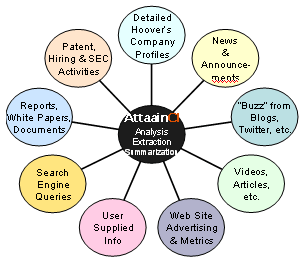
AttaainCI continuously monitors, filters and integrates intelligence from a wide range of sources.

AttaainCI

The software had its start mostly tracking social networks such as Facebook, Twitter, LinkedIn among others.  Recently AttaainCI included Hoovers as a resource for information, greatly boosting its one-stop shopping appeal for research. You can use it both for a one-time research project, for example a company or person; and you can receive email alerts delivered to your mailbox according to a personalized schedule. It is cooperative in that you can share results with co-workers and view results more visually.

The typical output for a one-time company research query might be 3 or 4 pages of data that is easy to scroll through, as the abstracts appear neatly in 4 columns: Search Results, News & Announcement, Blog Mentions and Additional Intelligence. You can quickly connect to the best articles or reports to get up to speed on the topic you’re researching. You can also find out who is talking about that topic through your social networks. I find it is useful since I have a huge LinkedIn network, so I always find relevant people to follow-up with. Similarly I often can connect to good people on Twitter, who lead me to others once I determine the # for the topic in question, like #eldercare.  If you need more information than what is on those several pages, AttaainCI provides links to even more data right off the initial report.

AttaainCI is a good software package to get up to speed on just about any topic, and it’s great to use at the outset of a project whether it’s competitive intelligence or general research for sales, marketing, product management or strategic planning. AttaainCI is an effective tool for daily monitoring on topics to get the latest and greatest while you’re working on a project, which goes on for two weeks to a month, for example. Find out what people are saying about you, key executives, your products, and your company through AttaainCI.  AttaainCI will greatly reduce your communication time for intelligence deliverables.