Peace at Last: Reflections of my Dad’s Final Days

I lost my wonderful Dad this past Saturday night. It was the most difficult experience of my life watching him die a natural death during his last week. A week before he died he ate his last scrambled egg, and by the next day he didn’t want anything to drink aside from very small sips to keep down the inevitable dryness and choking. This is a biological reaction when the body is failing and is in the early stages of death.

As the week went along we noticed that Dad’s pulse rate went up gradually, yet his blood pressure was normal as was the oxygen level in his blood.  I wondered how long he could live with no nourishment. He told us how much he loved us and we had a lot of kisses. He has always been loving so this behavior was an extension of the man we knew and loved. As the days progressed he choked more often and found it harder to bring it up. Dying people can’t swallow over time and as they become increasingly dehydrated, they have less to swallow, so it’s a lot more concentrated than a healthy person’s saliva. We helped him get the “stuff” out of his mouth and I started to smell death a few days before he died.

We all cope with death differently.  My Mom kept telling my Dad that he looked good, and that everything would be OK. As the week passed, she changed her tune to thanking him for all the wonderful years and all the joy and love he had given her. They were married for 62 years which is so awesome!  Mom kept chattering to him and wiping his face to give him relief. It seemed to me he would rather have been left alone to be quiet for some of this time.

My brother, Steve, stood by and continued his toil to keep Dad comfortable by changing his adult diapers, cleaning him and finding ways to make his life more pleasant. His bedside manner was better than incredible. He gave my Dad such comfort, and had been caring for him every weekend since May 2008 earning him the title of Saint Steve.

In these last couple of weeks we shifted his body to prevent bed sores. He much preferred being on his back, but after a few days he seemed to be uncomfortable regardless of what position he was in. He had this odd restlessness where he wanted to rub his head and eyes quite often. I gradually realized that this was a form of anxiety and that pharmaceuticals could help this. It took me a couple of days to realize that this was anxiety and not just a nervous habit.

I had the honor of sitting with Dad the last night of his life. It was frustrating as by now his breathing was labored, and I wasn’t sure how often I could give him pharmaceuticals such as morphine. I was afraid to give it to him while he slept.  It was interesting that he could sleep at all in hindsight as he must have been so uncomfortable.  I think he took comfort when he heard my Mom’s rhythmic snoring, and he also knew I was sitting by him quietly with the lights out praying for him to be peaceful.

As soon as he roused at around 6:30 a.m., I gave him morphine and another anti-anxiety drug. He relaxed within 10 minutes, but had moved his face to resist the meds even though he could no longer hold his neck straight and didn’t have enough energy to talk at all. The hospice nurse told me that he probably thought I was attempting to feed him and he didn’t want anything.

I had such mixed emotions about giving dad morphine as I felt like I was killing him. Actually it brought him relief as he was able to breathe more regularly and it was calming. The very small amount that you give a person will not cause him to choke, and it will be absorbed by the gum tissue so you can give them morphine while they sleep. Hospice didn’t explain this to me until late in the game, else he would have been peaceful sooner than he was.

I learned that the human body’s ability to hold onto life is a strong instinct even while dying. Pharmaceuticals helped my dad relax so he could die peacefully. Another big help was the use of oxygen towards the end. We were lucky that my sister-in-law is a nurse and she knew about this. About 3 hours before he died his pulse was up to over 140+ beats per minute. Then it gradually slowed and his breathing became shallow and he died. Once his heart slowed, he lived only about 2 hours. We sat around his bedside at home as he died and that was very bonding.

We were very blessed to have my father in our lives. He was a giver his whole life even the day before he died. Early in his career he defended Japanese war criminals. He saved the US government millions of dollars in the 1950s and 1960s through procurement deals he negotiated with the Japanese, when millions of dollars was a lot of money. He continued his procurement work at the Pentagon until he retired in 1984. He was a religious man and helped the less fortunate in so many ways, helping orphanages in Yokohama, visiting prisoners of all sorts of description. What I really loved about him was his warmth and his uncanny ability to make each person he spoke to feel like they were so important.  He didn’t multi-task and gave a person his undivided attention. Many of us in this crazed world of social networking could take a lesson from my Dad.

Are We Losing the Art of Conversation?

As I spend more time at my parents watching my Dad drift towards death, I have less energy for blogging, but plenty of time to ponder.

I recently read a blog by Sarah Perez about a study from Pew Internet and American Life Project which finds that social media is actually social. Those who surf the web and use mobile phones are more social and better connected to the world at large than those who don’t.

But what is ‘social’? I find that the connections I make and the blogs that I read through social networking are shallow in comparison to the connections and knowledge I gain and exchange in conversation. Social networks provide snippets and tidbits of information. As a society are we losing our ability and culture of conversation?

While this is anecdotal, enough friends tell me they don’t like to receive or leave voice mails since they find the phone to be a waste of time. Maybe I am too old, but I find the phone to be a great use of time, since I both speak and listen to words a lot faster than I can type/read them. Granted I can only engage is one conversation at a time, but there is a depth of conversation that I can routinely get to even on the telephone that just isn’t possible through social networks or any Internet communication.

As a researcher I appreciate that I can find and connect with people I could never have previously reached through social networks. However, I also recognize that those connections can be shallow, and that some people take advantage of what they can get from you through social connection. I had one person lead me to believe that he wanted to do business. Instead he took my proposed solution and implemented it himself. I found this out when I saw his firm listed as a user of a database I had recommended. There is even less loyalty among social connections, since many people don’t really know you, and don’t want to know you. They just want to connect with you to get to your connections. That isn’t what I call social: but, this does extend one’s network beyond one’s known business connections.

As a society we have been creeping away from conversations ever since television became common, and many of us remain glued to TV even as we eat dinner instead of conversing about our day. Now we have the Internet with its many distractions, one of which is email.  We have so many choices of ways to connect such as text messaging, and social media such as LinkedIn, Twitter, Facebook, Google+ and Pinterest . There isn’t a day that goes by that I don’t get several invitations to join various social networks or LinkedIn groups from people who have no idea who I am. I get so much spam through LinkedIn connections who are selling me something, asking me to endorse them or to join their LinkedIn Group. There is a lot of noise out there, and many distractions through an increasing number of social networks. I find that it’s a real balancing act to get my work done for all the noise.

But for now I’m having some deep conversations with family members. There is nothing like the impending loss of a loved one to draw out emotion and connection.

AttaainCI wins AIIP’s 10th Annual Technology Award

This time last week I was at Internet Librarian in Monterey, California. AttaainCI earned AIIP’s technology award. Founder and President, Daryl Scott was present to receive the award from AIIP’s President, Marcy Phelps. Every year, the AIIP Technology Award is presented to a company whose product, in the panel’s opinion, best assists independent information professionals in locating, analyzing, organizing and delivering information.AttaainCI software, was launched in early 2008, and provides real-time intelligence gathering, analysis, sharing and reporting alerts. One of my favorite uses is company tracking: your company, one you want to acquire or a competitor, for example. Track what’s being said about your company’s products or your key customers. It is reasonably priced at $149 per month for the first user and $69 for the second user for unlimited usage on a month-to-month basis. Discounted annual plans are negotiable with Attaain. Watch 10 instructional videos and learn in detail how AttaainCI will work for you.

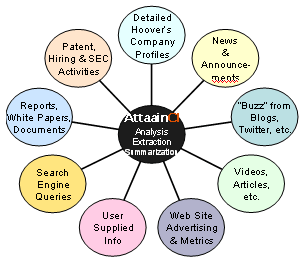
AttaainCI continuously monitors, filters and integrates intelligence from a wide range of sources.

AttaainCI

The software had its start mostly tracking social networks such as Facebook, Twitter, LinkedIn among others.  Recently AttaainCI included Hoovers as a resource for information, greatly boosting its one-stop shopping appeal for research. You can use it both for a one-time research project, for example a company or person; and you can receive email alerts delivered to your mailbox according to a personalized schedule. It is cooperative in that you can share results with co-workers and view results more visually.

The typical output for a one-time company research query might be 3 or 4 pages of data that is easy to scroll through, as the abstracts appear neatly in 4 columns: Search Results, News & Announcement, Blog Mentions and Additional Intelligence. You can quickly connect to the best articles or reports to get up to speed on the topic you’re researching. You can also find out who is talking about that topic through your social networks. I find it is useful since I have a huge LinkedIn network, so I always find relevant people to follow-up with. Similarly I often can connect to good people on Twitter, who lead me to others once I determine the # for the topic in question, like #eldercare.  If you need more information than what is on those several pages, AttaainCI provides links to even more data right off the initial report.

AttaainCI is a good software package to get up to speed on just about any topic, and it’s great to use at the outset of a project whether it’s competitive intelligence or general research for sales, marketing, product management or strategic planning. AttaainCI is an effective tool for daily monitoring on topics to get the latest and greatest while you’re working on a project, which goes on for two weeks to a month, for example. Find out what people are saying about you, key executives, your products, and your company through AttaainCI.  AttaainCI will greatly reduce your communication time for intelligence deliverables.

Introduction to Competitive Intelligence

At a recent Denver joint SCIP and APMP chapter meeting, I was asked to put together some introductory slides about competitive intelligence to set the stage for the more sophisticated discussion around “Price to Win,” which is sophisticated analysis around bids/outcomes for major contracts, usually with huge government customers.

As I assembled my slides, I realized that very little has changed in the competitive intelligence (CI) process, while the execution of the collection phase of competitive intelligence has changed remarkably over the 20+ years I have been in the business with the advent of the Internet in all its iterations, e-mail, text messaging and more recently through social networks.  This also affects counterintelligence, since it is easier for your competitors—or anyone who is interested enough—to dig up information about your company that you consider proprietary. This information comes not only through electronic means, but through ex-employees, especially from all the downsizing in the last couple of years.

One common misconception is that competitive intelligence just focuses on the competition. Make no mistake competition is part of this: but you also want to take into account all the factors that affect the competitive marketplace such as economic conditions like the current unstable economy. In the US, the stock market has staged a quick recovery although the NYSE is still 4000 points below its peak in 2007. When you consider the stock market’s quick ascent after such a steady descent, you have to wonder how sustainable it is and how this will affect your customers, suppliers and competitors. Politics can affect the competitive marketplace. Were I in the US healthcare business, I would study all the ramifications of the proposed healthcare reform, and would conduct scenario planning exercises to prepare my company for change.

Here are 10 points to consider whether you’re starting or leading an established CI operation regardless of how you’re organized or what country you work in. These points are timeless: I put this list together in the early 1990s. While technology impacts our lives far more than it did then, human nature has not changed, and that’s what’s behind these steps.

1. Identify primary users
2. Focus on critical users’ needs
3. Fashion products to meet users’ needs
4. Be mindful of the company culture
5. Identify & build on infrastructure that supports CI
6. Organize & expand your people network constantly
7. Promote communication
8. Don’t implement automation before people
9. Checkpoint performance always
10. Stay focused

I didn’t include cooperative intelligence when I started my CI career since I was too focused on learning how to do competitive intelligence. Cooperative Intelligence focuses on good communication, solid connections, and being respected as a leader by providing good knowledge and insightful work. CI is more of a back office function: CEOs don’t look to hire people in their c-suite with CI experience. However, many areas within a company do rely on good competitive intelligence–which if communicated well and in a timely fashion–does lead people to respect the CI manager. You can be the greatest executor of competitive intelligence, but if you can’t communicate relevant information and analysis to the right people at the right time, it really doesn’t matter. This is the core of cooperative intelligence in the context of competitive intelligence—being so connected with your internal customers, that you know what to provide when—and get feedback from them, so you stay on target.

Competitive Intelligence Advantage by Seena Sharp

SeenaSharpSeena Sharp’s book Competitive Intelligence Advantage  has just been published! I just ordered my copy and strongly encourage you to do the same! Seena Sharp has been doing competitive intelligence (CI) since before she founded her Los Angeles-based CI firm, Sharp Market Intelligence in 1979.

What I like about Seena, and it’s a long list–way too long for this blog–is her provocative nature as she looks at the causes for events. She has focused on soft intelligence for years, which is often what drives decision-making. She is really good at uncovering sources that others would overlook, who always look in the “same old places” or the “industry publications/trade journals.” She has a holistic outlook as she helps her clients uncover what is about to happen in the marketplace, and how they can take advantage of these trends, and perhaps influence them. BTW I also like her laughter!

So here is a little bit about her book that I picked up on the Internet…I’ll write more when I read her book!

Competitive Intelligence Advantage:

* Defines and refines the elements of quality CI
* Details why what you don’t know will hurt you
* Equips you with techniques for detecting opportunities and seizing them
* Shows you when and why to use CI to your advantage
* Helps you understand and evaluate information sources
* Demystifies and debunks common myths about CI

This book explains why data is not intelligence, why competitor intelligence is a weak sibling to competitive intelligence, when to use it, how to find the most useful information and turn it into actual intelligence, and how to convincingly communicate findings.

Competitive intelligence is a robust management discipline that is often misunderstood and underestimated, yet results in numerous benefits when used wisely. CI is critical for minimizing risks when formulating your business strategy. The true power of CI lies in its ability to reveal what’s happening outside your organization—to take off the blinders and show you the true competitive state of play.

Businesses would benefit from viewing competitive intelligence from a COST to viewing it as an INVESTMENT that saves money and provides immediate value. If you’re a senior-level executive or organizational leader—and you aren’t tapping the power of CI for an external perspective on your customers and the marketplace—you’re giving your competitors the upper hand.

Order your hardcopy
Order your electronic copy

Meet August Jackson, Competitive Intelligence Podcast King!

AugustJacksonI first met August Jackson several years ago when he was leading the Washington, DC SCIP chapter. Since then he has taken the program lead for SCIP annual conferences, a monumental task, and is one of the profession’s leading edge users of social media, which he openly shares. I was honored earlier this month when he interviewed me for a podcast on cooperative intelligence. I shared a lot of examples from my experience in sales, and relationship building to create a competitive intelligence process at Bell Atlantic, now part of Verizon. The first 20 minutes is all about how I got into the field of competitive intelligence since I wanted to win more deals as a sales person. The cooperative intelligence discussion starts after that, and consumes most of the rest of the podcast—the last 40 minutes. The right people connections and effective communication are what separate best in class competitive intelligence operations from the rest that rely too heavily on digital monitoring in its many forms and are less sensitive as to how people want to be communicated with.

As August was interviewing me I had the feeling that he had done a lot of podcasts! Check out his podcast postings which go back to 2005. I’ve selected some of my favorites, but there are more!

CI 2020 with Arik Johnson (2009)
Eric Garland the Futurist (2009)
Suki Fuller on Social Networking (2009)
Adrian Alvarez on CI in Latin America (2006)
Alessandro Comai: Mapping & Anticipating the Competitive Landscape (2007)
Roger Phelps on LinkedIn (the podcast) (2007)
Ben Gilad on Strategic Early Warning and Blindspots, & David Hartmann on Proactive Asymmetric Strategy (the podcast) (2006)

You can read August’s blog.  He shared a nice slide deck on competitive analysis in his blog on Sept 17th, from his lecture at Johns Hopkins.

August is a Senior Consultant and specialist in competitive market intelligence and analysis at Verizon Business. His area of expertise is emerging IT and communication (ICT) technologies and their impact on business. Working in the private sector as a competitive intelligence manager with British Telecommunications, AT&T and MCI, he created competitive intelligence materials to support executive scenario planning, to turn insights from sales cycles into priorities and recommendations for operational and product development; maintained industry, technology and competitor profiles for diverse audiences.

August has provided technology trend analysis which guided major strategic decisions, and has developed profiles and delivered training globally. He is also recognized as an expert in the application of advanced secondary research methods including social media in competitive intelligence practice. Just look at his podcast collection and download most of them here!

August holds an Executive MBA from the University of Maryland’s Robert H Smith’s School of Business and earned a BA Cum Laude from the Elliott School of International Affairs at George Washington University. August can be reached at jackson.august at gmail.com.

Real-time Collaborative Architectural Modeling Enhances Complex Product Development

Bryan Moser spoke to our Denver PDMA (Product development Management Association) chapter about the value of models such as the one his company, Global Project Design (GPD) developed  to forecast, optimize, allocate and measure coordination in complex product development projects. These models take into account different cultures, time zones, language barriers, and dispersed decision-making. They also incorporate engineering behavior among different cultures based on their typical interaction.

Today there is pressure to succeed in a dramatically concurrent fashion, which increases the risk of rework, quality and design. The thinning of the workforce affects production as does the loss of deep knowledge and connection from workers who have been laid off or who have retired. Another finding in these complex product development initiatives is that the cost of coordination is high and is on average 30%-35% of the time consumed.

Bryan walked us through the example of the Sikorsky S92 helicopter product development project. Their biggest concern was defending their intellectual property as they selected companies in various countries to work as an integrated team. The team was spread across the globe in countries such as Brazil, Taiwan, Spain, China and Japan, and included big company names such as Embraer of Brazil and Taiwan Aerospace, for example. Sikorsky USA was the decision-making company.

Sikorsky had predicted that it would take 5 years from product spec to prototype development. It took 9 years, and GPD’s model prediction was only off by 2 months from the actual time. Sikorsky hadn’t taken into account the dynamics that would add considerable time to product development, such as coordination, culture, language, time zones, and a lot of dead time that one team would experience if another was late in delivery, for example.

We can’t turn the clock back on product development since the expertise for various segments of complex product development is best served by a global team. However, putting on a nationalist hat, previously teams all worked for one company, in similar time zones and had strong connection and communication since they all spoke the same language, and could develop products more expeditiously from having worked together extensively over the years. This is lost in these complex product development projects where people who have never worked together, are thrust together to develop a product.

This real time collaborative model takes into account the various languages and points of view, and the time needed to build relationships with people who have never worked together before.

One of the key findings for these complex projects is that there is a fair amount of wasted time as work time averages:

~54% Direct Work
~30% Coordination
~16% Less Useful Time

The key takeaway is that coordination is often way underestimated in these complex product development projects across multiple countries. It’s better to run the model earlier in the process, so as to re-schedule or re-work pieces to reduce the less productive coordination time. GPD’s model is agent based on simulation models about how teams make choices and includes the last 30-40 years of research of behaviors in engineering work.

In conclusion, product development professionals face:

A decline in judgment based on experience alone. Traditional centralized and detailed plans ignore and misrepresent the complexity of projects.

Coordination – Interaction of teams to satisfy dependence across subsystems can be 35% of the effort, cost and duration of these development projects.

Choosing the best coordination architecture can lead to a 20% improvement in time/cost performance and will improve your competitiveness! Judgment through situation awareness is also gained.

Are Associations Going the Way of Print Media?: Part II

Association chapters, the grass roots of associations, are often the step-children in the association world since they don’t produce revenue, and many don’t even break even. I think that is particularly true using the traditional model, especially if the association centrally controls chapters versus letting them run themselves.

In today’s world the high cost of in-person chapter meetings has resulted in much lower attendance. Chapter leadership often runs in-person meetings using the same format in the same location year after year. We are certainly guilty of that in our Denver SCIP (Society of Competitive Intelligence Professionals) chapter, which I really hadn’t thought about until I did the research to analyze the location of our members. About half of us work in Boulder and the Northern Denver suburbs, so are not keen on trekking into Denver where we hold our meetings. We have never hosted a Boulder meeting, and then again none of our Boulder members has volunteered to host. They probably didn’t realize that half of us are there!

Recently a few of us put our heads together to start adapting our chapter meeting venue to the reality of today’s dispersed and busy workforce. We are co-hosting a meeting with the Denver APMP (Association of Proposal Management Professionals) chapter on Sept. 25 at 3 p.m. where people will have 3 choices for connection:

1. In person business meeting: 3:00 – 4:30 pm
Ballard Spahr, LLP
1225 17th Street, Suite 2300 Denver, CO  80202
Directions:  http://maps.google.com/maps?hl=en&tab=wl
Cost:  $10 (pay on-site or register through SCIP)

2. Webinar Business Meeting: 3:00 – 4:30 p.m.
Dimdim Webinar: RSVP apmp.colorado@gmail.com, and include name, SCIP/APMP member or guest and David Shipley will email you instructions from Dimdim.
Cost: None

3. Social Meeting: 4:40 p.m. – 6:00 p.m. (or later…)
Location: Prime Bar
1515 Arapahoe Street Denver, CO  80202
(One block away from Ballard Spahr) RSVP: renaylor at wispertel.net
Cost: You pay for your drinks & snacks

The presentation “From CI to the Opportunity: Practical Steps to Winning!”
addresses the competitive intelligence (CI) process and how to use CI to get to the “First Place”—that is winning more business!

Folks are invited to attend any of these venues. If you don’t have time for the meeting, you can meet us at Prime Bar. We are hoping to engage our members by giving them more choices for connection, and the additional cross-pollination between SCIP and APMP members. Just in case you’re interested, here is the detail for things like registration, speakers, etc.

So what are you doing to engage participation and cooperation among your membership at the local association level? We’re considering a LinkedIn Group, a Ning group, or starting a Denver chapter within the already existing CI Ning group. We will Tweet on Twitter about our local meetings under #denverci. Our virtual space will provide 24/7 communication and we will help our members find work through job postings there too.

In the spirit of cooperative intelligence, I am forming a Denver group around intelligence collaboration to include people who are not full-time CI practitioners. For example your job might be in product management, sales, marketing, forecasting, strategic planning or mining information, but intelligence collection and analysis is part of your job. If you’re interested, please contact me at renaylor at wispertel.net and I’ll include you in our future events.

BTW, this is similar to the intelligence collaboration instigated by futurist Eric Garland  on our CI Ning which I invite you to join.

Key Insights to Be a Better Leader in Today’s World

leadershippanelists2009DenIn the spirit of cooperative intelligence I am sharing my takeaways from this workshop on leadership sponsored by Denver-based Sustainable Business Group, a leadership and management consulting firm led by Herb Rubenstein.

Wayne Nelson, Chief Strategist at Anderson Professional Systems Group kicked off the meeting with a discussion about emotional intelligence, telling us the 5 components of emotional intelligence: self awareness, self-regulation, motivation, empathy and social skill from Daniel Goleman’s book, Emotional Intelligence.

What I found even more interesting was his discussion about 6 leadership styles:

Coercive – Tight control over things. “Do what I tell you.”
Authoritative – Build the vision. “Get people to follow where you need to go.”
Affiliative – Promote harmony, cooperation. “Puts people first, tasks second.”
Democratic – Builds on group consensus. “So what do you think?”
Pacesetting – Intent on setting high performance standards. “Do as I do it.”
Coaching – Develop the team or individual for the future. “Try this: How can I support you?”

We all have a tendency towards a particular leadership style.  A good manager is flexible and uses the right style to be effective at the appropriate time. It’s also good to employ people whose styles you lack to keep balance in the workplace.

Jennifer Churchill of Opus Leadership Group focused on talent retention.

She suggests 3 key areas to promote talent retention:
1. Senior Management must be involved (acquisition/retention of top talent)
2. Conduct a gap analysis of your company’s talent to find what’s missing
3. Strong leaders attract and retain strong talent (management by example)
So know yourself and the kind of leader you are.

Kevin Asbjörnson, Founder and Principal Performing Artist of Inspire! Imagine! Innovate!  brought a global aspect to leadership. Music is a global language and inspires whole person leadership by getting us to use the right side of our brain and connect both sides of the brain to bring leadership balance and passion. One take-away for me was that Empathy is the foundation of emotional intelligence regardless of your culture. I had thought it was Self-Awareness. As a behind the scenes primary researcher I am an ‘off the chart’ empath, and don’t think of myself as a leader. I look forward to hearing and experiencing Kevin’s piano performance around leadership. Somehow we didn’t have room for a Yamaha at our session!

Inevitably, the topic of social networks came up in the context of emotional intelligence as people reach out for connection in cyberspace. I have the idea that social networks have taken off since the workplace has become lonely. Gone are the days when a product team meets in the company cafeteria. We work remotely from each other all too often with a lack of leadership and weak connection. We have this human need to connect and cooperate and help each other out. This is increasingly achieved through connections made via social networks!

I liked the saying that Herb shared with us, “Nobody cares what you know until they know you care.” That’s good to keep in mind when you’re connecting, whether through the old fashioned ways of in-person meetings, telephone and email; or the various forms of social networks such as LinkedIn, Twitter and Facebook. Keep that communication two-way and listen!

Tips on Setting up a Competitive Intelligence Process

I was recently asked by a prospective client to summarize how I could help his company develop and implement a competitive intelligence process. While I tend to follow certain steps in setting up a CI process, I was taken aback since this company’s industry is such a specialized niche within financial services, and I am not a “one size fits all” consultant.

Here are some of the takeaways that apply to any industry:

Determine the most important areas to track and analyze or what we in competitive intelligence refer to as Key Intelligence Topics (KITs). You can’t focus on everything or you won’t do anything well. Within in that, focus on the most essential KIT immediately and make a big splash within your company. Your company executives and marketing people will have a lot of good ideas about KITs, but don’t just rely on them. Ask people in other functional areas so you gain balance and aren’t blindsided.

Don’t forget to market and position your CI initiative. Start by letting people know what CI is: what you do and don’t do and set up ethical boundaries. Nobody owes you anything in the busy workplace. Present CI in the context of what they do and how you can help them, and that will go a long way to gaining their cooperation. Create a logo so people can readily identify what you send them by its look, and share only quality stuff and not too often.

I think most companies are close to parity when it comes to conducting secondary research, that is monitoring competitors, market trends including and all the components of the STEEP analysis:

S=social
T=technological
E=economic
E=environmental
P=political

However, where excellent companies stand out is in connecting with people who are responsive both inside and outside their companies across a variety of disciplines. The initial challenge is to locate these connections, and then keep track of them as they move to different areas within your company, leave your company, or start at your company. It’s even more of a challenge to track your external contacts. I use both ACT!, a great contact database to keep track of my contacts, as well as Outlook.

If you establish cooperative relationships and disciplined communication with relevant people you will have a competitive advantage. You will keep your network informed and over time, those people you connect with will think to inform you when they find nuggets that they know you value.

Trade shows are often overlooked as a means to obtain competitive intelligence and so much more. Dig into your company’s trade show strategy and engage those who are attending to become collectors of CI. Sales is often conducting some form of win loss analysis, and is a great conduit to your customers, a great source of CI if recorded.

Lastly, don’t forget your competitors are collecting against you, which we call counterintelligence. Influence your company to take steps to protect your company’s important information like R&D, product development & intellectual property.

For lots more detail about setting up a CI process, I suggest you buy SCIP’s intelligence guide book, Starting a Competitive Intelligence Function.

Find out how we can work with you to develop a competitive intelligence program.

Win/Loss Analysis book gives you a process to learn why you’re losing business and how to keep more of it!

Receive our 6-page Win/Loss Cheat Sheets

Connect on LinkedIn  Connect on Twitter