Getting into Your Competitor’s Head: A Case Study

Competitive intelligence professionals often spend too much time collecting competitive data and not enough time digesting what it really means, and how it can help their managers make better decisions.  In the February McKinsey Quarterly, “Getting into Your Competitor’s Head,”  the authors (Hugh Courtney, John Horn and Jayanti Kar) discuss that in order to be more predictive you need to insert yourself into both your competitor’s company moves as well as their decision-making, which often don’t match.  In the usual McKinsey style, they supplied a great visual to get people thinking about a process to predict competitor’s moves and reactions to your moves outside of scenario planning.
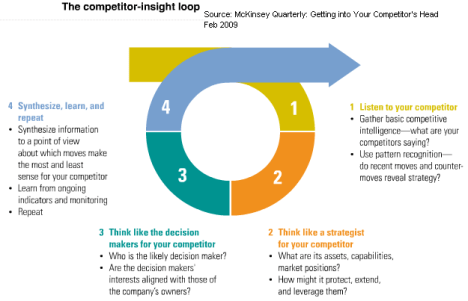
the-competitor-insight-loop-mckinsey-feb-09

This article reminded me of a company I analyzed in the glass industry.  I learned their major factory was in disrepair, as the company was investing minimally in new equipment and was just patching up the glass furnaces. They were hiring workers who spoke little English, a huge safety hazard around the extreme heat of glass production.  The company was clearly losing money in this business, and I just couldn’t understand why they stayed in the business.  The analyst community was also puzzled.

I got my answer as I listened to a quarterly earnings conference call.  One analyst queried the CEO about the failing glass business, and the CEO sadly answered, “Ah well yes, there is our glass business…sigh…” with a heavy voice full of remorse.  He was staying in the industry since his Dad had bought into it, and he wanted to keep it going.  It was an emotional decision, so I predicted that the glass business would not be for sale unless something drastic happened, like an accident at the factory which resulted in the loss of human life or stockholders complaining that this glass business was pulling down the company’s earnings and stock value.  A couple of years later, an influential stockholder wrote up his disgust about this company’s poor performing glass business and publicized it widely.  My client seized the moment and put in a bid for the glass business and I’m sure they got a good deal.

Some companies conduct an elaborate and expensive process called wargaming to get inside their competitor’s heads.  In some cases it’s warranted. In simpler cases, be creative: identify the key decision-maker’s motivation, personality style and track record through personality profiling, to predict how s/he will lead the company or react to your product launches.  There may be several decision-makers to consider depending on the company and your focus. Don’t get blindsided: sometimes market events change in a way that affects the executive’s decision-making pre-disposition due to stress or they rely on a key influencer that you hadn’t considered.

Do you have any stories to share about how you got into your competitor’s head?

Win/Loss Analysis book gives you a process to learn why you’re losing business and how to keep more of it!

Receive our 6-page Win/Loss Cheat Sheets

Connect on LinkedIn  Connect on Twitter

Build Cooperative Trust: Learn from Millard Fuller, Habitat for Humanity Visionary

creativitycentralmariacharlie1I just had the privilege to attend my friends, Maria and Charlie Girsch’s 40th wedding anniversary celebration which started with a renewal of their vows.  Maria and Charlie are toy inventors who lead Creativity Central where they teach people how to be creative based on their 25 years of creativity with toys.  Their list of toy inventions numbers over 200!

Their celebration service was led by The Very Reverend Peter Eaton of Saint John’s Cathedral in Denver, Colorado.   He gave a stirring homily as he recounted the life of Millard Fuller, the visionary whose ideas and tireless work created Habitat for Humanity in 1976 who died on Feb. 3, 2009. How fortunate for Millard Fuller that President Jimmy Carter publicly supported Habitat in its early days which gave the organize a huge PR boost!  He has been an active volunteer in building Habitat homes and endorsing Habitat.

By Habitat’s 25th anniversary, tens of thousands of people were volunteering with Habitat and more than 500,000 people were living in Habitat homes.  “Millard Fuller’s drive and relentless commitment to affordable housing captured people’s imagination and changed lives around the world,” said J. Ronald Terwilliger, chair of Habitat’s International Board of Directors. “His inspiration lives on in Habitat’s work and through its employees, volunteers, partner families and supporters.”

Today more than a million people live in Habitat built, reconstructed or revamped homes, which are in more than 100 countries. Former President Jimmy Carter said: “He (Fuller) was an inspiration to me, other members of our family and an untold number of volunteers who worked side by side under his leadership.” Former President Bill Clinton has also volunteered on Habitat projects. When he presented Fuller the Presidential Medal of Freedom in 1996, Clinton said, “I don’t think it’s an exaggeration to say that Millard Fuller has literally revolutionized the concept of philanthropy.”

Millard Fuller’s leadership of Habitat for Humanity is an example of cooperative intelligence in the non-profit world, which continues to thrive.  It is a hugely successful cooperative effort by many people to restore or build homes for the less fortunate around the globe.

In our tough economic times, leadership needs to engage in cooperative intelligence and build support systems among employees, customers and suppliers like Miller Fuller did for Habitat. Many employees feel fear, and that they’re beaten up by their company’s management to do more with less.  How will companies foster a cooperative spirit when they are struggling to survive? It is more important than ever that the remaining employees in companies feel valued and are motivated to work hard, not just to keep their jobs, but because they want to.

What steps can you take to build up your company’s cooperative intelligence “trust” fund?

Sharpen Your Emotional Intelligence Skills

Emotional Intelligence is a important component of cooperative intelligence. Referred to as EI, often measured as an Emotional Intelligence Quotient (EQ), it is the ability to sense, understand, and effectively apply the power of emotions to facilitate high levels of collaboration and productivity. (Cooper & Sawaf 1998, Executive IQ, New York: Perigee)

According to Daniel Goleman, the father and author of Emotional Intelligence, there are 5 skills that enable EI:

1. Self awareness – knowing your moods, emotions and drives, as well as their effect on others

2. Self regulation – the ability to control or redirect disruptive impulses and moods and the propensity to suspend judgment and think before acting

3. Motivation – a passion to work for reasons that go beyond money or status and a propensity to pursue goals with energy and persistence

4. Empathy – understanding other people’s emotional makeup and the skill to treat people according to their emotional reactions

5. Social skill – an ability to find common ground and build rapport. Skill in managing relationships and building networks

In my field of competitive intelligence a high EQ is helpful since we’re often delivering people bad news like, “Competitor A is getting ready to launch a disruptive technology,” or “We need to get this product to market before Competitor A or does else we’ll lose X% market share.” We are being paid to “tell the truth” and we cause stress since often “they” don’t want to hear bad news or threats to the business even if it is the truth. We have to stay strong to deliver bad news, and also be sensitive as to how “they” are going to take the news and not spring surprises, for example. I found one way not to be regarded as Darth Vader is to present management with opportunities as well.

What’s neat about EI versus IQ is that we can learn and be coached to improve our EI skills, whereas we’re born with a certain IQ. In this vein, I am studying to be a certified mentor for a company called EQmentor founded by the genius of Izzy Justice.

What’s really neat about EQmentor is it’s all on-line and there is total anonymity between mentors and mentees. I think their timing is really right as about 70% of communication is electronic, an indication of its high acceptance. When I formed The Business Intelligence Source  in 1993, my phone rang all day. Now it’s email, Twitter Tweets, LinkedIn and Facebook communication that talk to me 24/7.

EQmentor provides an incredible repository of information that mentors and mentees have access to in addition to members of the EQmentor community. The company carefully matches mentors and mentees and the relationship is a 6 month engagement, long enough to make a change in a person’s life. I know the price is right compared to traditional coaching so it will be affordable to more people.

What do you think about this concept at EQmentor? How do you use emotional intelligence in your profession?

Win/Loss Analysis book gives you a process to learn why you’re losing business and how to keep more of it!

Receive our 6-page Win/Loss Cheat Sheets

Connect on LinkedIn  Connect on Twitter

Diplomat Dennis Ross: Cooperative Leader & Active Listener

I was inspired by Kit Cooper’s  interview with Dennis Ross, one of the most skilled diplomats in the world who was appointed by President Obama to serve as the chief envoy for Iran.

“I tell people that work with me that one of the most important skills in negotiations is active listening. I believe in not always asking questions with the purpose of getting the other side to reveal things. There is immense, untapped benefit to getting a deep understanding of what drives them and you certainly build good will with such an approach. “Why is that issue important to you? I want to understand it the way you understand it. I don’t want to have a false impression. Explain to me why that matters so much to you. Where does it come from? Why does it create an imperative?” You can’t find the underlying sources of behavior and issues unless you ask questions in this way. When people see that I am curious by being an active listener, they get a message of respect from me. And of course you have the benefit of actually learning something.”

Mr. Ross’s actions and attitude are that of a cooperative leader. Cooperative leadership is more a state of mind than a position within a company or in politics. Leaders are uncomfortable with the status quo, and live uncertain, risk filled lives and yet have a sense of belonging to the human race. They are life long learners who often serve and contribute to others. Thus people who work for them or connect with them in everyday life are uplifted and feel free. A cooperative leader really values and trusts the interdependence of relationships. Active listening is a leading characteristic of a cooperative leader and crosses all job functions. I think executives who are cooperative leaders give their companies a tremendous competitive advantage since they are open to listening and learning so are less likely to be blind sided by surprise market developments, new technology or an emerging competitor.

BTW if you want to gain great insight into Dennis Ross, check out his book, Statecraft: And How to Restore America’s Standing in the World.

Win Loss Analysis is more than Competitive Intelligence

Win loss analysis is my favorite tactical cooperative intelligence practice as it offers the best ROI of any sales intelligence tool. You gain intelligence by interviewing your customers shortly after the sales event to find out why they chose to do business with you or decided on a competitor. The data gathered combines knowledge from sales, customers, competitors, and your marketplace.

Consider these points to develop a cooperative B to B win loss process:

  • Clearly identify objectives for conducting win loss
  • Invest the time to develop the questions you want answered
  • Include Sales
  • Maintain professionalism throughout the process
  • Don’t just “survey” your customers
  • Don’t just interview losses; include wins
  • Communicate findings broadly within your company

I’ve conducted win/loss interviews and analysis for years, and enjoyed reading Ford Harding’s post, “Learning from Loss,” where he shared findings from Ken Sawka of Outward Insights about what can be obtained from conducting win loss interviews.

What I found most interesting was Ford’s experience in professional services firms where partners do the work and make or lose the sale so there isn’t a dedicated sales force.  Ford’s focus isn’t competitive intelligence so his perspective is valuable to those of us with our heads in the competitive intelligence sandbox.  He is the author of Rain Making: Attract New Clients No Matter What Your Field.  A rain maker is an employee who creates a significant amount of new business to a company. Rain Making uncovers how professional services are marketed successfully in terrific detail.  I decided to buy the book to gain the perspective of selling in professional services as I sold in the retail and telecommunications arenas. BTW Rain Making gets very good reviews on Amazon.

As a competitive intelligence professional, you will be more successful in capturing competitive data from sales if you build your emotional intelligence by gaining an understanding and empathy for the challenges and joys of their job. You will most certainly acquire this from Rain Making.  You might even give your company’s sales and PR folks some tippers from this book.

For more reading on win loss analysis consider this article, “Increasing Sales through Win Loss Analysis.”

Do you conduct win loss interviews at your company?  If so, how have you used the findings to improve your business?

Be notified when our book, Win/Loss Analysis: How to Clinch and Keep the Business You Want is published.

Don’t be a verbal pack rat!

This is inspired by Seth Godin’s post entitled, “Sorry we’re out of time.”

Here is the part which spoke to me:

“I often hear presenters who always manage to need just two more minutes than the time allows. So, instead of exiting gracefully when there’s ten seconds left on the clock, they either steal time from the next person or try to rush through six slides and their conclusion.

What a waste.

Do you save the most important part of the meeting for the end, when everyone is already standing?

Plan for the end.”

OK I am guilty as charged as I always have more than enough material to cover in a presentation right up to the end.  Why do I do this?  I am a researcher at heart and I want to impart as much information as I can so my audience gets their money’s worth.  That is what I appreciate in a speaker, lots of information flying at me.  I am a verbal pack rat, just like “ahem” the electronic and paper files that are overflowing in my office.

But does my audience really get their money’s worth from this verbal pack rat? Is it really respectful for me to barrage them with more information than they can process in the time allotted?

Thank you Seth. Verbal pack rats are often guilty of one-way communication. I never really thought about it this way. I am going to shorten my presentation material into more easily digestible bites, and think about the end, since the ending comments are often the longest lasting with audiences.  I will also leave some time for questions and interaction with the audience, which is also respectful.

This really epitomizes cooperative communication. Consider how every audience wants to be addressed with respect. Give them enough time to process the information you present and the opportunity to get answers to their questions.

Think about the end. “I’ve learned that people will forget what you said, people will forget what you did, but people will never forget how you made them feel.”  ~ Dr. Maya Angelou

Netiquette on LinkedIn

LinkedIn is primarily a business to business social network with over 30 million members as of Jan. 09.  Users have different objectives and come from different cultures on LinkedIn.  Some people use it to connect with people who they would never otherwise know.  These people benefit from the synchronicity of connecting that often happens in my field of competitive intelligence during the process of cold calling where one source tells the caller the names of additional sources. At the other end of the spectrum are those who will only connect with people they know. Remember there is an individual behind that electronic connection to avoid blunders that put you in WIFM-land. (what’s in it for me)

Here are 12 LinkedIn bad habits I find particularly annoying:

1. The writer tries to make the invitations look customized.  I see right through that, so does everyone else.  I prefer invitations that get right to the point and invite me to join a person’s LinkedIn network.  If it’s customized I like that even better and I can tell for example that s/he decided to connect with me based on something s/he read from my profile or perhaps we are in the same LinkedIn group.  If I don’t know the person that well, I appreciate knowing how we met.

2. I don’t like being solicited for non-relevant services by my direct LinkedIn connections.  That is the downside of being a LION (LinkedIn Open Networker).  Others assume that we want to receive emails that promote their business.

3. I am continually asked to LinkIn with people who I am already connected with.  Some of them send out big email blasts and ask everyone to connect with them and claim they’re out of invitations (many of them are not).

4. If you want someone to connect with you on LinkedIn, ask them.  Some people ask me to go to their profile and initiate the invitation.  They often claim to be out of invitations.  Most of them are not.  They want you to use up your invitations.

5. I don’t like being invited into LinkedIn groups that obviously are not a good match for me.  For example, many recruiters have invited me to join their recruiting group on LinkedIn.  I am not a recruiter and wish they would look more look at targeted profiles before they send out these massive email blasts.

6. I don’t like being asked to recommend someone unless I know him or her.  Some people ask me who barely know me.  It makes me feel like I’m part of their cattle drive to collect endorsements, and that they don’t care about the quality.  You can tell when an endorsement is shallow so I don’t know why anyone would want one.

7. I also get aggravated by those who thank me for connecting with them and proceed to write me a long sales pitch. If you want people to read your “thank-you for connecting note,” you need to make it personal or don’t bother!  “Thanks you for connecting: let me know how I can help you” is a “non-thank-you” note.

8. LinkedIn has a Question and Answer section.  Some people ask questions to direct people to their business and it’s really an obnoxious ploy.  You can tell by how they ask the question and look at the name of their business and title.

9. Many people’s questions are dumb.  They’re so broad that you could write a book to answer them or they’re so unclear and in such poor English that I don’t understand them.  Think! Proofread!  Remember, the quality of your answers is directly related to the quality of your questions.

10. When answering questions, answer the question in the spirit of sharing and giving.  We don’t want to read all about your business.  LinkedIn links readers back to your profile.  It’s just like people who overtly advertise their business while making a presentation.  It turns people off.  You’ll get plenty of business by giving a good presentation, just like you will if you give good answers and are declared an expert on LinkedIn.

11. I am aggravated by people on LinkedIn whose profiles tell me nothing about what they do.  They are as brief as they can be and just go back through a couple of jobs, and I know they’re older than that.  These are often the same ones who are not open to being contacted: why are they on LinkedIn?

12. At the bottom of a person’s profile, some people are only willing to be contacted if it benefits them.  Their profile reads something like this:

Contact Settings
Interested In

business deals                    job inquiries
career opportunities

Someone who is a giver will include all the Contact Settings which includes ways that person might help others:

Contact Settings
Interested In

career opportunities           consulting offers
new ventures                        job inquiries
expertise requests              business deals
reference requests             getting back in touch

So these are my Big 12 No No’s on LinkedIn.  Do you have others to add?

Connect Cooperatively through your social & old fashioned networks

When Bonnie Hohhof, SCIP’s editor of Competitive Intelligence Magazine asked me to write about social networking etiquette, I was totally overwhelmed since there is reams of information on this topic.  How could I make it meaningful to SCIP members?  I found my answer in Chris Brogan‘s blog entry of Jan. 27, 2009 entitled, “You’re All Doing It Wrong.”

I loved this post so much that I copied it below and invite you to check out all the comments that this short provocative post attracted, 111 as this post is published.

• “You follow too many people on Twitter.
• You don’t allow blog comments.
• You add people to LinkedIn that you don’t know very well.
• You have ads on your blog.
• You use partial RSS feeds.
• Your blog posts are too short (too long).
• You shoot really long videos and don’t edit.
• You don’t follow people back.
• You swear.
• You talk in LOLcat speak.
• You aren’t using FriendFeed.
• You are using FriendFeed.
• You push the same updates to every platform.
• You don’t use Creative Commons.

Guess what? We’re all doing it wrong. Because we’re all doing it our own way, and it’s not always going to match the way you think it works best.”

People’s objectives in using social networks are very individual and are influenced by our gender, background, culture and Internet savvy.

In my field of competitive intelligence I notice there are two camps: those who want to find data about their competitors and don’t want to be found– mostly corporate managers and consultants who collect competitive data; and those who want to be found– management and research consultants looking for their next gig.  I notice many of my colleagues – I’m one of those shameless consultants — will only connect with people they know personally on LinkedIn and other networks.  I feel they are missing the opportunity for synchronicity to connect with people they would never meet except through connecting via strangers.  As we conduct cold calling to collect competitive intelligence, we often experience a similar synchronicity as one contact leads to another and another…the same thing happens in social networking when you connect with “strangers” if you are open to it.  Since you talk with so many people at one time through social networking the synchronicity is multiplied.

The point is with social networking, as with in-person networking you have to decide what works best for you based on your objectives for social networking, your ethics and philosophy and recognize that everyone you connect with has their own standards which might be different from yours.  Remember there is a person behind that electronic connection who has feelings in the same way that person has when you shake their hand physically.  Thus it takes time to build a successful social networking presence just like it does using the old fashioned way through meetings and phone calls.  Relationships take time to develop, and the best way to nourish them is through a real communication, such as a customized communication when you first connect and by being a generous giver.

At the end of the day, you create and tweak your brand and your personality through the various forms of connecting in cyberspace which includes social networks, blogs, your website, videos, podcasts, e-mails and text messages.  Just remember you can’t retract what you have written, and each communication leaves a permanent record in cyberspace.

Don’t forget that old fashioned marketing over the telephone, in-person meetings and personal notes still work too.  In fact I find they work great since so many have jumped into the social networking bandwaggon and have forgotten the value of personal connections the old fashioned way.  What’s been your experience with connecting on social networks versus traditional marketing? What works for you?

Integrate Competitive Intelligence and Marketing: Jazz Up Your Presentations!

Last week I shared a book list which we used to supplement our AMA (American Marketing Association) course on Integrating Competitive Intelligence into Marketing. In the cooperative spirit, this list continues with 3 books to help you spruce up your communication and presentation skills.

I love Advanced Presentations by Design: Creating Communication that Drives Action by Dr. Andrew Abela, associate professor of marketing at the Catholic University of America in Washington, DC. He was the founding managing director of the Marketing Leadership Council, and is a former McKinsey consultant.

I had the good fortune to attend Dr. Abela’s full-day training session at the SCIP’s (Society of Competitive Intelligence Professionals) Annual Conference in 2006.  It is one of the most practical workshops I have ever attended and I couldn’t wait to use my new found skill as I re-wrote my SCIP presentation based on what I learned right away!

Professor Abela goes through 10 steps that are guaranteed to help you write a persuasive presentation.  He starts out by making you think about the motivation, personality and communication preferences of those who will be in your audience and thus tailor your message and style accordingly.

As we went through his 10 steps to create an “extreme presentation,” I realized that I would have to re-think my presentation look to be more audience-centric.  I had been creating Power Point decks to help me remember the points I wanted to convey rather than considering how my audience might want to be communicated with.  And heavens my slides were laden with bullet points and lacked life!

Dr. Abela suggests two presentation styles: Ballroom for large groups of 100 or more, and Conference room, a 1-3 page handout for smaller groups.  The Ballroom look is mostly pictorial and is a one-way communication, whereas the Conference room is more like an architectural drawing and is designed to engage and persuade your audience and to change their behavior.

I use both of Dr. Abela’s styles with a large audience at SCIP conferences since SCIP attendees tend to be analytical and like to take notes.  I’ll present using the Ballroom style and give each attendee a one-page handout summary in Dr. Abela’s Conference room style so attendees can take notes.

Dr. Abela’s presentation book concentrates on the back room operations of presenting–that is planning and presentation creation—not delivering the talk.  However, if you follow his format of either a Ballroom or Conference room format, you better know your material.  In Ballroom, you are not reading bullet points, but showing pictures that tell the story.  In Conference room, you have 1 or 2 handouts for a meeting which might run an hour.  Again you better know your material since you can’t cram it all on a page or two.

The second book I recommend is: Presentation Zen: Simple Ideas on Presentation Design and Delivery by Garr Reynolds and is endorsed by none other than marketing guru Seth Godin. “Please don’t buy this book! Once people start making better presentations, mine won’t look so good. (But if you truly want to learn what works and how to do it right, Garr is the man to learn from.)”

The third book is The Back of the Napkin: Solving Problems and Selling Ideas with Pictures by Dan Roam. The premise behind Roam’s book is that anybody with a pen and a scrap of paper can use visual thinking to work through complex business ideas. This book is recommended by Dan Heath of Make to Stick: Why Some Ideas Survive and Other Ideas Die who says, ““Inspiring! It teaches you a new way of thinking in a few hours — what more could you ask from a book?”

Remember you can still attend this AMA workshop in Chicago on March 12.

Happy Reading!

Cooperative Leadership: The White House Has a Blog!

Just in case you missed President Obama’s inaugural address, here it is!

Wow, the White House has a Blog!  Our new President reaches out to all of us through various means of communication as he has embraced social networking in a big way in addition to traditional media.

I particularly enjoyed the commentary of President Obama’s speech by Lee Iacocca, former president and CEO of Chrysler, in today’s Wall Street Journal.  I still like getting the printed version of the WSJ, even though I’m on-line most of my waking hours!

“President Obama got it right in his inauguration speech. He did the one thing that I believe is the most important: he asked everyone to join the team in service to the country.  He is smart enough to know that the presidency in not a one-man show. It’s a team effort, and in this case, the team is millions strong. A true leader has the humility to understand that when he’s at the top, he’s standing on the shoulders of the people. We all have our work cut out for us.”

President Obama’s attitude embodies cooperative leadership, which stresses that through cooperation, reaching out and listening, we are effective both as self-leaders and leaders of others.

President Obama inherits a wounded America, and he is determined to bring us back, if we help!  Many people are out of work, have no healthcare benefits, our education system needs reform, and our collective cash flow has declined.  However, I hold great hope for this new administration due to its grassroots-level support in communities across American which continues even past the campaigning season. Yes we can.  And he is surrounding himself with such a talented staff!  Witness the approval of Hillary Clinton as Secretary of State!

In closing, a colleague shared this poem which talks to me, especially in tough times:

Your Goal

Ships sail East, and ships sail West,
While the selfsame breezes blow,

It’s the set of the sails, and not the gales,
That determine the way they go.

Like the winds of the sea,
Are the ways of fate,

As we journey along through life,

It’s the set of the soul,
That determines the goal,
And not the calm nor the strife.

Author Unknown