Timing is Everything in Win/Loss Interviews

Too many product managers seem to avoid customer interaction. While they know that customer Insights are useful to define products, features and the marketing message, there is this fear of customer confrontation. Yet most customers are actually quite willing to share the experience of dealing with your sales force, and how they chose your product or a competitor’s.

In a recent webinar I learned a few new things about the psychology behind conducting win/loss interviews. I have always told clients to makes sure that the sale is complete and implemented before handing them off to me to interview. In the webinar, Steve Johnson of discussed the timing of the win/loss interview.

Customers are the least confident during implementation, and often experience stress, so you are less likely to get a clear headed reaction to their decision-making process, and what features they do/don’t like or what they think of your products or marketing message. They will be preoccupied with the process of implementation. For example, they might have thought they would get more handholding or professional services during implementation.

Timing is everything in life, and the same is true in win loss analysis. I think the best time to call customers is after implementation, since how that went will often affect their desire to do future business with you or the competition. If implementation did not go well with a lost customer, you might have a chance to jump back into the sales mode sooner. The loss interview will uncover this. You will also learn, in detail, how the competition implemented the product or service, which is great competitive intelligence. The customer is more level headed after the stressful implementation phase is complete and they are trained on how to use the product.

Another observation: It used to be rude to email customers/prospects to schedule win/loss interviews. Now, this is the best way for connection. People appreciate knowing who you are; the value proposition of partaking in a win/loss interview; and that you are not trying to jump back in to sell. Another reason I like to connect via email ahead of time is I hope that they will pick up the telephone when I call them. Caller ID is not a win/loss interviewer’s friend since many people won’t pick up the phone unless they recognize the telephone number.

I like it the best if my client informs their customers and prospects that I will be calling. Better yet, if Sales informs all prospects and customers during the sales presentation that win/loss interviews are part of doing business, and they occur after the sale is consummated and the product is installed regardless of who wins the business: your company or a competitor.

Win/loss learning is often more about the failure of the selling process rather than selling the product. There were several sources that Steve shared that are worthwhile for those who want to understand customers and the buying and selling processes.

The New Rules of Sales Enablement by Jeff Ernst – This explains that the way we sell is often out of synch with how people want to buy.
Buyer Persona – Adele Revella instructs people on how to ask probing questions to learn what matters to your buyers. This relates to win/loss since it’s by probing that you learn the real reasons why your buyers choose you or your competitors, or decide to do nothing at all. You want to uncover how to delight the person who is buying your solution. Other books include: Innovation Games and Never Eat Alone.

In conclusion, if you just have one time to conduct win/loss interviews, wait until after implementation or a rule of thumb is wait 2-3 months after the sale closes. If you wait too long, they’ll forget the details around the sales event that you are trying to collect and analyze.

Win/Loss Analysis book gives you a process to learn why you’re losing business and how to keep more of it!

Receive our 6-page Win/Loss Cheat Sheets

Connect on LinkedIn  Connect on Twitter

How Intuition Can Guide Your Research & Research Business

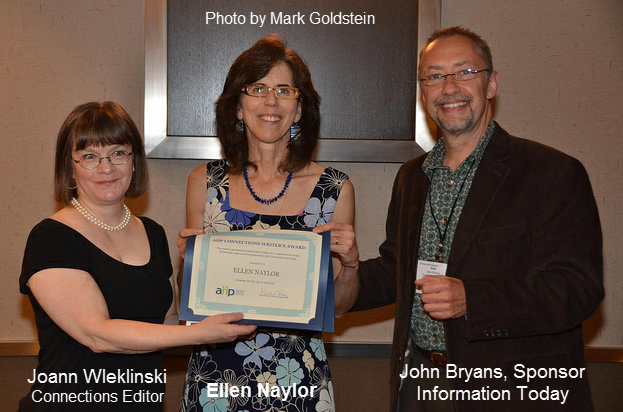
I recently was the recipient of the AIIP’s Connections Writer’s Award, which is presented to “the writer of the best original article published in AIIP Connections each year.” Unfortunately you have to be an AIIP member to access this article. However, in the spirit of cooperative intelligence, I will provide a summary, and encourage you independent entrepreneurs to consider joining AIIP to help you grow your business. This is a group of people who want to help you succeed in your small business, whether you’re just starting out or have been in business for a while. In addition to full members who own their business, AIIP also offers associate membership to those who work in larger companies and student membership.

Critical thinking and intuition are two skills that are often overlooked in this information explosion. We often jump to conclusions with more certainty without testing our conclusions by standing back and questioning our assumptions in a broader context. Likewise, many of us have lost touch with our intuition, which I consider the barometer of veracity. Nothing replaces the gut reaction that tells a researcher that something doesn’t feel right, something is missing, or that she is confident with her findings.

I recall a project where I couldn’t understand why the target company would remain in the glass industry when they were losing more money every year in this business. I learned that the company had invested as little as it could to keep the operation running, that there were occasional accidents, and that many glass products were trashed since the quality was so bad. There were glass trash piles around the factory and it sounded like an awful place to work.

The company was making money in its other divisions, and was publicly held so there was scrutiny by analysts about its operation. My client suggested I listen to a quarterly earnings discussion, which I reluctantly agreed to as I figured I could more quickly read it later. Boy was I wrong. One analyst asked the CEO about the failing glass business. The CEO’s voice turned emotional as he skirted the question in a mournful tone of voice. His Dad had bought the glass business, and the CEO was emotionally attached to it. He would feel like a failure were he to sell this business.

My intuition told me that it would take a major bad event to push this CEO out of the glass business, such as a bad factory accident or a disgruntled stockholder. A couple of years later, a disgruntled stockholder, an investment company with a large share of stock ownership, issued a formal written complaint (Form 13D) with the SEC. Divestiture followed. My client was ready to grab the business.

I have been in business for almost 20 years, and still make mistakes when I don’t listen to or trust my intuition. Listening to your intuition is one of the most precious gifts you have in life. It can save you a lot of time in the research and competitive intelligence processes, and can help you qualify your sales prospects and deal with people authentically.

Personality Profiling: Gauge Your Competitor’s Management Team

Last week I attended AIIP’s annual conference in Indianapolis, IN. I learned so much about running a small business better!

I gave a talk on competitive intelligence, and how information professionals can make a decent living by adding this skill to their research toolkit. Many are good at the collection and organization of findings. However, one area that folks seemed less familiar with was analytic tools, which allow you to communicate findings more persuasively if you use the right tool. In an earlier post, I described the Boston Consulting Group’s (BCG) Matrix model  and how I used this to set the marketing stage for an acquisition some years ago.

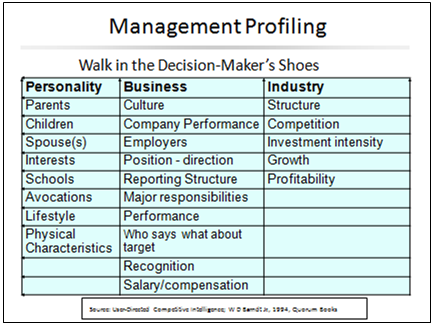
Another great analytic tool is personality profiling. Most often companies study their competitor’s management team or key employees such as the head of R&D. Usually their strengths and weaknesses follow them from job to job. It’s good to understand their predisposition; what mistakes they have made in the past; and what blind spots they might have. You can obtain the intelligence to develop personality profiles easily enough for executives in publicly held companies since you have plenty of sources such as speeches made to various audiences such as industry conferences and the financial community. It can be trickier to find information for executives running privately held companies. I find that local sources are the best, such as local newspapers and magazines, the chamber of commerce, economic development offices and perhaps their schools. In some cases you will get lucky and locate a chatty employee or ex-employee through a social network such as LinkedIn, Twitter, an industry Ning, forum or association.

Don’t just focus on their professional experience as their personal life is just as important, and often highly influences their professional decision-making. Sometimes you get great intelligence through an executive’s favorite charitable cause or hobby. The non-profit that they make donations to probably has some information on this executive, since they will need this information to pitch their cause to him or her.

My favorite grid for organizing what you need to collect and how to organize it comes from Walter Barndt, Professor and author of User Directed Competitive Intelligence. This is one of my favorite competitive intelligence books since Walter gets the reader to empathize with the user of competitive intelligence, rather than simply describing how to conduct competitive intelligence.

For those who want to read some books on analytical tools, I have listed three favorites here. Just recently, another analytical book, Analyst’s Cookbook, Volume 2 was published by Mercyhurst College for the Kindle. I have not read it yet but see that it’s a short book, less than 90 pages and retails for $4.99. Here is the Amazon connection to purchase it.

12 Tips to Guarantee Your Success in Collecting Intelligence from Sales

Recently I gave a webinar for SCIP chapters in Mercyhurst and Ohio on how to capture competitive intelligence from Sales by using cooperative intelligence skills. I love serving Sales Reps since I can easily translate what I provide into an ROI benefit, namely more sales. Ongoing sales intelligence is the best tactical competitive intelligence, and it’s current.

1. First realize how Sales is motivated: they have a short-term outlook, want to look good, are often in competition with each other, and have a high need for recognition.

2.You need to Give to Sales before they will believe in you. And it better be what they need, not what your corporation wants Sales to have. Likewise if you don’t use what Sales provides, they will stop giving.

3. Gaining cooperation from Sales isn’t tough. It’s in their best interest to collect competitive intelligence to do their job, to win more deals. You just need to convince them that you’re a worthy client.

4. Find out what’s hard for them to get that they value. You have access to so much information. What about those industry analyst or financial analyst reports? How about competitor profiles you’ve developed? They’ll tell you what they need.

5. Make it easy for them to locate what you develop for them. It’s best if you can make it part of a software system that they already use like salesforce.com. Remind them where your nuggets of information reside periodically.

6. Think about ways you can help sales depending on where they are in the sales cycle. What do they already produce that you can build off of?

7. Start slow in Sales and find the right people to service. They can be low in the organization as long as they’ll publicize how great what you provided is. While Sales Reps spend a lot of time out of the office, it’s amazing how connected they can be. As you start producing the right deliverables for Sales, their bosses will find out, and you will be recognized.

8. Insert yourself into Sales events like teleconferences, conferences, webinars or blogs to maintain your visibility.

9. Be easy to find and responsive since many in corporations hide from Sales rather than service them.

10. I enjoy developing win loss analysis programs since I can cooperatively include Sales as I get positioned with their customers and prospects to learn how we can improve win rates, customer service, product features, implementation, tech support, customer testimonials, develop better products and so much more.

11. Involve Sales for Trade Show collection since they’re already at shows with their customers, so put them to work collecting competitive information since most have not a shy bone in their body. They know how to ask the right questions, so you don’t need to train them.

12. A final tip: don’t forget to ask Sales how you’re doing so you continue to deliver the right products to your sales force.

Serve Sales well and you will have job security even in a tough economy since they are the company’s revenue producers!

I have posted the Sales Intelligence presentation in Slideshare.

Be a Masterful Thanker

In the holiday spirit, I share this Fast Company article, “Make 2012 Your Best Year Yet.”

My favorite suggestion is to embrace gratitude as a business strategy. Many of us suffer from GDD or Gratitude Deficit Disorder. Who do you know who is a masterful “thanker”?

Despite our good intentions and actions, we receive much more flak than gratitude. We are hungry for genuine appreciation and thanks. We want to know that we matter, and that our efforts make the world a better place.

So as we end 2011 and start a new year, think how you will communicate your appreciation. How can you catch people in the act of goodness or kindness? How can you fill the global hunger for gratitude?

In this spirit of gratitude, here is a poem that a fellow Tweeter shared with me recently. It’s a golden oldie.

Desiderata

Go placidly amid the noise and the haste,

and remember what peace there may be in silence.

As far as possible, without surrender,

be on good terms with all persons.

Speak your truth quietly and clearly;

and listen to others,

even to the dull and the ignorant;

they too have their story.

Avoid loud and aggressive persons;

they are vexatious to the spirit.

If you compare yourself with others,

you may become vain or bitter,

for always there will be greater and lesser persons than yourself.

Enjoy your achievements as well as your plans.

Keep interested in your own career, however humble;

it is a real possession in the changing fortunes of time.

Exercise caution in your business affairs,

for the world is full of trickery.

But let this not blind you to what virtue there is;

many persons strive for high ideals,

and everywhere life is full of heroism.

Be yourself. Especially do not feign affection.

Neither be cynical about love,

for in the face of all aridity and disenchantment,

it is as perennial as the grass.

Take kindly the counsel of the years,

gracefully surrendering the things of youth.

Nurture strength of spirit to shield you in sudden misfortune.

But do not distress yourself with dark imaginings.

Many fears are born of fatigue and loneliness.

Beyond a wholesome discipline,

be gentle with yourself.

You are a child of the universe

no less than the trees and the stars;

you have a right to be here.

And whether or not it is clear to you,

no doubt the universe is unfolding as it should.

Therefore be at peace with God,

whatever you conceive Him to be.

And whatever your labors and aspirations,

in the noisy confusion of life,

keep peace in your soul.

With all its sham, drudgery, and broken dreams,

it is still a beautiful world.

Be cheerful. Strive to be happy.

Written by Max Ehrmann in the 1920s

Happy Holidays however you celebrate: Merry Christmas, Happy Hanukkah, Joyous Kwanzaa and Happy New Year!

Six Things you Can Learn from Conducting Win Loss Interviews

I am always surprised that more companies don’t have a formal win loss program since the ROI is amazing, and what you learn from this process can often be quickly implemented.

To conduct win loss, interview your customers or lost customers shortly after the sales event to find out why they chose to do business with you or decided on a competitor. The data gathered combines sales intelligence and knowledge from customers, competitors, and your marketplace. Those companies that do win loss analysis claim to improve their win rate by 15-30%. That’s a nice return on investment.

Here are some improvements I have helped companies uncover through win loss interviews and analysis.

1. Improve sales professionalism: Benefit-more customers and customer retention.

Beware of the sales person who is fixated with, “How are we doing compared to the competition?” This is a turnoff. In one recent case, this behavior cost the sale. The customer was strongly leaning towards this company’s solution, but the account rep rubbed the decision-maker the wrong way with his pushiness to close the deal. This was a gift to the competition. This behavior is most injurious when your product really isn’t that different from the competitor’s.

2. Improve the quality of your customer testimonials: Benefit-more customers

This one comes up often. Make sure you have picked respectable and responsible people among your customers to represent your product or service. Make sure they really know your product, and can answer just about any question your prospect might have. Provide enough customer testimonials, so prospects have a choice and you are not overburdening your testimonial customers.

3. Improve implementation, training and service: Benefit-customer retention

I hear this one time and time again. Companies often get careless after the sale is made, and don’t hold the customer’s hand enough during implementation and during that period of time when the customer is ramping up and learning how to use your product or service. Make it easy for them. Ideally assign them a dedicated rep, so they don’t have to repeat their story to a new “help desk” rep every time. This continuous repetition is also not efficient for your staff. Get it right sooner and you will have happier customers, less downtime and fewer help desk calls.

4. Focus on Product Features Your Customers Value the Most: Benefit-more customers and customer retention

You will find out about features that your product doesn’t offer that the competition does or does better. This isn’t always a quick fix, but sometimes it is. However, this knowledge can fuel product development. More immediately this information helps Sales focus on your product features that customers value the most, perhaps by vertical market, knowledge that also comes out of win loss interviews.

5. Learn Which Clients Are and Are Not Good Prospects: Benefit-qualify the right customers sooner. More customers

Good sales people tend to focus on solving the customer’s business problems with your company’s solution. They usually are not fixated on the competition, but rather on your company’s solution. Win loss data can help provide fuel for how and why your solution is the best, and where it is not so strong. Knowing which clients are not good prospects for your service gives Sales more time to focus on better prospects, which improves close rates and revenue.

6. Don’t Forget to Research Wins: Benefit-customer retention and incredible intelligence, not just competitive intelligence

Many companies just want to focus on losses. Wow, are they missing the boat. Your customers are usually a better source of intelligence. Generally they will spend more time telling you what you’re doing right; what you’re doing wrong; and provide you with ideas for product development and the competition. They will tell you about implementation, service and how well your product is working for them (or not). Psychologically they want you to be successful. They chose your solution. Their sharing is a reflection on their good business decision using your company’s solution.

Conclusion: This is just a smattering of what you can uncover in win loss interviewing. If you analyze the data, you can quickly uncover trends in your business, and more importantly take corrective action.

What have you uncovered in win loss interviews to help your company or your client?

Connecting with Business Colleagues in Thanksgiving

Thanksgiving is a time for sharing, caring and expressing gratitude. I am grateful to have so many wonderful friends in business. In the spirit of cooperative intelligence and sharing, I recently was a panelist in a SLA Competitive Intelligence division (CID) webinar on “Integrating Marketing and Sales to Capture & Deliver Intelligence.”  While this is an SLA CID member benefit, all four of us panelists posted our slides on Slideshare.

I will list us in the order we presented so you have the benefit of a good flow:

Susan Berkman: Producing Intelligence for Sales & Marketing

Marcy PhelpsCompetitive Intelligence for Marketing Professionals

Ellen NaylorCollaborating with Sales

Anna Shallenberger: Research & Analyzing Competitors

Sponsored by Aurora WDC aka Arik & Derek Johnson

Likewise we just concluded a series of Colorado Future Ready blogs on SLA’s FR365 site which features a blog a day. This was initiated by Cindy Romaine, current SLA President as of Jan. 1, 2011. Here is the list and links to each of our Colorado blogs:

Who is SLA? by Connie Clem

Introducing eBooks into the Denver Public Schools by Charles Leckenby

The Value of Information Professionals by Laura Cullerton

How Cooperative Intelligence will make you Future Ready by Ellen Naylor

Economic Gardening by Recca Larson

Collaborative Librarianship by Joseph Kraus

Take a Risk: Reap the Rewards by Shelly Walchak

In closing, here is a poem about Thanksgiving that one of my Facebook buddies shared today. Whether you celebrate Thanksgiving tomorrow or not, I think it presents a good way to view life!

Thanksgiving…. More Than A Day

As Thanksgiving Day rolls around,

It brings up some facts, quite profound.

We may think that we’re poor,

Feel like bums, insecure,

But in truth, our riches astound.

We have friends and family we love;

We have guidance from heaven above.

We have so much more

Than they sell in a store,

We’re wealthy, when push comes to shove.

So add up your blessings, I say;

Make Thanksgiving last more than a day.

Enjoy what you’ve got;

Realize it’s a lot,

And you’ll make all your cares go away.

By Karl Fuchs

Reviewing “Win/Loss Reviews”

This is the first book I have read on win loss analysis where Sales is the primary executor of this process. After all, Sales is the best source for sales intelligence as no one is more directly connected with your company’s customers. This is also the first book I have read where a company is using technology to collect customer intelligence from Sales which includes wins and losses.

Win/Loss Reviews is real-time intelligence collection from selected sales events. It provides Microsoft sales, marketing and product mangers with early warning intelligence like no other win loss process out there. While there is incredible value from deeper interviews of your customers by a neutral third party, there is delay both in execution and the time to assemble good analysis, and get it to the right people.

Author, Rick Marcet describes how he established a scalable win loss process using technology that hangs off Microsoft’s sales force management system. This makes it easy for Sales to input their data, no more than 15 minutes per case. He refers to Sales’ input as micro intelligence.

I particularly appreciate the psychological aspects Mr. Marcet weaves throughout this book to engage Sales cooperatively as so many in marketing and competitive intelligence fail to motivate Sales to share!

  • Sales is the primary beneficiary of these win loss reviews and the cumulative database, and they know it. After all they helped design the system.
  • Sales highly values peer-to-peer interaction, which this database of sales and customer intelligence facilitates.
  • Conducting win loss reviews is part of the sales process and is considered an “advanced” sales skill.
  • Rick also created an APP so Sales can tap into this intelligence on the fly from their Smartphones. Wow, talk about powerful and “for Sales.”
  • Win loss input is essential to be considered for various rewards and recognition at Microsoft.

However, Sales is not the only beneficiary of this real-time intelligence and cumulative win loss database at Microsoft. Product management, product development, executives, and marketing can all tap into the collective “crowd wisdom” from this database, to help them make better decisions with timely information.

Just in case you are skeptical about Sales’ bias in reporting (We win because we’re great. We lose due to price.), Mr. Marcet has factored these biases within his database algorithms.

Kudos to Rick Marcet for developing this process to capture valuable customer and competitive intelligence directly from Sales! This book is a must read for anyone in sales management, marketing especially customer insight, and competitive intelligence.

Win/Loss Analysis book gives you a process to learn why you’re losing business and how to keep more of it!

Receive our 6-page Win/Loss Cheat Sheets

Connect on LinkedIn  Connect on Twitter

Remembering the Wisdom of Steve Jobs

We have lost a great man in Steve Jobs. I have been reading the many stories and obituaries that people have shared across the Internet. @Monica Jarski shared her story and took us back to the inspirational speech that Steve so humbly gave for those lucky Stanford graduates in 2005, the year after he was diagnosed with pancreatic cancer. While he shared how he started Pixar as a result of being let go from Apple at age 30 as its co-founder, and how this led him to meeting his wonderful wife, Laurene, what really got me were the words that followed.

“Stay Hungry: Stay Foolish” which appeared in the last issue of “Whole Earth Catalog” in the mid-1970s. Keep looking and don’t settle until you have found what you are passionate about.

“If you live every day like it was the last day, some day you’ll most certainly be right. ”

Remembering you will die wipes away all the fear of embarrassment and failure and all those trivial things that keep us from being who we can be.

“Even people who want to go to heaven don’t want to die to get there. And yet death is the single best invention.” It clears life to make space for the new. Remember your time is limited. Don’t be trapped by other’s lives and dogma.

Life is a great change agent. Your time is limited. Don’t waste it by living another’s life.

“Follow your life’s instinct and intuition. They already know what you truly want to become. Everything else is secondary.”

You’ve got to find what you love both in romance and work, and do what you believe is great work. Like any relationship, your relationship with work gets better and better over the years.

Here is the Link to Steve’s 2005 commencement address. 

And as a good competitive intelligence professional, although he was not espousing this at the time, he said that you can’t connect the dots in the future, but only in the past. You have to have the confidence that somehow they will connect. This is the story of life.

Steve was a wise man who followed his heart, his passion, his instinct and was playful in his inventiveness. The world is a better place thanks to him. May he rest in peace, and bless his wife Laurene and all his family and friends who will miss him terribly.

18 Tips to Improve Your Telephone Collection Skills

In her recent newsletter, Kendra Lee, CEO of KLA Group lists the worst prospecting voicemail mistakes sales people make. As I reviewed the list, I thought much of it applies to making calls regardless of your profession.

Whether it’s for research, cold calling to collect information, competitive intelligence or win loss analysis, when you instigate a telephone call you are in the sales mode. You want information. In the spirit of cooperative intelligence I have modified these tippers for research and competitive intelligence professionals!

  1. Not having planned what you will talk about in advance. I always prepare a list of questions, but love to start the interview with open ended questions. And often enough this open ended approach renders answers to specific questions, which I won’t have to ask, and we can get to better intelligence gathering sooner.
  2. Forgetting to mention a common colleague or someone who has referred you. Why cold call when you don’t have to!?
  3. Not thinking through the possible responses they might have, thereby missing the chance to probe more deeply.  I like to think about the likely responses, and what additional questions I will ask. This helps me think of entirely new questions that I didn’t think about before the call, based on what the person shares, right on the spot.
  4. Talking about yourself instead of what matters to the other person. People usually like to talk about themselves. It also loosens them up before you talk about the issues you are collecting on. Look them up on social networks like LinkedIn, Twitter or Pipl to gain appreciation of who they are.
  5. Sounding too canned to catch the other person’s attention. Customize each call as much as you can and watch people be responsive unless you have caught them at a busy time.
  6. Speaking so quickly that you can’t be heard. Or worse, mumbling. You want to exude confidence and come across as positive. People like to talk those who are upbeat.
  7. Calling when you’re tired, depressed or not alert. You want to be on top of your game to maximize in collection. If you’re too tired, it’s hard to think of questions and comments to probe more deeply that are outside of your script. You will sound flat and your voice mail will be drippy too.
  8. Not asking if this is a good time for a quick call. You want to let people know that you respect their time!
  9. Not verifying that you have the right contact before leaving multiple messages.
  10. Speaking for more than 30 seconds without letting the other person say anything.
  11. Not showing that you have researched the other person’s situation in your voicemail message.
  12. Leaving a message that’s too short and doesn’t give the other person a compelling enough reason to call you back.
  13. Leaving a message and then passively waiting for a call back, instead of continuing to try to reach the person. (unless of course you find a better source)
  14. Not leaving your name and contact information at the end of the message. Better yet, leave it at the beginning when the prospect is poised to take notes.
  15. Leaving a voicemail with lots of verbal pauses (“ums” or “ahs”) that make you sound less confident, and less credible.
  16. Using a tone of voice that suggests you don’t expect a call back.
  17. Failing to stick to one topic per voicemail message.
  18. Not following up via other means like email.

What tips can you add?

Win/Loss Analysis book gives you a process to learn why you’re losing business and how to keep more of it!

Receive our 6-page Win/Loss Cheat Sheets

Connect on LinkedIn  Connect on Twitter