Templates for Win Loss Analysis

loss win photoI am now writing my win loss analysis book in earnest, over 2500 words, and adding at least 500 per day although I take Sundays off.

The question I get asked the most often is: “Can you share your win loss templates?”

This is a hard question to answer. While there is some commonality among the questions you want to ask your customers and prospects based on your industry and the things sales, marketing and product developers want to know; you need to use your creative juices. You also want to ask the right questions to answer your goals for conducting win loss interviews and analysis. For example, you might want to learn how your product or service is used, since it might be different from your company’s intention. Product developers will eat this up. Sales people will too if it means they can sell more.

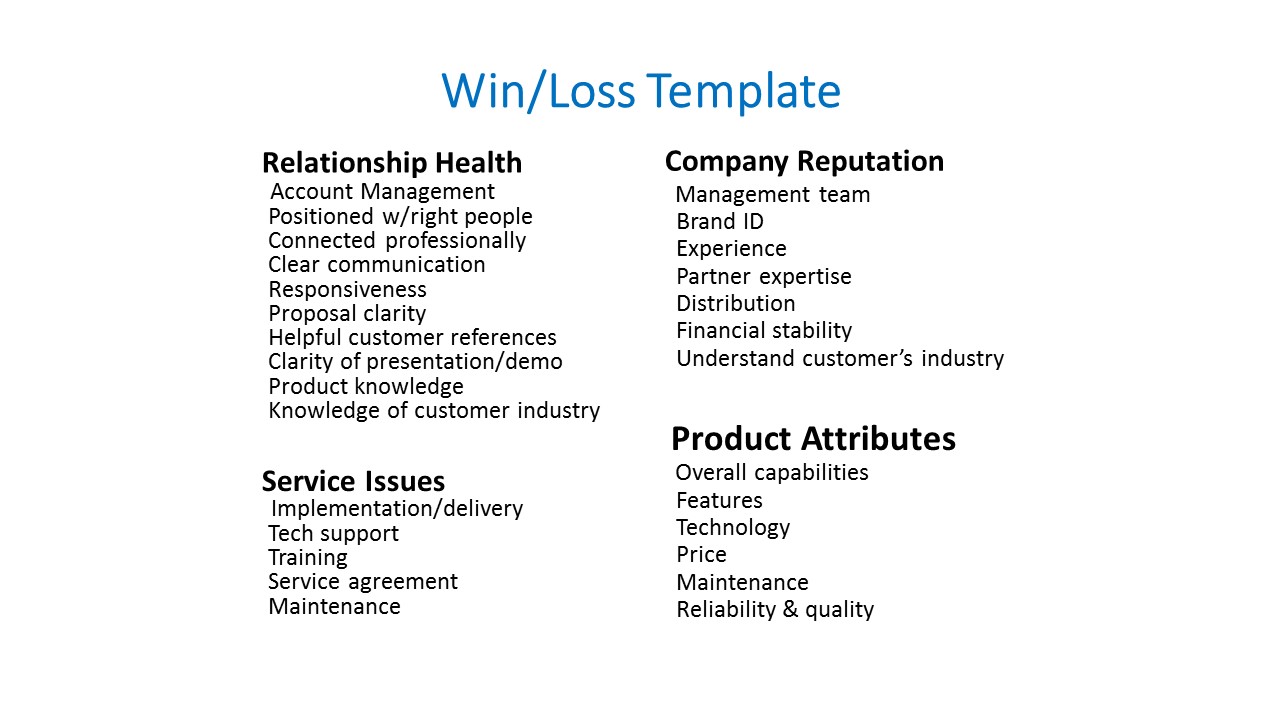
Creativity aside, below is my template to stimulate your line of questioning for win loss interviews.

I break down questions into 4 buckets:

  • Relationship health
  • Company reputation
  • Product/Service attributes
  • Servicing issues

Win Loss Template

I hope this helps you create your win loss interview questions. Stay tuned for more tips on how to set up and execute a win loss program to help retain and grow your business.

In the meantime, feel free to checkout my Slideshare on “The Why, What and How of Win Loss Analysis.”

Win/Loss Analysis book gives you a process to learn why you’re losing business and how to keep more of it!

Receive our 6-page Win/Loss Cheat Sheets

Connect on LinkedIn  Connect on Twitter

20 Reasons to Do Win Loss Analysis

loss win photoI have some exciting news to share. I am writing a book on how to develop a win/loss program, even if you only do it for one quarter. I had thought that you would only gain benefit if you conducted these interviews quarterly, but I found out that you can learn so much, even from 20-25 interviews.

I hope to share this skill so small and mid-size companies can take advantage of what they can learn from more in-depth interviews with customers and prospects a couple of months after the sales event. I have been doing win loss interviews and analysis since the late 1980s and I keep coming back to it, since my customers learn more from these interviews than any other tactical analytic technique, as long as they take corrective action from the findings.

Why do you care about doing win/loss interviews?

  1. You learn things that your customers and prospects don’t want to tell Sales
  2. You learn things that your customers and prospects do tell Sales, but Sales doesn’t tell you
  3. You learn why customers really chose your solution
  4. You learn why prospects chose another solution provider
  5. You learn why undecided customers aren’t upgrading their solution
  6. You learn what your company is doing well
  7. You learn where your company can make improvements
  8. You learn what the competition does well
  9. You learn where they can make improvements
  10. You learn that the competition doesn’t always deliver on what they promise
  11. You learn that your company doesn’t always deliver on what your sales force promises
  12. You learn about good customer testimonials
  13. You learn about bad customer testimonials
  14. You learn how customer testimonials affect the sale
  15. You learn about shortcomings in the marketplace
  16. You learn about new technology being promised
  17. You learn how customers and non-customers perceive your selling process from start to finish
  18. From your wins, you learn how well implementation, training and customer service is perceived
  19. From your losses, you learn how well the competition’s implementation, training and customer service is perceived
  20. You learn about other marketing factors that affect customer perception: your trade show booth, industry write-ups, your advertising, etc.

Given all these benefits, I don’t understand why more companies don’t conduct win loss interviews and the resulting analysis. It’s the most cost effective form of research I know of, and talk about real-time intelligence. You gain so much more insight from a conversation than from conducting on-line surveys. I wish companies did fewer on-line surveys, since most of them seem meaningless. How can I assess good customer service from a grocery store cashier or retail cashier, who just rings up my sale?

You can gain great intelligence from talking to your customers, and win loss interviews are another marketing touch point if they are properly positioned as learning how you can improve your relationship with customers and prospects.

Be notified when our book, Win/Loss Analysis: How to Capture and Keep the Business You Want is published.

Connect on LinkedIn  Connect on Twitter

Honoring Maya Angelou

The world has lost one of our greatest women this week, Maya Angelou. Her words have inspired so many people ranging from world leaders to the mainstream population of men and women around the world.

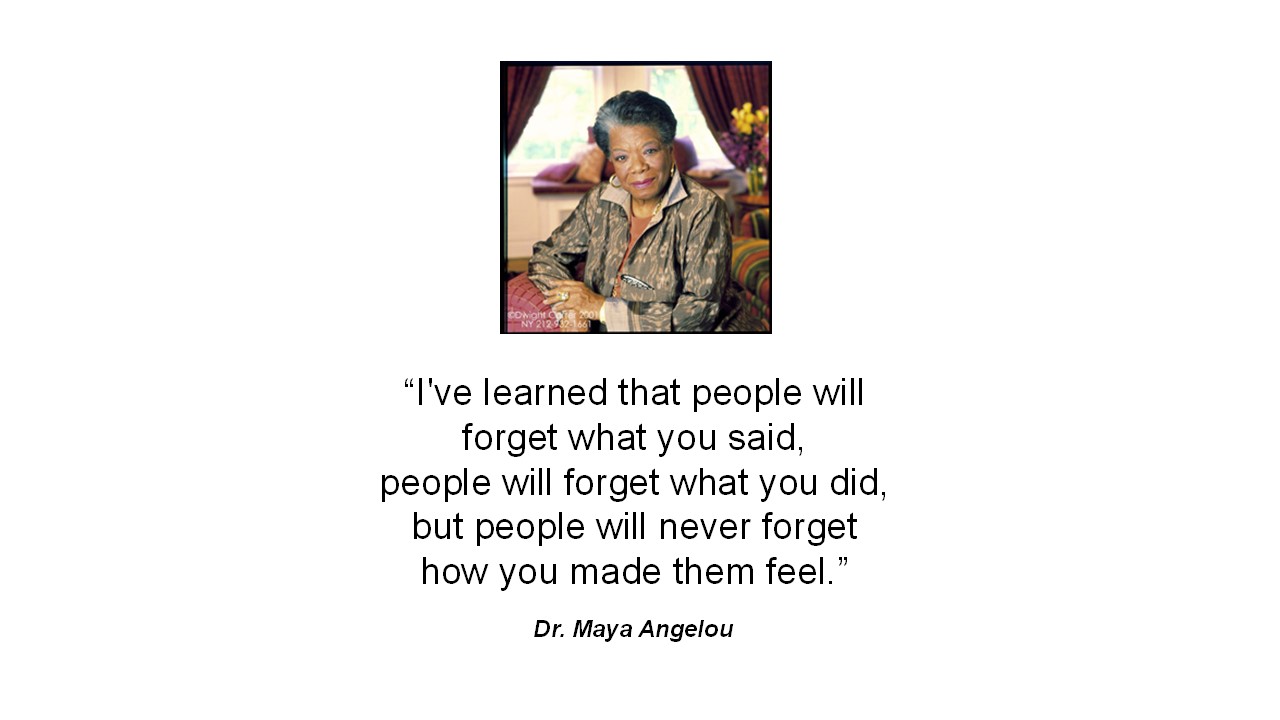
Years ago, I read about her life, and how she chose to be silent for a number of years during her difficult youth. I am so grateful she endured that time, and chose to share her many reflections about life over the years. She has impacted my life with her statements, particularly this one.

Maya Angelou

So many of us, myself included, spend too much time thinking about saying the right words when we hold a conversation. Maya made me realize that it’s my intention and the tone that I share that influence the conversation much more than the exact words.

I intend to make the person I talk to feel better at the conclusion of our conversation than when we started, even when I cold call.

I reinforce this intention with a short meditation or reflection before a conversation. This helps me think about the other person.

Another habit that reinforces this intention, physically is to put a smile on your face, whether on the phone or in person. Sometimes I have to force it at first, and then it just stays.

“Don’t take yourself too seriously.” What’s the worst thing that will happen in a conversation? Nothing life threatening that’s for sure.

Be enthusiastic: it’s infectious and you bring good energy to the other person, which is a gift.

Show appreciation for their time and what they’re sharing; and not just at the end of your conversation.

Be polite. This is a rare commodity in this digital world.

Listen closely and without judgment. Wow, it’s amazing what great questions you will ask; how much you’ll learn; and how good you’ll make them feel.

I share this Maya Angelou wise saying in almost every competitive intelligence, elicitation training, interviewing or conversational presentation or training session I give.

Thank you Dr. Maya Angelou.

Connect on LinkedIn  Connect on Twitter


Is Mindset Block a Lack of Listening?

I read two great blogs in the last couple of weeks: David Harkelroad’s which asserted that the biggest problem in strategy is mindset; and an HBR blog on “What Gets in the Way of Listening?” I think they are related since if you truly listen, you are open to having your mind changed.

There are many reasons people don’t listen well. We aren’t trained on listening from childhood with the competition that seems to thrive in the classroom for the best answer, to be the best, often at the expense of the other students. Sometimes we don’t listen since we’re scared. We are trying to appear confident and assertive and miss others’ perspectives in the process.

I like the flexible mindset shared in the HBR blog, “I do have a viewpoint going in, but I don’t assume or try to show I’m the smartest person in the room. I’m willing to hear them (colleagues) out for the sake of getting the best answer, not just my answer.” Listening is a sign of incredible self-confidence. Back to David’s point about mindset. I think many leaders don’t fully listen since they aren’t confident, but they want to appear confident. In the example cited of Blockbuster’s Wayne Huizenga having the intelligence to get into digital media, there is something that stops many executives from taking corrective action. Maybe the extremely generous pay that executives receive clouds their judgment and reinforces them not to change their mindset.

“Leaders who take organizational conversation seriously, know when to stop talking and start listening.” (“Leadership is a Conversation” by Boris Groysberg and Michael Slind). When you put aside your fear and anticipation, you are more open to listening. You are fully present and ready to respond to whatever gets thrown your way. You’re not thinking about what you might say next. You realize that a critical part of your job is to fully listen. Good interviewers and journalists have known this for years.

Interestingly enough, when you focus on yourself, you can pick out your listening weaknesses.

  • Do you listen to your inner critic rather than your audience when giving a presentation or sharing findings in a meeting?
  • Do you only see your role as an information professional? (fill in your job title)
  • Does your listening shut down when you are emotionally uncomfortable?
  • Are you trying so hard to show confidence and be right that you aren’t listening?

So what can we do as marketing, strategic or competitive intelligence professionals to change our leadership’s mindset as we provide them information and insight to assist in decision-making, which perhaps doesn’t support where they were headed? I have found that many of them possess a major ego. If I can provide them with the intelligence to feed their ego in a way that makes them think it’s their idea, I don’t have to change their mindset, which I think is a lot harder. But they do change their course of  action when it becomes “their idea.”

I am curious as to how others deal with their leadership’s lack of listening ears? I know as a telephone interviewer that there are not enough listening ears and that job disengagement in the US is around 70%, so if they answer their phone, they are likely to be informative.

Win/Loss Analysis book gives you a process to learn why you’re losing business and how to keep more of it!

Receive our 6-page Win/Loss Cheat Sheets

Connect on LinkedIn  Connect on Twitter

From Competitive Intelligence to Sales Enablement: Free Webinar

Join us for a free 45 minute webinar on April 22 at Noon Eastern US time (11 am Central, 10 am Mountain, 9 am Pacific).

Getting from collecting competitive intelligence to winning more deals from collected competitive intelligence can be tricky if you don’t have a good road map.

  • Companies collect competitive data, but don’t know what to do with it
  • Sales teams waste time finding the data they need to win competitive deals
  • Product selling is not an effective way to convince customers to buy

Join our informative webinar and learn how to turn your competitive intelligence into sales intelligence to improve your sales force’s close ratios and customer retention.

ellenmitchdean

Ellen Naylor of The Business Intelligence Source will share her knowledge on how to collect from your sales force, which helps them win more deals and retain more business. Mitch Emerson of Compelligence will show how you can transform that data into competitive intelligence that your sales reps can tap into for each deal. Dean Davison of Forrester Research will show you how to convert your marketing buzz words into conversation that customers resonate with, so they listen, ask questions, engage and buy.

Compelligence offers the first software solution which targets Sales to input and share competitive intelligence that works seamlessly with Salesforce.com. This is awesome since many sales reps use Salesforce.com already, so are more likely to use a system that builds off of what they know.

For more information on the webinar, check out: http://www.compelligence.com/2014/04/01/webinar-from-competitive-intelligence-to-intelligent-sales-enablement/

To register directly, go here.

Motivation: Treat Them the Way They Want to Be Treated

I have been conducting primary research collection interviews for over 25 years. I am most fascinated by what motivates people to share, and how to figure this out quickly, especially during a telephone conversation where you don’t have the benefit of body language. Contrary to what I have been taught: “Do not treat others like you want to be treated.” Treat them the way THEY want to be treated. Give or ask for information in a way that they are comfortable hearing the message.

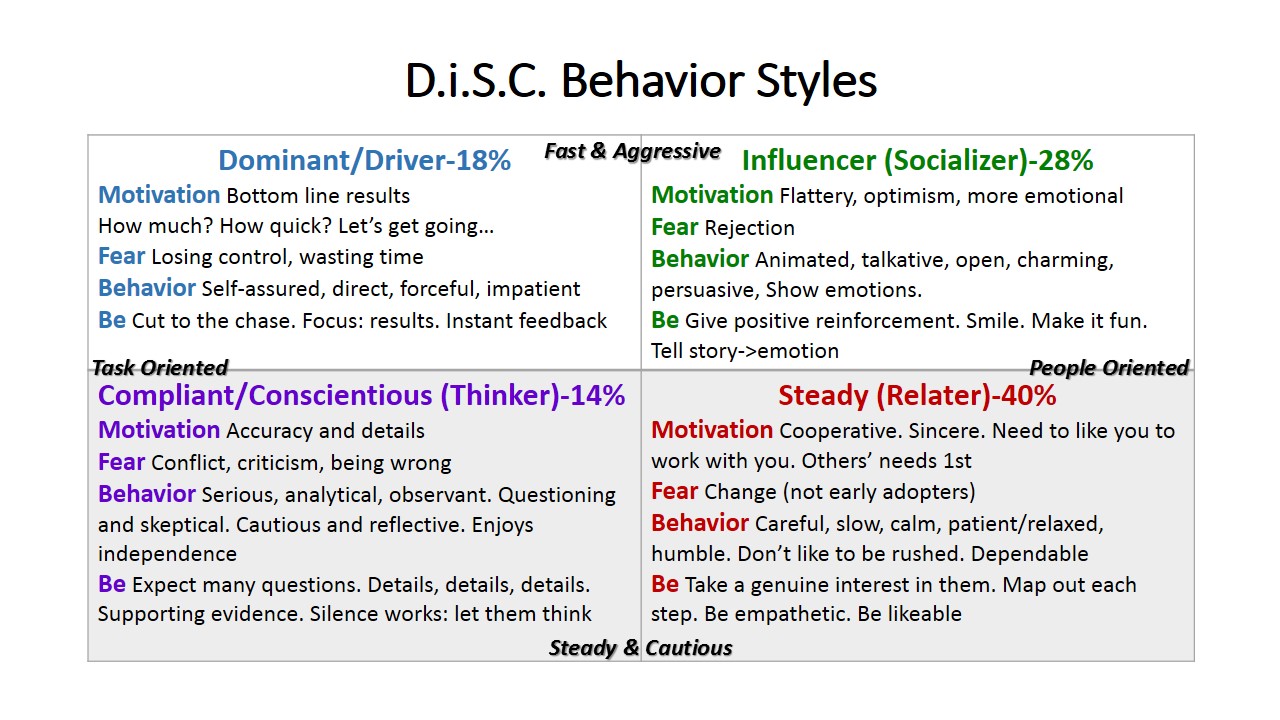
For years, I relied mostly on the Myers Briggs personality types to gauge how people were motivated. However, I think that DiSC Behavioral Styles as developed by Dr. William Marston, are a better indicator of how you should best communicate with people in conversation. There are 4 personality types: Dominant (driver), Influencer (socializer), Steady (relater) Compliant (thinker). The focus of DISC is to understand the behavior, fear and motivation people exhibit in communication.

DISC Styles

In intelligence, we think about Johari’s Window as a model for knowledge acquisition as we gather data by talking to individuals. We consider what we do and don’t know as we seek to fill the gaps of our knowledge: what we know with certainty; what knowledge we have that needs to be verified; what we don’t know that will be hard to find; and what is simply the vast unknown.

I have applied this model to classifying those we talk to in the collection process. It’s helpful to be aware of their pre-disposition towards sharing versus what they know.

1. Egocentric: They are “know it alls,” who really don’t know that much, but have this need to let us know they are an expert and are always right. These are dangerous sources, and often want to linger on the telephone conversation. I guess they aren’t listened to enough or respected by their co-workers.

2. Deeply Knowledgeable: They are experts with deep knowledge about our research topic. They don’t have the need to be “right” like Egocentrics. They just know and pull information from their brain. They recognize the value of what they know, so might be reluctant to share when you probe deeply, especially if they feel you are querying about proprietary, sensitive information. People in the legal field and finance are often this way.

3. Intellectual: They are knowledgeable, but unlike the Deeply Knowledgeable, they don’t recognize the value of what they know and will share freely. They may suffer from low self esteem, which motivates sharing or they may not realize the value of they know, since this is what they do and they assume everyone knows what they know. Technical and scientific people often fall into this category, as they are highly focused in what they know and love to talk about it. They often have passion for what they do, and are happy to talk with anyone who will listen. They are often proud of their knowledge and might seek recognition from you during the conversation. But beware, you better know something about their expertise and their professional vocabulary or they will not open up much. Although not thought of as Intellectual, people in sales and marketing tend to be chatty, and often know a lot about products, how they’re marketed and sold, and about future products.

4. Helper: Many in America want to help, even if they don’t know. Helpers will try to answer your questions, but their knowledge is shallow, and what they share is incomplete and inaccurate. When you probe more deeply, you find this out. I tend to have shorter conversations with Helpers, but I do leave them feeling good about themselves. If I sense they are open, I will ask if they can refer me to a more knowledgeable source, especially when they admit, “I really don’t know,” when I probe more deeply. They sometimes give great referrals since they feel guilty that they couldn’t have helped more. They can be anywhere in the company.

Armed with elicitation skills–and an awareness of the person’s DiSC behavior and their pre-disposition towards sharing versus what they know– is very empowering for you whether interviewing people at trade shows, through cold calls or win loss interviews.

Competitive Intelligence Software Integrated into Salesforce.com

Compelligence recently introcompelligenceuced the Compelligence App which is competitive and market intelligence software that integrates seamlessly within Salesforce.com. It builds off the strengths of Salesforce.com in that it helps sales close more deals since it extends the reach of Salesforce.com to include data from the competitive marketplace.  Armed with this information at their fingertips, account reps have even more time to sell. Typically, sales people and others populate the fields at various points in the sales cycle, most notably at the conclusion of the sale in conjunction with reporting results in the Salesforce.com world. This information is shared with the sales force, but can also arm marketing and competitive intelligence personnel with current information about customers, competitors, suppliers and partners as well as market trends. The Compelligence solution enables sales teams to win competitive deals faster by providing them with on-demand, customized sales strategies that are tailored to each deal.

The Compelligence App is the only app on the market that can provide sales people with customized competitive sales strategies directly within Salesforce.com.  By simply specifying the products or services that a customer is considering, the sales person is given guidance that includes:

  • Detailed competitive product or service comparisons
  • Highlighted strengths and weaknesses
  • Competitive sales positioning guidance
  • Access to relevant content and news

When I interviewed Mitch Emerson, Compelligence President and Co-Founder, he said, “We really believe our strongest unique capability is Dynamic Comparison, where we can determine relative strengths/weaknesses between sets of specified products or between products and the rest of the industry in general.  We are building this into a feature that will allow the system to create customized silver bullet lists for each sale.” Anyone who has sold or supported sales knows that silver bullets are what sales people crave, and they do help them close deals.

Mitch Emerson

Mitch Emerson

When I first read about this Compelligence App I thought, “Finally, a nice place to park the results of win loss interviews and the analysis in a place where sales, marketing and product developers can access it right in salesforce.com, a software they already know and use.” My customers have been screaming for this capability. Compelligence captures so much more, such as data from suppliers, partners and how the various players are positioning themselves in the competitive marketplace. Not only will Sales win more deals and improve retention rates with existing customers: product developers, marketing and competitive intelligence people will be armed with a real-time flow of data from customers and sales people that previously was not shared dynamically at best, and in many cases not shared at all.

The Compelligence solution is being used at Hill-Rom, a leading worldwide manufacturer and provider of medical technologies and related services for the health care industry. Another customer is electronics manufacturer, Jabil. The product is in beta trial at a major financial services company as well.

Compelligence’s CI software is available as through the Salesforce1 App exchange. You can walk through the demo and take it for a test drive.

Put your request here for a more detailed walk through with the Compelligence team. Mitch Emerson or one of his staff will provide the demo and answer your questions right on the spot.

Benefit from Analog Communication aka Conversation

When you rely solely on the Internet and social media as sources of intelligence, you just have your interpretation of what you think is going on. You perpetuate your blind spots, which we all have. That’s why I like to engage in conversation with others when I seek information for important things in my life, such as where I will attend school. I have almost completed my health study at the Institute for integrative Nutrition (IIN) to become a certified health coach. I am so pleased with how much I have learned in just a year’s time. IIN is the largest nutrition school in the world and I found them on the Internet.

health coaching IINBeing a long time researcher, I was skeptical that I could learn enough in one year to be an effective health coach. I found other programs on the Internet including a couple in Colorado not too far from home that were 2 years programs. I spoke to people at one of the programs, and since the other didn’t respond to my call, they were disqualified. I interviewed people at out of state health programs. When I spoke to people at IIN, they answered my questions thoroughly and were professional. A former student is assigned to you when you telephone IIN. She ended our call by telling me that I would have a transformational year if I attended IIN as that was her experience. “Yah right,” I thought. I did, but that’s a conversation for another time.

The point is while I found the program on the Internet, this was an important decision for me, so I reached out to several people before I settled on IIN. At my age, I also favored a one year program, since I was anxious to get my new coaching business launched, Naylor Wellness, which will focus on corporate wellness programs.

It’s a relief to me that leadership in America is stressing the importance of conversation. Perhaps there is some correction from the imbalance and overreliance of digital connections to provide us with the answers we seek in our personal and business lives.

Here is what a couple of leaders have shared about conversation versus email communication:
According to Diego Rodriguez, Partner at IDEO, “Here’s the truth: when it comes to making stuff happen, email can’t hold a candle to talking. The root issue is that email makes it difficult to recognize critical communication signals such as humor, fear, anger, defensiveness, kindness, curiosity… Empathy gets stymied. The generative give-and-take of an in-person conversation devolves into a disjointed, inefficient volley of keyboard strokes.

There’s a productivity hack that riffs on that age-old military saying, “never stand when you can sit”:

* Never email when you can call
* Never call when you can video chat
* Never video chat when you can face-to-face

Whenever possible, talk. Listen. Talk some more. Digest. And then talk again.

Yes, plain old talking is the ultimate productivity hack in situations involving anything beyond your quotidian routine. Why? Because crafting solutions to new problems demands the highest fidelity communications possible. Success comes from grappling with the most important issues via the energetic collaboration of warm-blooded human beings, each a wonderful mélange of hopes, fear, talents, and foibles.” (Excerpt from LinkedIn’s Productivity Hacks: More Talk Less Type.)

Another LinkedIn influencer, Ilya Pozin, Founder of OpenMe and Ciplex recommends that people skip social media and pick up the phone as a way to improve productivity and reduce distractions. “Let’s be honest, sometimes the quickest route to information is to actually just pick up the phone. The typical employee sends about 43 emails per day and receives a whopping 130 messages. Instead of wading through a never-ending deluge of emails, picking up the phone can be a much faster and more personal way of getting the information you need. Not only will you be building connections with your coworkers, you’ll be cutting down on your distraction-filled inbox.” (Excerpt from LinkedIn Productivity Hacks: 6 Ways to Fight Distractions).

I have certainly found the conversation to be a useful conduit to great information in my competitive intelligence practice, and wonder what others think.

How often?

Look at your intelligence on your competitors, your competitive environment, your customers, your suppliers, that is, on your entire corporate environment. How current is that intelligence? Using the above analogy, after some period of time, say 90-180 days, your data, and therefore the conclusions which you have based on that data, and the actions you have planned to take based on those analyses, are at least “cold”.

See the full post: http://diy-ci.com/2013/12/12/how-often/

Ellen Naylor‘s insight:

Add to the fact that so many just monitor Internet sources for competitive intelligence, and you can understand why companies make some uninformed decisions. Even some of the data which is news, is old news with the reporting party’s bias. You need to include conversation with people in your mix to really stay current.

Why I like Company Transparency in Win Loss Interviews

Transparency

Transparency

Why is it that companies don’t want to disclose who they are in win loss interviews? Is it fear? Transparency versus blind win loss interviews is a question that plagues many in marketing.

Many feel if they don’t identify who they are, they’ll get a more objective interview. They are also afraid if they let the customer know who they are—especially when they lost the business—the customer won’t take the interview or if they do, they won’t tell much. A third common reason is they don’t want their sales force to know that they’re conducting these interviews since some of the questions assess the effectiveness and quality of the sales force.

Do these reasons make sense? Let’s explore each separately:

Get a more objective interview: I don’t find that interviews are any more objective when the company’s identity is blind. People are opinionated period. When you conduct blind interviews, where the client doesn’t know the identity of the company behind the call, they usually can guess. So often, it’s the market leader who is going to take the time and has the resources to research deeper. Often enough there are only 2 or 3 companies competing for the business. Customers are not stupid. While they may not let on that they know who is behind the call, they usually figure it out sooner or later.

Sometimes those I interview try so hard to get me to tell them who hired me to telephone them. When they think they know, then they’ll start sharing more. It’s an ego thing: they want to know who is asking. I think it’s also decency: they deserve to know.

Rather than feeling threated by identity disclosure, smart companies realize that a win loss interview is another marketing touch point, even if it’s conducted by a third party. It’s an opportunity for connection with customers and prospects to let them know you value their business enough to ask and listen to what went right and what went wrong, and then take corrective action.

If the customer knows the company which is behind the call, they won’t agree to an interview: I have found that just the opposite is true, even when Sales botched up the deal or it was won by a caustic competitor. Even if another service provider won the business, people will agree to an interview, unless they don’t have time. Time is the biggest enemy to getting the interview, not company identity!

Don’t want Sales to know we’re checking up on their customer relationships: This is one I just don’t get in a society where we are surveyed to death. Even after a cashier rings up a sale in a retail store, they ask us to fill out a survey on the Internet on his or her performance. It’s ridiculous: how can we assess the performance of this person when we barely had a touch point!

However, responsible companies that have a direct or indirect Salesforce and want to keep winning deals for the right reasons, should want to know how effectively and professionally Sales is representing their company and its products and services. There is a relationship here to protect, and you want to keep it ongoing. Too bad if Sales doesn’t like the win loss process.

You come out ahead if you are straight with Sales and let them know you follow up on some sales events. In fact, I like to involve Sales in creating the questions to ask customers. I get better questions and they feel less threatened since they are part of the planning process. Likewise if you share customer communication with Sales, they have an opportunity to learn what they are doing well and their shortcomings. They can feel good about what they do well, and can make improvements where they are weak.

I still like how Rick Marcet, author of Win/Loss Reviews: A New Knowledge Model for Competitive Intelligence, considers the win loss analysis process to be an advanced sales skill. Responsible sales people want to know how they’re doing. They want to improve and close more deals. In fact, best in class companies let their customers know that as part of the sales process, they may be contacted post sale for a win or loss interview as part of doing business.