Elicitation with Enthusiasm

I have been pondering the use of elicitation skills in competitive intelligence collection.  I have been using these techniques for many years, but not quite in the military intelligence way, which seems like using the other person in a more negative way. The techniques take advantage of human tendencies to complain, gossip, correct and inform, which certainly works. However, I like to capture the human desire to be happy.

OLYMPUS DIGITAL CAMERAWhile my research assignment is to get information that clients can use to make the decision at hand, I have a relationship goal as well. By the end of the telephone call, my goal is to make the other person feel good about themselves. This was inspired by Maya Angelou, “I’ve learned that people will forget what you said, but people will never forget how you made them feel.”

A great way to make people feel good about themselves is for you to have an attitude of optimism, joy, and enthusiasm while you converse with the other person. Enthusiasm is infectious, and people like to share with you because you are making them feel happy. There are three ways I get myself in this zone:

1. Overall, I don’t take myself too seriously, so laughter comes easily in conversation. Work is a serious, less fun environment for many that I talk to. A little levity is often appreciated, but only if you sense that the other person is open to it. In my experience, most Americans are.

2. I put a smile on my face just as I am dialing to remind myself that happy is a good way to be. There is something about putting a smile on my face that puts me in a happy place. When I first make that connection with the person I am interviewing, they can feel my smile.

3. Before I dial, I get myself grounded and focused, by taking deep breathes. I want to forget about me, and to just concentrate on the person who I will be connecting with, even if this is a cold call. I want to get myself on their channel, sort of like sitting in their chair in my own mind. This also helps me be prepared for however the interview might go, since they seldom quite go as planned.

Being grounded is the one technique that has improved my success in collection more than any other. I can spend all the time in the world getting my value proposition written out and etched in my brain. But if I am not confident and grounded, the person at the other end can sense it right away, and won’t feel like connecting or sharing with me. When I am grounded and confident they will share, since I am in their zone, and the words just flow.

These practices also have another benefit: they help me get to the other person more readily, since I am more absorbed in how they are, and readily forget about myself while in conversation. My challenge is to remember to cover all the material that the client has hired me to collect, since I will often get lost in conversation as I let the other person control the flow of sharing, according to how they are comfortable.

Learn more about elicitation techniques here. Learn how you can become an elicitation expert.

Win/Loss Analysis book gives you a process to learn why you’re losing business and how to keep more of it!

Receive our 6-page Win/Loss Cheat Sheets

Connect on LinkedIn  Connect on Twitter

The Art Of The Email Introduction: 10 Rules For Emailing Busy People – Forbes

See on Scoop.itHolistic Nutrition

Chris Fralic, First Round Capital By Chris Fralic, Partner at First Round Capital in New York. Email is broken.   Do you know anyone who loves email?

Ellen Naylor‘s insight:

Email isn’t going away. It’s a digital conversation, especially when you make it easy for people to understand your message. Great tips.

See on www.forbes.com

Develop your competitive intelligence skills

See on Scoop.itcooperative intelligence
Slideshare Develop CI Skills

Developing Your Competitive Intelligence Skills is an introduction to competitive intelligence, which includes the definition of competitive intelligence, and 5 flavors of competitive intelligence: tactical, strategic, technical, counterintelligence and benchmarking. It also illustrates some analytic tools like SWOT, STEEP, BCG share of market matrix, and Adrian Slywotsky’s radar screen. This is a good introductory presentation for those who are new to competitive intelligence.

How to Think Like Sherlock Holmes

See on http://www.farnamstreetblog.com/2013/04/how-to-think-like-sherlock-holmes/

Ellen Naylor‘s insight:

A longer, but insightful read. There are two takeaways I appreciate:

Mindfulness thinking and that ability to put distance between the problem you are solving once you feel stumped and can do not more. You might just do something totally unrelated to problem solving which you enjoy and relax. Then when you come back to the problem, since you have used your brain in a different way, and relaxed it a bit, you will solve the problem having just let it fester a bit.

Following are a couple of excerpts from Shane Parrish’s blog:

“Forcing your mind to take a step back is a tough thing to do. It seems counterintuitive to walk away from a problem that you want to solve. But in reality, the characteristic is not so remarkable either for Holmes or for individuals who are deep thinkers. The fact that it is remarkable for Watson (and that he self-admittedly lacks the skill) goes a long way to explaining why he so often fails when Holmes succeeds.

Not only does distance facilitate imaginative thinking but it also helps counter short-term emotions.”

Shane Parrish writes on a number of interesting subjects and blogs every day.

I found this one to be particularly relevant to competitive intelligence professionals.

See on http://www.farnamstreetblog.com/2013/04/how-to-think-like-sherlock-holmes/

City Mayors: Mayors from Europe, The Americas, Asia and Africa

See on www.citymayors.com
Biographies of mayors from America, Europe, Asia and Africa

Ellen Naylor’s insight:

and much more…

In a range of profiles of mayors from Asia, Africa, Europe and The Americas, City Mayors’ editors and freelance writers examine what makes an outstanding mayor. They also ask city leaders which of their policies and actions have been particularly successful and could be emulated by other cities. This is a good intelligence source for very regional information. Take note, researchers.

See on www.citymayors.com

REPORT: COMPETITIVE INTELLIGENCE – THE UNTAPPED RESOURCE

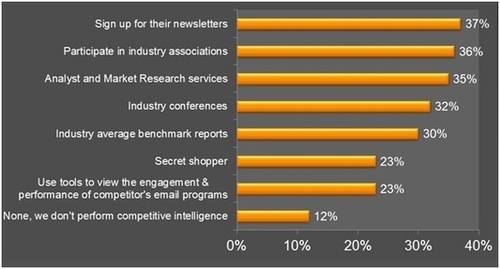
Few marketers have a formal competitive review process in place. The extent to which they do competitive analysis typically consists of subscribing to their competitors’ email promotions and newsletters; there is little analysis of their programs. Understanding a competitor’s frequency, use of personalization, and other apparent tactics is a necessary, but often-untapped knowledge resource.

Late last year, David Daniels, a leading e-mail expert and consultant surveyed 333 marketing executives on the competitive intelligence tactics they’re using. The data featured a balance of B2C and B2B email senders. The survey participants were mainly in the following industry verticals: financial services, retail, travel/hospitality and media/publishing.

See on http://sq1agency.com/blog/2013/03/report-competitive-intelligence-the-untapped-resource/

How to Write, Publish and Market Your Book | Social Media Examiner

Self publishing: Guy Kawasaki’s latest book APE (author, publisher, entrepreneur) shows you how to go from manuscript to book, without giving up control to a publisher. Of course, when you’re Guy Kawasaki with his cache and name recognition, people want to buy what he publishes since he seems to often be ahead of the pack in his thinking and research.

See on http://www.socialmediaexaminer.com/how-to-write-publish-and-market-your-book/

10 tips for ‘spying’ on your competition – Sales Machine – CBS News

Want to get a leg up on your competitors? Here are 10 tips for gathering intel Read more by Tom Searcy on CBS News’ Sales Machine.

1. Educate yourself about Google Scholar

2. Go where the writers go, the Writers Guild of America

3. Get to know university librarians

4. Run a background check https://www.knowx.com/index.jsp

5. Read all the news that’s fit to sell

6. See your industry analyst

7. Shop the competition

8. Opt in to receive the competitive company’s email marketing newsletters

9. Check out the wire services

10. Take stock of the competition

See on http://www.cbsnews.com/8301-505183_162-57420826-10391735/10-tips-for-spying-on-your-competition/

The Enduring Importance of Communication & Curiosity

Last week I saw a thought provoking video of Sally Blount, Dean of the Kellogg School of Management on the Enduring Importance of Curiosity and Communication. In the last 10 years, the world has become more complex, inherently unstable, a world that is reaching for a new equilibrium. The technological capabilities have far outstripped our very rudimentary human ability to organize effectively. Sally is amazed how important effective communication still is, and how important and well curiosity serves a human being.

She talks about “organizational intelligence.” We can see social networks in our brain; who is linked to whom; which groups convene regularly or not; and how if you interact and intervene in that system, you can change outcomes over time. By being an architect of collaboration, you can affect outcomes through team meetings or Facebook, for example. You need to orchestrate conversations in person and virtually to move the team forward.

As the school’s dean, she comes into contact with Millennials frequently. There are two things she would like to see them do since their brain works in new ways due to their early exposure to technology. They are excellent data collectors. She would like to see them get away from collecting information and into generating insight and inspiration for what to do with that information. The only way she knows to do this is to step away from the chatter and the stimuli.

Secondly, she ponders on how we develop more organizational intelligence. How do we think with more deliberateness about the conversations that we need to have in order to move humankind forward? Her hope is that the sacredness of face to face interaction isn’t lost.

I am also reading MIT psychology Professor Sherry Turkle‘s book, Alone Together: Why We Expect More from Technology and Less from Each Other. From her extensive research, she concludes that people look at technology for ways to be in relationships and yet protect ourselves from being in them at the same time. In her 15 years of research, she describes the “always on, always on you,” relationship that many people have with their smartphones, which keeps them from living in their present space.

Short, shallow, frequent bursts of communication via Twitter, Facebook or texting do not develop deep and emotional relationships, whether among friends, parent to child or between business colleagues. Taking all this time to be social media connected has reduced individual’s time and capacity for solitude, which nurtures relationships and critical thinking that Sally Blount also alludes to.

I fear that people are losing their ability to hold a conversation in our infected society of social networks, which favors many forms of digital connection with numerous people who are practically strangers, rather than really getting to know fewer people a whole lot better.

I spend a lot of time talking to people on the telephone. They answer even though they have caller ID, and don’t know who I am. Some of these folks don’t use social media so they aren’t part of that overstimulated world. Most do, but many still answer their telephone since they are inherently curious, and there aren’t enough listening ears these days, at work or at home. Technology will never replace true human connection.

What has been your experience?

Interviewing Versus Elicitation

People often ask, “What is the benefit of elicitation versus the standard interview?” Actually they have a lot in common.

Preparation in similar. You want to learn as much about that person as you can before you talk to them. Is there something about their profession that you can comment on to get the conversation flowing? Do they work in an interesting industry? Is there some industry jargon that you better know to be believed? What is their communication style? What will put them at ease to share with you early in the interview? Do you have something in common that you can build rapport with?

For an interview, I list all the questions I want answered and then rephrase them in a way that makes it easier for the person to become engaged based on my research of their personality, preferred communication style and profession. This is a great exercise since mentally I start thinking about all the different ways they might respond, and in turn what other questions I might ask, that are not on my list, based on their response. I create something like a decision tree for interviewing, and you thought decision trees were just used in statistics. You can never be too prepared to talk to people, since interviews seldom go as planned, especially over the phone.

Whether you have an appointment or make a cold call, you are interrupting the person’s day, so you need to use your words wisely so as not to waste their time. With some people, a little small talk is all it takes to jump start the interview. With others, state your purpose and get to the point. Others will ask you questions to test your knowledge before they’ll share.

Elicitation is a conversational interview, a planned conversation. People remember the beginning and the end of a conversation more than what is spoken in the middle. If you are asking a series of questions they might wonder why you are asking those questions, and how they should answer. How is the interviewer going to use the information I share? Hmm, I wonder how much I should share? What’s in it for me to share this information?

So you start and end your elicitation conversation with some inconsequential questions about the weather, last night’s football score or ask what brings them to the trade show. Other than this small talk, you don’t ask questions. For some this takes practice. For me it comes naturally, since it’s human nature. When John Nolan taught us a workshop on elicitation in 1995, I remember thinking that I had been using some of these techniques and didn’t know this was elicitation.

Elicitation builds off human tendencies that most people have: a desire for recognition, showing off, curiosity, gossip, complaining, correcting you. Most people can’t keep a secret. There are numerous techniques, and I will illustrate a couple.

One of my favorites is flattery. Some people have a strong ego while others get so little recognition that stroking their ego really works.  Simple flattery often coaxes a person into a conversation that otherwise would not have taken place. Everybody, whether prominent, or very low on the totem pole, reacts to flattery as long as it’s genuine. A common way to use flattery is, “I’ve heard you’re the best…an expert…”

Another favorite is coming across as naïve. People just can’t resist enlightening you. Naïve doesn’t mean stupid. It just means that you don’t quite understand something.  For example when I spoke to a trades person about his instrument, I wanted to learn why he liked this particular competitor’s model. I simply said, “I am not as familiar with this company as I only know the market leader’s instrument which you replaced with this competitor’s model.” That’s all it took, and he told me what he liked about the competitor’s model, and why he didn’t replace it with the market leader’s.

This above call didn’t go as planned. According to my client’s database, this trades person was using one of their instruments. However, that was an error, and he was using a competitor’s model. I didn’t hesitate to find out more information about the competition.

I bet many of you who conduct primary research or interviews use elicitation techniques and don’t even realize it. If you want to learn more about this, you can read John Nolan’s book, Confidential. I gave a webinar for SLA’s Competitive Intelligence division. Check out the Slideshare deck.