Debra Fine & The Fine Art of Small Talk
Debra Fine was the keynote at our AIIP 2013 Annual Conference in Denver, Colorado. Here are some of her shares.

Small talk is an appetizer to any relationship. People like to do business with their friends. For example, when you see someone at a trade show, and you have forgotten their name, you could just avoid them, and then they’ll think you’re aloof. Or you could approach them with, “You look so familiar, but I forgot your name.” This might be gutsy for a shy person, but it’s a great way to open a conversation and put the other person at ease. You are assuming the burden of their comfort. Remember what a low risk it is to engage in conversation.

When two people are talking and a third person walks up, a good conversationalist will make sure that all the people know each other. Look for approachable. Often enough the person who is alone will engage in conversation, and will think you’re a savior since they’re by themselves.

Often at meetings, there are clusters of people who know each other, hang out together. The lonely person, the outsider, feels like the spotlight is on them since they are alone with no one to talk to. Debra says, “Get over this.” The people in these clusters are not paying attention to you. It’s up to you to expand your network by meeting some of these people.

People decide if they have time to talk with you that often has nothing to do with your opening line. It’s about them: not you.

Here are some common questions, often enough icebreakers that Debra recommends we discontinue:

  • What do you do? It makes people feel they’re being interrogated.
  • Are you married? This is a bit too personal.
  • Do you have kids? This is almost presumptuous. Not everyone wants kids or can have them.

Realize that “How have you been?” “How was your day?” “How are you?” and “What’s been going on?” are equivalent communication for “Hello.”

Rather break the ice with:

  • “What keeps you busy outside of work?”
  • “Describe your most important work experience?”
  • “What significant changes have you seen take people in your work since you started?”
  • “Bring me up to date…”

Why people don’t answer and build relationships:

  • Don’t think you care
  • Are lazy
  • Are too busy

Debra also shared a couple of exit strategies that are graceful:

  • “I have a couple more minutes before I need to wrap this up.”
  • “Would you like to join me and see the exhibits?”

The psychology of assuming the burden of someone else’s comfort is similar when you are on the telephone doing research or competitive intelligence. Make the other person feel you care, but also keep in mind that you might be catching them at a busy time.

Debra ended her talk with a poem, “Thoughts from a New Member,” to remind us to reach out to newbies.

  • I see you at the meetings,
  • but you never say hello.
  • You’re busy all the time you’re there
  • with those you really know.
  • I sit among the members,
  • yet I’m a lonely gal.
  • The new ones feel as strange as I;
  • the old ones pass us by.
  • Darn it, you folks urged us to join
  • and talked of fellowship,
  • You could just cross the room, you know,
  • but you never make the trip.
  • Can’t you just nod your head and smile
  • or stop and shake a hand,
  • Then go sit among your friends?
  • Now that I’d understand.
  • I’ll be at your next meeting
  • And hope that you will spend
  • The time to introduce yourself,
  • I joined to be your friend.

Anonymous, pp 15 -16 The Fine Art of Small Talk by Debra Fine

Develop your competitive intelligence skills

See on Scoop.itcooperative intelligence
Slideshare Develop CI Skills

Developing Your Competitive Intelligence Skills is an introduction to competitive intelligence, which includes the definition of competitive intelligence, and 5 flavors of competitive intelligence: tactical, strategic, technical, counterintelligence and benchmarking. It also illustrates some analytic tools like SWOT, STEEP, BCG share of market matrix, and Adrian Slywotsky’s radar screen. This is a good introductory presentation for those who are new to competitive intelligence.

Connecting with Business Colleagues in Thanksgiving

Thanksgiving is a time for sharing, caring and expressing gratitude. I am grateful to have so many wonderful friends in business. In the spirit of cooperative intelligence and sharing, I recently was a panelist in a SLA Competitive Intelligence division (CID) webinar on “Integrating Marketing and Sales to Capture & Deliver Intelligence.”  While this is an SLA CID member benefit, all four of us panelists posted our slides on Slideshare.

I will list us in the order we presented so you have the benefit of a good flow:

Susan Berkman: Producing Intelligence for Sales & Marketing

Marcy PhelpsCompetitive Intelligence for Marketing Professionals

Ellen NaylorCollaborating with Sales

Anna Shallenberger: Research & Analyzing Competitors

Sponsored by Aurora WDC aka Arik & Derek Johnson

Likewise we just concluded a series of Colorado Future Ready blogs on SLA’s FR365 site which features a blog a day. This was initiated by Cindy Romaine, current SLA President as of Jan. 1, 2011. Here is the list and links to each of our Colorado blogs:

Who is SLA? by Connie Clem

Introducing eBooks into the Denver Public Schools by Charles Leckenby

The Value of Information Professionals by Laura Cullerton

How Cooperative Intelligence will make you Future Ready by Ellen Naylor

Economic Gardening by Recca Larson

Collaborative Librarianship by Joseph Kraus

Take a Risk: Reap the Rewards by Shelly Walchak

In closing, here is a poem about Thanksgiving that one of my Facebook buddies shared today. Whether you celebrate Thanksgiving tomorrow or not, I think it presents a good way to view life!

Thanksgiving…. More Than A Day

As Thanksgiving Day rolls around,

It brings up some facts, quite profound.

We may think that we’re poor,

Feel like bums, insecure,

But in truth, our riches astound.

We have friends and family we love;

We have guidance from heaven above.

We have so much more

Than they sell in a store,

We’re wealthy, when push comes to shove.

So add up your blessings, I say;

Make Thanksgiving last more than a day.

Enjoy what you’ve got;

Realize it’s a lot,

And you’ll make all your cares go away.

By Karl Fuchs

Real-Time Competitive Intelligence

Competitive Intelligence has historically focused on strategic and tactical forms of intelligence. In fact, SCIP changed its acronym from Society of Competitive Intelligence Professionals to Strategic and Competitive Intelligence Professionals. While competitive intelligence is an important component in strategic planning, and companies benefit from scenario planning: many companies miss the boat by not conducting and communicating competitive intelligence in real-time. Real-time competitive intelligence deserves to be a focus within the profession.

Many companies think they are conducting real-time competitive intelligence since they monitor their market landscape continuously on the Internet and increasingly through social media such as Twitter, LinkedIn and Facebook as well as industry specific forums or social networks like Ning. While monitoring is the foundation of real-time market intelligence, it is not actionable. The action you take in real-time will give you a competitive advantage.  As David Meerman Scott said at our AIIP conference, “Speed and agility bring competitive advantage…Act now before the window of opportunity vanishes.”

That’s the point: many in competitive intelligence sit on the knowledge they gain from monitoring the environment. I think part of the reason is that competitive intelligence is a staff job, and many in the profession don’t have the authority to take action. Some corporate cultures reward information hoarding, the exact opposite of sharing and taking action.

However, competitive intelligence managers can inform our company employees in real-time, and in areas where we have more knowledge, we can make recommendations. The balancing act in our job is to offer cooperative intelligence: don’t inundate people with too much information, just what you know is important to them.

When you read a rumor about a competitor or marketing trend that could significantly impact your company, check it out right away. This usually involves talking to another human being. That’s why having a deep human source network is essential for every competitive intelligence practitioner.

When you’re at a trade show, report back your findings several times during the day to the sources in your company who are asking. Invariably your findings bring up more questions.

It’s interesting that Sales will quickly follow up with leads immediately after a conference or trade show. With the same exuberance, you need to fire off a report of your key findings to those who need to know, and those you suspect should know. Don’t put it off: some of the most timely intelligence comes from trade show interviews. What I really like is that much of this is not published yet, and can be used to give your company’s marketing, sales and product teams a leg up.

When you hear that a competitor is merging or acquiring another company, put the word out immediately at your company, especially to sales people, as they can reassure your customers that your good service will continue, and perhaps instill doubt about the merged competitor entity.

The point is those companies that take action more immediately are the winners these days. Those that ignore events or sit on valuable information lose. What has been your experience with real-time competitive intelligence?

Gain Competitive Advantage through Risk Management: NCBA’s Story

Kendal Frazier, Senior VP at National Cattleman’s Beef Association (NCBA) spoke at our Denver Association of Strategic Planning meeting on the subject of crisis and risk management. To appreciate NCBA’s risk management program, it’s helpful to understand this industry. They are HUGE, a $70 billion industry. Cattle are raised in every state, and occupy more land than any other industry in the US. There are over 800,000 in beef cattle; and 200,000 in dairy cattle. The two key goals of NCBA are to protect the safety of US cattle and thus protect the health of beef consumers and maintain consumer confidence in the product. There are strict rules to reduce the risk of disease entering the US cattle market from imports. There is a big push for risk communication: that is how NCBA will react to bad news such as Mad Cow disease!

While the more sensational story was around NCBA’s involvement in the Oprah Winfrey show in 1996, I more appreciated how NCBA implemented its risk management strategy when Mad Cow entered the US on Dec 23, 2003, and believe they reacted in a way that reflects cooperative intelligence principles.

On that same day, NCBA reached out to a pre-selected list of government contacts. They activated a dark website which had been developed just in case Mad Cow penetrated the US. At 5:30 pm that night, Ann Veneman, Secretary of the USDA, made the announcement. Then NCBA held a news conference with 140 media contacts. At 7:30 pm, they made announcements to state agencies, beef councils and affiliates, like McDonald’s who sells 3% of US beef. As of Dec 23, 20 – 30 people worked solely on this issue as prescribed by the emergency response process plan. They had a communication response plan all set to go and worked throughout the holiday season.

What lessons did they learn?

Practice, practice, practice–even down to the level of conducting media interviews.

Organize a team of spokespersons at the National and State level.

Organize your internal resources. Make sure that you have all functions around the table when these crises happen. You need everyone’s perspective: legal, marketing, administrative, purchasing, research, government affairs—all functions!

Drive consumers and media to your dark website. It was helpful to have already developed a dark website for Mad Cow disease.

Your enemies will attack: be prepared. NCBA had a list of enemy activist groups as part of their preparedness for this event.

Expect people to overreact and have your response ready (some schools said they would eliminate beef at cafeterias).

Communicate this difficult problem in easy terms to the consumer.

Make sure that industry amplifies what the government is saying.

Keep major partners in the communication loop.

The media is not the enemy, but is the battle ground. Choose multiple spokespersons for your message.

Evaluate how well your spokesmen come across in the media. Pull weak players and use the more effective spokespersons.

Give the ground team more support (the Washington State team where Mad Cow entered the US).

Being ready when a crisis hits is a huge competitive advantage! Scenario planning is a great exercise to flesh out which crises you should be prepared for. If you wait until the crisis hits, it’s too late, especially in today’s real-time world!

Improve Your Competitive Intelligence Skill: Move out of Your Comfort Zone

Yesterday I impatiently waited for the lady driving the car in front of me to turn left onto the Freeway. The coast was wide open. Her head just kept wagging from left to right for what seemed like an eternity. So I went around her onto the right hand lane to turn left. As I swung onto the Freeway, so did she. She was going straight across the Freeway to a restaurant. I never assumed that’s where she was headed, as I always turn left from that lane as does most of our neighborhood. Fortunately, I stopped in time and she got to her destination.

How often do we get stuck in patterns and either make mistakes or don’t see events coming?  In competitive intelligence, we look for what is missing or what looks odd or out of place since oddity often is a precursor to change. How many people predicted that the overturn of the Tunisian government would lead to the riots in Egypt and the resignation of 30 year dictator, Hosni Mubarak? And now the wave continues to grow in that part of the world as other country’s citizens express discontent with their government. It reminds me of the surprise the world felt when the Iron Curtain tumbled in 1989.

There is always surprise in life and business. How we prepare ourselves for surprise is what separates the excellent from the average. I find I react better to surprises if I move out of my comfort zone more often.

  • Don’t rely on RSS feeds too much! That’s too much the same old same old.
  • Be spontaneous and pick up magazines you don’t normally read.
  • Pursue Twitter links that are out of your mainstream.
  • Comment on blogs out of your mainstream.
  • Go to a trade show which is not relevant to what you do.

In cooperative intelligence, I follow the time tested “Make new friends, but keep the old. One is silver and the other’s gold.” Retain and cultivate your Gold relationships, but keep your connections fresh!

Don’t always rely on the same colleagues to support your research projects. Reach out to new people, and prevent yourself from being blindsided by industry changes, new competitors, innovative technology and regulatory change. Seek new sources of intelligence on the Internet and social networks, but don’t forget the reliable standbys. Did you know that Highbeam Research is coming out with a business research product that will compete with Hoovers? Connect with people on LinkedIn that you don’t know, who are not “relevant” to what you do. You won’t believe how many more people you can connect with for research projects when you have over 10,000 first connections rather than the 300 people you already know!

The explosive growth of e-publishing makes me squirm as a prospective book author. However, I am squirming less as I just attended a class on “how to” given through our Denver Author U by the good folks at Darkfire Productions! Darkfire Productions will format your book for e-publishing. I’m excited as a first time book writer, since I don’t have to wait 1 year to get my book published! I have only myself to blame for any delay in getting published.

Design Thinking for Strategic Competitive Advantage

Many strategic planning executives assume that their strong leadership will lead their company to grow and thrive. Some of us are more visionary and curious by nature. Others are more comfortable taking great ideas and immature products and improving them using their analytical, financial and marketing skills. The simple idea behind design thinking is that you need both traits in leadership: the exploratory innovative to produce great ideas, and the analytical that exploits the business, improves the offering, and develops the right processes to gain market share. In the spirit of cooperative intelligence here are some nuggets that Arik Johnson, Chairman of Aurora WDC recently shared with the Denver Association of Strategic Planning (ASP) chapter. Check out his presentation!

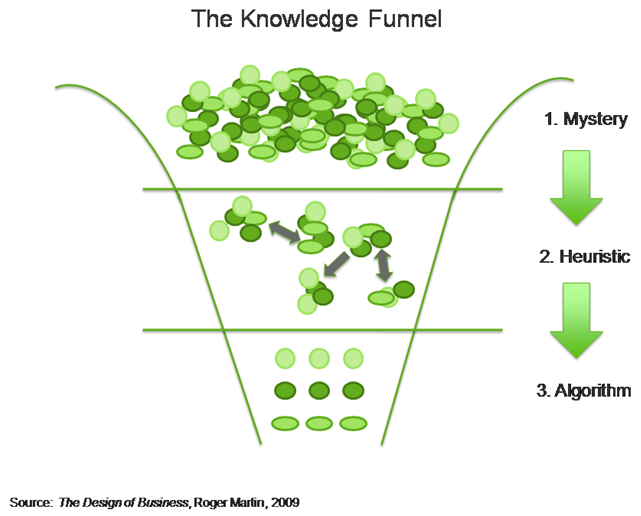
The ideas behind design thinking are well expressed in Roger Martin’s The Design of Business. Think of both the learning and the discovery process as moving through a knowledge funnel.  People need to apply analysis and creative thinking at different points within that funnel.

In Martin’s words, “This form of thinking is rooted in how knowledge advances from one stage to another-from mystery (something we can’t explain) to heuristic (a rule of thumb that guides us toward solution) to algorithm (a predictable formula for producing an answer).”

New firms emphasize exploration.  As they mature, they shift to exploiting known ideas, but if they stop at that point, other innovators will surpass them. Your organization must balance predictable or reliable production with validity, experimentation that leads to new ideas and commercial success. To protect a company, leaders must protect the exploration that leads to its validity. However, over time, organizations tend to emphasize reliability instead. We are too analytical which is good for refining current knowledge, but not great for innovating, the mystery stage. Sometimes we push product development too quickly once the product is in the marketplace, and customers aren’t ready to leap that far just yet. Or we make the product too feature rich and hard to use. This gives entrepreneurs a chance to enter the marketplace or competitors to gain share whose product is developed in balance with customers’ needs and acceptance.

Roger Martin gives examples of companies whose leadership supports design thinking. McDonald’s has perfected the hamburger business to be operationally efficient and serves the same hamburger product worldwide. The company creates new food products, and perfects production of products that the public supports.  For example, McDonald’s managers noticed customers were coming in with Starbuck’s coffee when buying their food at McDonald’s. So McDonald’s analyzed the market and developed an upgraded gourmet coffee to capture that business, which has been very successful.

Proctor & Gamble provides another example of applying successful design thinking.  P&G was losing market share across many of its numerous product lines. The company was investing considerable money into internal R&D and their products were losing market share due to lack of innovation. So they set up an external R&D lab (basically outsourcing their R&D), which has encouraged a higher level of innovation. As a result, their market share has climbed back up again.

A third example cited is Research in Motion (RIM) founded in 1984, but didn’t make it big until 1995. CEO Jim Balsillie was an intuitive thinker. Like many leaders with this tendency, he was distracted with new mysteries and got to the heuristic stage and then launched into the next project. It wasn’t until he hired co-CEO Mike Lazaridis to oversee sales and manufacturing (reliability) that the company took off. Now the company has the benefit of design thinking between the two CEOs.

Similarly Arik Johnson explained how he was influenced by design thinking when he promoted his brother Derek to CEO, due to his strong analytical and operational skills. Arik realized his visionary and exploratory skills were critical to create his business, but his brother’s skills would be more valuable in growing the existing business. Company founders are often entrepreneurial and visionary. Arik is now the company’s Chairman and has started an R&D lab, where he can focus on solving complex competitive intelligence problems and develop intellectual property around that line of business.

Morton suggests that to develop your design mind, broaden your “personal knowledge system.”  To start, be honest and identify the gap between what you think you know and what you actually know.  Living in the world of guessing is detrimental to business.  That’s why you need to understand both your known strengths and weaknesses as an individual and gain the knowledge you don’t yet have.

Design thinking and operating can give your company and you a competitive advantage since they provide a good balance between innovation and operational excellence. As a competitive intelligence professional I see another value to design thinking: it helps expose company and individual blind spots just as a course of doing business.  What a competitive advantage is that!

Denver Writing & Competitive Intelligence Event

When fellow Notre Dame alumni, Lynsey Strand asked me to speak about writing, I wondered how I could measure up since I haven’t written a book or published any of the music I have composed over the years. Then it dawned on me that I have published numerous articles for Competitive Intelligence Magazine among others. I also publish this cooperative intelligence blog and a newsletter, Naylor’s Mailer. Early this year I started a personal blog in honor of my dear Dad who died almost a year ago.

Like many things in life, my experience with publishing is part of my journey. In my case writing has been mostly in the field of competitive intelligence since that’s how I have made my living since 1985. Writing has helped me gain credibility in competitive intelligence and helps me develop as a person to dig deeper and be more expressive.

I think sharing my journey will help others feel encouraged about what they have done and where they are right now in their lives around publishing. I will also share where I am in the book publishing world which is where I am treading water. I will share some local Denver publishing venues like CIPA (Colorado Independent Publishers Association) and Author U. So in the spirit of cooperative intelligence I decided to say YES to this opportunity.

The evening will start with our featured author, Jenny Shank whose book The Ringer will be published early in March 2011. It sounds like a riveting story, and she will read some excerpts from it. Jenny is 20 years my junior and so accomplished. Unlike me, who has fallen into writing, Jenny is a trained and accomplished writer with an MFA in Creative Writing from the University of Colorado. I am looking forward to hearing her story and her words of wisdom.

BTW, our connection is our alma mater, the University of Notre Dame. In fact, it’s the women from the Denver Notre Dame Club who are sponsoring this event which takes place on November 5 at the Good Shepherd Catholic School Cafeteria at 620 Elizabeth St, Denver 80206 starting at 6 p.m. More details can be found at the Notre Dame club website. If this interests  you, I hope you will come!

Competitive Intelligence Ethics

I recently spoke with a consultant who was facing an interesting dilemma. Her firm had led the initiative behind a major technology roll out for a big company. One of their competitors was talking with her about competitive intelligence. Being conscientious, she was concerned that this could be ethically challenging.

Another key issue was trust. If the key competitor found out she worked for the other firm, even though the gig would be helping them set up a process, not competitor research, would they lose trust?

It’s Your Reputation

It takes many years to build a credible business that you need to consider building and maintaining relationships continuously. It’s easy enough for people to misinterpret what you’re doing which causes your reputation to sink. We face these issues often in the field of competitive intelligence.

Competitive Intelligence Is Not Competitor Intelligence

Competitive intelligence is often misunderstood. This consultant had immediately translated competitive intelligence into COMPETITOR intelligence. After we spoke for a while, I found out that there were a number of competitors in her client’s marketplace.

Competitive intelligence is about staying competitive, so there are a whole host of other factors that keep you competitive.

It’s easy to fall into the competitor trap. Here are few things to keep in mind about competitive intelligence. Much of my time is helping companies with market opportunity analysis, that is finding ways to make more money or perhaps studying the marketplace to find out that an opportunity we believed would be lucrative, is a money loser.

A popular competitive intelligence tool is STEEP analysis where you consider the macro environment that you compete in, how it is shifting, and how you might shape it to maintain your leadership. My colleague, Futurist Erik Garland gives a great explanation of STEEP.

S = social trends

T= technology trends

E = economic trends

E = ecological trends

P = political trends

Porter’s 5 Forces is an industry analytical tool used in competitive intelligence that looks at competitors, substitute products, potential new competitors, customers and suppliers and the relative influence and power of each in your industry.

Competitive intelligence folks also talk to numerous internal and external people to learn about the marketplace, and the competitors are only 1 small piece. I spend more time studying customers’ needs, and feel that the sales force is one of a company’s richest sources of competitive intelligence since they are talking to customers every day, learning not only about the competition, but enabling product development with products and services customers will pay for. They hear about new technology, innovation and rumors about political changes that could threaten your company’s sales success, and so much more once you make the connection into their collective and individual wisdom.

Back to Competitive Intelligence Ethics

I don’t work for competing firms if I’m doing competitor research/analysis work, and have not worked for competitors when setting up a CI process. If I’m asked to research a competitor I refer the business to another firm. How do you weigh in on this?

Here is an article, Timeless Advice for Making a Hard Choice, by Joseph L. Badaracco of HBR Online. This gives a broader perspective on ethics in business.

Win/Loss Analysis book gives you a process to learn why you’re losing clients and how to keep more business! Competitive Intelligence ethics lives here.

Improve Your ROI by Integrating Marketing & Sales Intelligence


I (Ellen Naylor) will be giving a 2 hour session at the American Marketing Association’s Spring Marketing Workshop which takes place in Denver, Colorado from March 22 – 25 at the Westin Tabor Center. My talk, “Improve Your ROI by Integrating Marketing & Sales” will be given on March 23 from 2:45 – 4:45 pm, about a week before my birthday.

The Marketing Workshop allows attendees to mix and match sessions according to the following topics:

• Marketing ROI
• Pricing Strategy and Tactics
• Social Media and Marketing
• Branding
• Sales and Marketing Integration
• Customer Loyalty and Relationship Management
• Search Engine Optimization

Below is the write up which is buried in the AMA’s 20 page marketing workshop e-booklet.

Sales and marketing are often at odds. This workshop will focus on tools and techniques that are tried and tested, which integrate the smarts of sales, marketing and product development employees. Elicitation is usually used to collect competitive intelligence. Learn what elicitation is and how it can be used to improve your company’s sales intelligence by closing more deals and enabling Sales to collect valuable information from customers to boost your company’s knowledge about market trends, customer needs and the competition to name a few. Likewise, learn how win loss analysis and trade show analysis integrate sales and marketing often with the voice of the customer and other market intelligence.

You will learn:

Elicitation: what it is and why it’s a more effective means to collect information than direct questioning for interviews
Close more sales deals and collect valuable customer insight through the practice of elicitation
Implement a cooperative win loss analysis process that integrates feedback from sales, marketing and your customers
Improve both your sales lead generation and collection skills at trade shows

Matt Kelly, VP Business Development at Strategy Software will be presenting, “Competitive Affairs: Leveraging Competitor Information to Drive Revenue and Increase Market Share. His session takes place on March 24 from 8:30 – 11:30 a.m. Matt is an engaging speaker who I have known for years through SCIP.

I wanted to share this is the spirit of cooperative intelligence as it is pretty rare for the AMA to host events in Denver. March is also a great month to visit the Rocky Mountains if you like to ski as it’s our snowiest month.