5 Tactics to Research Your Marketplace using Competitive Intelligence Skills

Recently I was interviewed by Adam Sutton of MarketingSherpa, and in the spirit of cooperative intelligence I am sharing some highlights. For the full article you need to subscribe to MarketingSherpa. Check out MarketingSherpa’s free trial. It is chock full of marketing information, studies, white papers and current articles like this one. I will summarize each of the five tactics, and then blog on each of them individually this month.

Tactic #1 Conduct win loss analysis
Interview new customers and prospects you lost to the competition. Your goal is to uncover the motivations behind their decisions and to learn whatever great information they impart to help improve product development, tweak your existing products or service, change your marketing message, learn how your competitors are successfully unseating you and so much more.

I recommend you conduct these interviews in cooperation with your sales force, rather than behind their back. Building trust with Sales is the biggest reason to include them as part of the win loss analysis process. Sales can save you so much time by telling you how the people you’re going to interview are motivated to share. Wow, that reason alone is enough to work with Sales.

Tactic#2 Talk to internal and external experts
Use a cooperative approach when connecting with internal and external experts. People inside your company tend to know a lot about your industry and can connect you with external contacts who might be helpful. Be sure to thank your experts and send them information you come across that they might find helpful. This two way communication and connection is invaluable to your knowledge pool.

Tactic #3 Use trade shows as fact-finding missions
Trades shows are the biggest Meccas for competitive intelligence. No where are there more people who want to share their knowledge and insight with you: industry experts, prospects, competitors and journalists.

Do your homework: Prepare a game plan before the conference. Study the exhibitor floor plan and all the presentations and decide how best to use your time and write out the questions you will ask to the various audiences.  Keep the plan rough as you’ll need to be flexible since you’ll need to jump on opportunities as they arise, which you can’t predict.

Be observant. Most people think about gathering competitive intelligence from competitor’s exhibit areas and formal presentations, but sometimes the best intelligence is gathered at informal settings such as the conference coffee shops, the conference hotel cafe, the elevator, cocktail parties, the bus ride to the airport, even in the airplane.

Tactic #4 Build an information database
Build a database for all the information you have on the competition and the marketplace that can easily be browsed and that is easily kept up-to-date. Also build a database of contacts both internal and external to your company who are great sources of information about your industry, the marketplace, the competition…and make this sortable as well! This quick access to contacts and information greatly speeds up your research timeline!

Tactic #5 Remain ethical and avoid deception
Make sure anyone you use to collect information is operating under the same ethical standards as held by your company. Check out SCIP’s website for its code of ethics.

Remember I will provide more detail about each of these 5 tactics in future blogs.

Reviewing Early Chapters of “Competitive Intelligence Advantage”

I am reading Seena Sharp’s book Competitive Intelligence Advantage. In the spirit of cooperative intelligence, I am reading a couple of chapters at a time and will share what I like in this blog.

Her introduction is compelling. Seena enumerates what questions a person might ask who will benefit from competitive intelligence. Here are my favorites from her list of 12:

Have you been blindsided by the loss of a sale to a competitor—especially one who is unknown, emerging or to a substitute?

Do you question if your assumptions are still valid about your industry, competitors, customers and products?

Have you noticed possible signs of an opportunity, but aren’t sure if it makes sense for your company?

In her first chapter Ms. Sharp explains the dilemma we face when we deal with company executives who are often arrogant and overconfident and don’t want to hear bad or contrarian news (even though that’s what they pay us to do in competitive intelligence). While those who lead companies are often brilliant, all can benefit from better intelligence when making strategic decisions.

I particularly enjoyed chapter 2 which provides the most thorough definitions around competitive intelligence (CI) that I have read anywhere. In an effort to describe and define the benefits of CI, Seena describes other more commonly understood processes such as knowledge management, market research, scenario planning and business intelligence. I especially appreciated her distinctions between market research and competitive intelligence. Both include research on the market while market research tends to focus on consumers or business customers and is more quantitative while competitive intelligence is more qualitative and future oriented as it looks at what is emerging in a market or an industry, and considers other external factors in addition to customers.

Did you know that only 38% provide correct phone numbers all the time? 60% don’t always provide accurate info about their company’s size. 45% do not always provide their company’s true name. These are interesting facts in connection around how consumer technology buyers fill out registration forms, a common form of market research. (Source: a survey by Marketing Sherpa and KnowledgeStorm.) These findings make me question the validity of market research findings taken in isolation. That is why it’s often valuable to include market research as a component of CI. I recall our market research team at Verizon benefited when we added some competitor questions to their major annual survey to our strategic customers.

Also in chapter 2, I enjoyed Seena’s example of knowledge management which started as a simple suggestion box at a company. Due to the company’s sharing and expansion of these suggestions at lunchtime sessions, this process was encouraged and became engrained in this company’s culture. People who made suggestions were positively recognized. This reminded me of similar programs that companies have put in place to gather good sales intelligence from Sales about competitors, emerging competitors, product development and industry trends. If you give employees the freedom to communicate their ideas and drill down deeper, it’s amazing what you learn, and a little recognition and thank you goes a long way.

Assess Your Effectiveness at Trade Shows

In honor of my competitive intelligence colleague, Jonathan Calof, I am writing this post on his subject of expertise, trade shows! Jonathon just won SCIP’s esteemed Fellow’s award which will be officially presented at SCIP’s annual conference in Washington, DC which takes place from March 9 – 12. Trade shows are one of the best venues for cooperative intelligence practices since if you display cooperative connection and communication skills, the floodgates of knowledge will be yours!

Most discussion around trade show analysis measures their effectiveness in ROI terms:
How many sales did we close as a result of connections at our booth? How many new connections did we make that represent customer prospects?

Many of the other benefits are more squishy to measure:

How much scoop did we collect on the competition, market trends, technical innovation, product development, or new technology that helps us develop a better strategy or adjust our sales tactics?

What infrastructure do we have in place to quickly report our findings to those in our company which might engender further collect during the trade show? And after we return from the trade show?

What infrastructure do we have in place to qualify prospects for our business?
This can start right at the booth as you can qualify the better prospects and have coffee or drinks later, since you don’t want to spill all your company secrets right at the booth area since you never know who might be listening in who is not a prospect, but might be collecting on your company!

I like to prepare a cheat sheet which helps me qualify customers when I exhibit. It’s kind of cumbersome, but it is fail proof since people’s answers to these questions guide me on how and if we should further our relationship.  Remember customers aren’t the only great connections at trade shows. For example, industry experts, newspaper reporters and bloggers help sell your company too. They have their biases just like anyone else, and you want to influence them to favor your company and your products and services so they write good things about you. Think: who else do I want to connect at this trade show mecca where people are so pre-disposed to share what they know?

Lastly, I assess if this was even the right show for the company to exhibit at. Many companies don’t think about this as much.  We tend to exhibit at shows since, “We’ve always had a booth at ‘X’ show.” Each year I like to assess our effectiveness at trade shows we’ve attended. Sometimes I use an ROI calculation. Sometimes I realize I can’t afford not to be at a trade show since all my competition is there connecting with a finite number of potential and existing customers. At other shows, product announcements are made: can you afford not to attend this type of show and blow your horn? Where it gets gray in decision-making is when results are gradually getting worse: do you just pull out of the show or do you change your behavior and tactics in hopes of improving your results? Marketing through social networks is also competing with in-person events like trade shows, which could be the subject for another day.

How do you assess your effectiveness at trade shows?

Improve Your ROI by Integrating Marketing & Sales Intelligence


I (Ellen Naylor) will be giving a 2 hour session at the American Marketing Association’s Spring Marketing Workshop which takes place in Denver, Colorado from March 22 – 25 at the Westin Tabor Center. My talk, “Improve Your ROI by Integrating Marketing & Sales” will be given on March 23 from 2:45 – 4:45 pm, about a week before my birthday.

The Marketing Workshop allows attendees to mix and match sessions according to the following topics:

• Marketing ROI
• Pricing Strategy and Tactics
• Social Media and Marketing
• Branding
• Sales and Marketing Integration
• Customer Loyalty and Relationship Management
• Search Engine Optimization

Below is the write up which is buried in the AMA’s 20 page marketing workshop e-booklet.

Sales and marketing are often at odds. This workshop will focus on tools and techniques that are tried and tested, which integrate the smarts of sales, marketing and product development employees. Elicitation is usually used to collect competitive intelligence. Learn what elicitation is and how it can be used to improve your company’s sales intelligence by closing more deals and enabling Sales to collect valuable information from customers to boost your company’s knowledge about market trends, customer needs and the competition to name a few. Likewise, learn how win loss analysis and trade show analysis integrate sales and marketing often with the voice of the customer and other market intelligence.

You will learn:

Elicitation: what it is and why it’s a more effective means to collect information than direct questioning for interviews
Close more sales deals and collect valuable customer insight through the practice of elicitation
Implement a cooperative win loss analysis process that integrates feedback from sales, marketing and your customers
Improve both your sales lead generation and collection skills at trade shows

Matt Kelly, VP Business Development at Strategy Software will be presenting, “Competitive Affairs: Leveraging Competitor Information to Drive Revenue and Increase Market Share. His session takes place on March 24 from 8:30 – 11:30 a.m. Matt is an engaging speaker who I have known for years through SCIP.

I wanted to share this is the spirit of cooperative intelligence as it is pretty rare for the AMA to host events in Denver. March is also a great month to visit the Rocky Mountains if you like to ski as it’s our snowiest month.

How well do you Emotionally Connect?

I enjoyed Seth Godin’s blog a week ago on “too much data leads to not enough belief.” His bottom line is, “relying too much on proof distracts you from the real mission – which is emotional connection.”

I have noticed in my fields of research and competitive intelligence that we have this tendency to drown our customers with data, and while they might be impressed that we dug up all this information, they usually don’t want the details. We also talk the language of competitive analysis, which most people don’t resonate with, and there is no emotional connection—since competitive intelligence is not the issue. Solving a business problem or uncovering and entering new markets or product development are the issues.

Companies pay competitive intelligence professionals to provide them with what’s relevant and to weed out all the excess, which is most of the information that’s out there. Most of the time your customers will connect if you put together a crisp set of information and persuasively articulate your findings, and include some analysis, if it adds clarity and persuasiveness to your recommendations.

But whoa, remember everyone that you’re addressing has a different communication style, and it’s really all about them and not about you. This is a guiding principal of cooperative communication a key element of cooperative intelligence. Some people do want the details, and not just access to them “later”. You better present them and be ready to be grilled since they will have questions! Companies need these type of people to bring balance to decision-making and to avoid being blindsided. Not everyone can or should be a visionary!

Cooperative communicators know that they’re talking for their audience not TO their audience. Their attitude and practice is to listen to their audience, and to query ahead of time about how to connect with the key issues and concerns of their audience (or clients), and in a way that will stick with them.

There is another problem with all that data: it’s historic. The reams of research are helpful however, if you’re trying to put together some scenarios, since you need to be pretty thorough in developing scenarios to include all the factors that might change the scenario, to observe the patterns in the marketplace, including the competition and to conclude with a scenario that you believe is the most likely.

You ultimately want to get out your crystal ball and forecast where the market is heading, right? And better yet, be visionary and LEAD the market!

Back to Mr. Godin: emotional connection is what happens when you engage people. That doesn’t happen with some myriad of facts and figures. It happens because they believe. How do you communicate to make them believe?

Integrate Emotional Intelligence & Selling into Competitive Intelligence

Colleen Stanley

Last week I attended a webinar to improve my selling skills led by Colleen Stanley, Founder and Chief Sales Officer of SalesLeadership, Inc. Effective selling will help competitive intelligence professionals, product management and researchers gain respect, cooperation and appreciation from internal peers. Since many of us have no reporting employees, selling yourself is even more important in this “new economy”.

People obtain more knowledge than ever through the Internet, so they may feel like they don’t need you to provide them competitive intelligence. Due to the recession more people want to see a visible ROI for your solution. This isn’t always possible in competitive intelligence, but be creative and you can develop an ROI solution often enough. People are more skeptical due to the scandals which triggered this recession so really don’t like to be pushed into decision-making–not that they ever did.

Find the pain points and match your communication style to the decision-makers and key influencers in the buying process. This works for every business function I can think of!

People who are optimistic outsell those who aren’t by 33%. When bad things happen they realize that this is just temporary and their self-talk reflects this as they expect positive outcomes since they’re happy. They often find humor when others would be dragged down by unfortunate circumstances or stress. They live with an attitude of gratitude. Optimism must be real: people will see right through you if it’s feigned.

To really be successful in selling, your prospect needs to admit that they have a problem, and identify what it is costing them. This outlook works very well in competitive intelligence. I often ask what it will cost if we do nothing. Sometimes there is a very low cost to do nothing, so it’s not important enough to fix compared to bigger problems where we can more readily measure the impact of success or failure.

I loved Colleen’s Principles of Expectation:
1. Can the Sales person pass the pop quiz test? Make sure all parties in the meeting clearly understand the objective of the meeting.
2. Is there a Mutual Fit? Is the solution we’re discussing mutually good for all parties?
3. Examine your Intention. Are you there to Impress or to Influence? Influencers are intent on understanding customer’s issues; impressing is just selling.

Sales people with high emotional intelligence outsell those with low EI. I think high EI benefits anyone.

Here are some tippers to improve your EI:
Improve your Self-Awareness. Most people don’t take enough downtime to be reflective and introspective to learn why they react a certain way to situations. Solitude triggers the right brain where creativity often kicks in.
Be Assertive: Express your feelings and ask questions without being aggressive or abusive. You have the right to ask for what you need to know to do your job whether sales, marketing, research or competitive intelligence.
Delayed Gratification is usually worth it: Look beyond the immediate. Adopt a long term outlook when selling as relationships are always in development. Be a planner and work on time management towards connection and building these relationships.

Combine these emotional intelligence practices and selling with the collection skill of elicitation and cooperative intelligence, and watch your effectiveness as a competitive intelligence professional soar!

Purposeful Cooperative Leadership in Competitive Intelligence

I was led to the Purposeful Leaderships’ blog, “Leading from the Heart” by Janna Rust earlier this week. Leading from the heart is a trait of cooperative intelligence, namely cooperative leadership as it rings of caring and authenticity.  Janna also discusses taking care of your reporting people by being there for them and listening. Another great point is to “be protective” of your reporting people and let them know you’re all on the same team.

So many things I read about leadership focus on “managing up”, that is impress your bosses. This often comes at the expense of managing your subordinates, who are doing the work! Yet it’s a delicate balance since your boss decides on your pay raise, can open a lot of doors, and often controls or influences budget moneys allocated to your projects. Whether with bosses, peers or subordinates, cooperative leadership is more about “them” and less about me.

In competitive intelligence and research, many of us don’t have any reporting people and report into another functional area of the company such as Sales, Marketing, Strategic Planning, Product Development or Research & Development. Often enough, they aren’t quite sure what to do with us.

Cooperative and purposeful leadership skills are all the more essential when you rely on other people to give you great information or intelligence who don’t report to you, and your boss perhaps views you as an outlier since competitive intelligence doesn’t quite fit into anyone’s area.

I spent a lot of time meeting with people and listening to their business problems as a competitive intelligence manager. I was really attuned to emotional intelligence as I dealt with my network of contacts and internal company customers and was sensitive to how they were motivated. I would attempt to match my communication style with theirs, including my body language. This was how I behaved whether dealing with peers, subordinates, my internal clients, my sources or my superiors.

I was protective of my sources, especially Sales. Everyone in marketing wanted Sales’ input into their projects. Over time I became the “unofficial” marketing liaison person to Sales. This almost eliminated the number of requests that went to Sales for quick turnaround corporate projects. I made it my business to have more interaction with Sales, and to let them know I reduced their work load, and appreciated that their time should be spent selling. This was the most purposeful leadership I had while at Verizon. I knew I needed to be cooperative in order to gain sales intelligence and customer’s input to be successful in competitive intelligence.

In what ways are you purposeful and cooperative in your leadership and management?

AttaainCI wins AIIP’s 10th Annual Technology Award

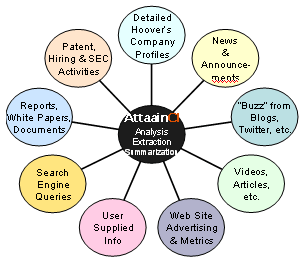
This time last week I was at Internet Librarian in Monterey, California. AttaainCI earned AIIP’s technology award. Founder and President, Daryl Scott was present to receive the award from AIIP’s President, Marcy Phelps. Every year, the AIIP Technology Award is presented to a company whose product, in the panel’s opinion, best assists independent information professionals in locating, analyzing, organizing and delivering information.AttaainCI software, was launched in early 2008, and provides real-time intelligence gathering, analysis, sharing and reporting alerts. One of my favorite uses is company tracking: your company, one you want to acquire or a competitor, for example. Track what’s being said about your company’s products or your key customers. It is reasonably priced at $149 per month for the first user and $69 for the second user for unlimited usage on a month-to-month basis. Discounted annual plans are negotiable with Attaain. Watch 10 instructional videos and learn in detail how AttaainCI will work for you.

AttaainCI continuously monitors, filters and integrates intelligence from a wide range of sources.

AttaainCI

The software had its start mostly tracking social networks such as Facebook, Twitter, LinkedIn among others.  Recently AttaainCI included Hoovers as a resource for information, greatly boosting its one-stop shopping appeal for research. You can use it both for a one-time research project, for example a company or person; and you can receive email alerts delivered to your mailbox according to a personalized schedule. It is cooperative in that you can share results with co-workers and view results more visually.

The typical output for a one-time company research query might be 3 or 4 pages of data that is easy to scroll through, as the abstracts appear neatly in 4 columns: Search Results, News & Announcement, Blog Mentions and Additional Intelligence. You can quickly connect to the best articles or reports to get up to speed on the topic you’re researching. You can also find out who is talking about that topic through your social networks. I find it is useful since I have a huge LinkedIn network, so I always find relevant people to follow-up with. Similarly I often can connect to good people on Twitter, who lead me to others once I determine the # for the topic in question, like #eldercare.  If you need more information than what is on those several pages, AttaainCI provides links to even more data right off the initial report.

AttaainCI is a good software package to get up to speed on just about any topic, and it’s great to use at the outset of a project whether it’s competitive intelligence or general research for sales, marketing, product management or strategic planning. AttaainCI is an effective tool for daily monitoring on topics to get the latest and greatest while you’re working on a project, which goes on for two weeks to a month, for example. Find out what people are saying about you, key executives, your products, and your company through AttaainCI.  AttaainCI will greatly reduce your communication time for intelligence deliverables.

Real-time Collaborative Architectural Modeling Enhances Complex Product Development

Bryan Moser spoke to our Denver PDMA (Product development Management Association) chapter about the value of models such as the one his company, Global Project Design (GPD) developed  to forecast, optimize, allocate and measure coordination in complex product development projects. These models take into account different cultures, time zones, language barriers, and dispersed decision-making. They also incorporate engineering behavior among different cultures based on their typical interaction.

Today there is pressure to succeed in a dramatically concurrent fashion, which increases the risk of rework, quality and design. The thinning of the workforce affects production as does the loss of deep knowledge and connection from workers who have been laid off or who have retired. Another finding in these complex product development initiatives is that the cost of coordination is high and is on average 30%-35% of the time consumed.

Bryan walked us through the example of the Sikorsky S92 helicopter product development project. Their biggest concern was defending their intellectual property as they selected companies in various countries to work as an integrated team. The team was spread across the globe in countries such as Brazil, Taiwan, Spain, China and Japan, and included big company names such as Embraer of Brazil and Taiwan Aerospace, for example. Sikorsky USA was the decision-making company.

Sikorsky had predicted that it would take 5 years from product spec to prototype development. It took 9 years, and GPD’s model prediction was only off by 2 months from the actual time. Sikorsky hadn’t taken into account the dynamics that would add considerable time to product development, such as coordination, culture, language, time zones, and a lot of dead time that one team would experience if another was late in delivery, for example.

We can’t turn the clock back on product development since the expertise for various segments of complex product development is best served by a global team. However, putting on a nationalist hat, previously teams all worked for one company, in similar time zones and had strong connection and communication since they all spoke the same language, and could develop products more expeditiously from having worked together extensively over the years. This is lost in these complex product development projects where people who have never worked together, are thrust together to develop a product.

This real time collaborative model takes into account the various languages and points of view, and the time needed to build relationships with people who have never worked together before.

One of the key findings for these complex projects is that there is a fair amount of wasted time as work time averages:

~54% Direct Work
~30% Coordination
~16% Less Useful Time

The key takeaway is that coordination is often way underestimated in these complex product development projects across multiple countries. It’s better to run the model earlier in the process, so as to re-schedule or re-work pieces to reduce the less productive coordination time. GPD’s model is agent based on simulation models about how teams make choices and includes the last 30-40 years of research of behaviors in engineering work.

In conclusion, product development professionals face:

A decline in judgment based on experience alone. Traditional centralized and detailed plans ignore and misrepresent the complexity of projects.

Coordination – Interaction of teams to satisfy dependence across subsystems can be 35% of the effort, cost and duration of these development projects.

Choosing the best coordination architecture can lead to a 20% improvement in time/cost performance and will improve your competitiveness! Judgment through situation awareness is also gained.